
New Zealand once held official gold reserves.
Today, it holds none.
That puts New Zealand in an unusual position. Many central banks continue to hold gold as part of their reserve assets, and several have been adding to their gold holdings in recent years. New Zealand, by contrast, relies on foreign currency reserves and holds no official gold at all.
If a future New Zealand government decided it wanted to rebuild official gold reserves, how could it actually do so?
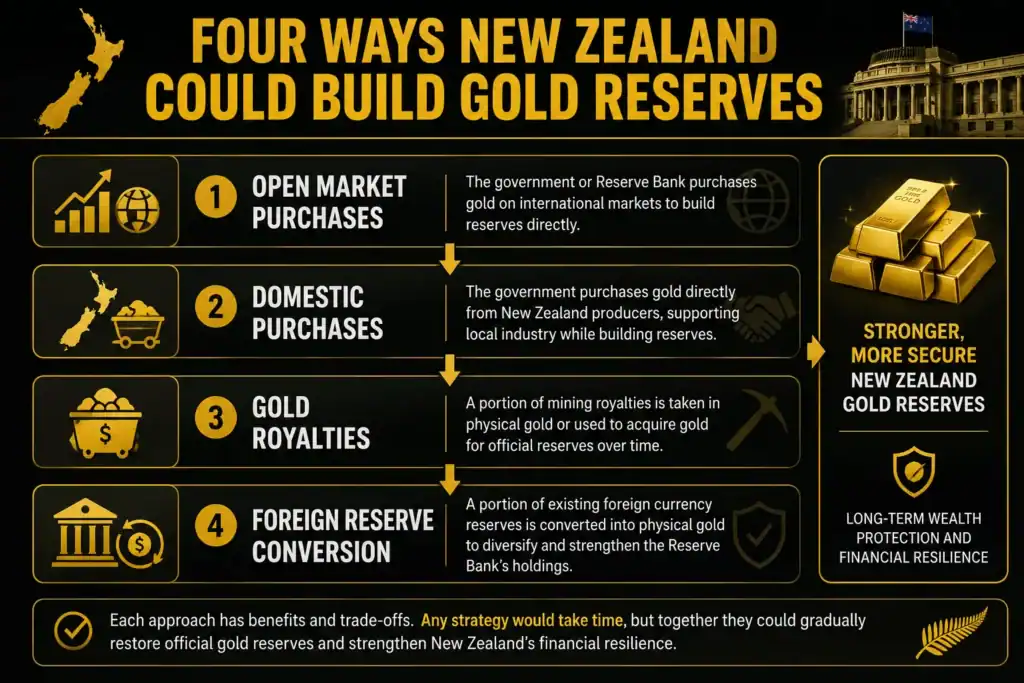
One option would be to buy gold on the international market. Another would be to purchase gold mined here in New Zealand. A third possibility would be to use royalties from domestic gold production to gradually build a national gold reserve over time.
Recent discussion around critical minerals and domestic resource development also highlights a wider issue: governments do not always treat minerals as ordinary commodities. Some resources are viewed as strategic national assets.
Gold is different from most critical minerals because it is not mainly used in manufacturing or technology. Its strategic value comes from its long history as money and its continued role as a reserve asset.
In this article, we’ll look at how gold royalties work in New Zealand, whether local gold production could help rebuild national reserves, and what the idea reveals about New Zealand’s unusual position of holding no official gold.
Table of contents
Estimated reading time: 9 minutes
Quick Answer
Yes. If a future New Zealand government decided to rebuild the national gold reserve, there are several ways it could do so.
It could purchase gold on international markets, buy gold directly from New Zealand producers, or potentially use royalties from domestic gold mining to accumulate reserves gradually over time. Another option would be to convert a small portion of existing foreign currency reserves into physical gold.
None of these approaches are current government policy, and the Reserve Bank has repeatedly stated that gold does not meet its liquidity requirements. However, they demonstrate that rebuilding official gold reserves is a practical question rather than an impossible one.
Why Rebuilding Gold Reserves Is Being Discussed Again
For many years, the idea of New Zealand rebuilding it’s gold reserves attracted little attention.
That has begun to change.
Since 2010, central banks around the world have been net buyers of gold. Many have steadily increased their holdings as they diversified reserve assets and responded to a changing geopolitical and monetary landscape.
At the same time, New Zealand remains one of the few developed countries with no national gold reserves at all.
This combination has prompted a simple question: if so many countries continue to view gold as a strategic reserve asset, should New Zealand at least consider the options available to it?
This article doesn’t attempt to answer whether New Zealand should rebuild its gold reserves. Instead, it explores how that could be done if policymakers ever decided the benefits outweighed the costs.
Background: Before exploring how New Zealand could rebuild its gold reserves, it helps to understand why the country holds no official gold today. Read: How Much Gold Does New Zealand Have? Why the Reserve Bank Holds Zero Gold Reserves
How Could New Zealand Acquire Gold?
If a future government decided to rebuild New Zealand’s official gold reserves, there are several possible approaches.
Some would involve buying gold on international markets. Others would make use of New Zealand’s own gold production. Each has different costs, practical considerations and policy implications.
1. Buying Gold On The International Market
The simplest approach would be to purchase gold in the same way many other central banks do.
Gold is traded globally, and central banks regularly buy and sell bullion through international markets. A future New Zealand government could choose to allocate part of its reserve assets to physical gold without changing domestic mining or royalty arrangements.
The main advantage of this approach is simplicity. It would allow New Zealand to acquire gold gradually while maintaining flexibility over the size and timing of purchases.
The downside is that every ounce would need to be purchased using existing foreign currency reserves or government funds.
2. Buying Gold Directly From New Zealand Producers
Another possibility would be for the government to purchase some gold directly from New Zealand mining companies.
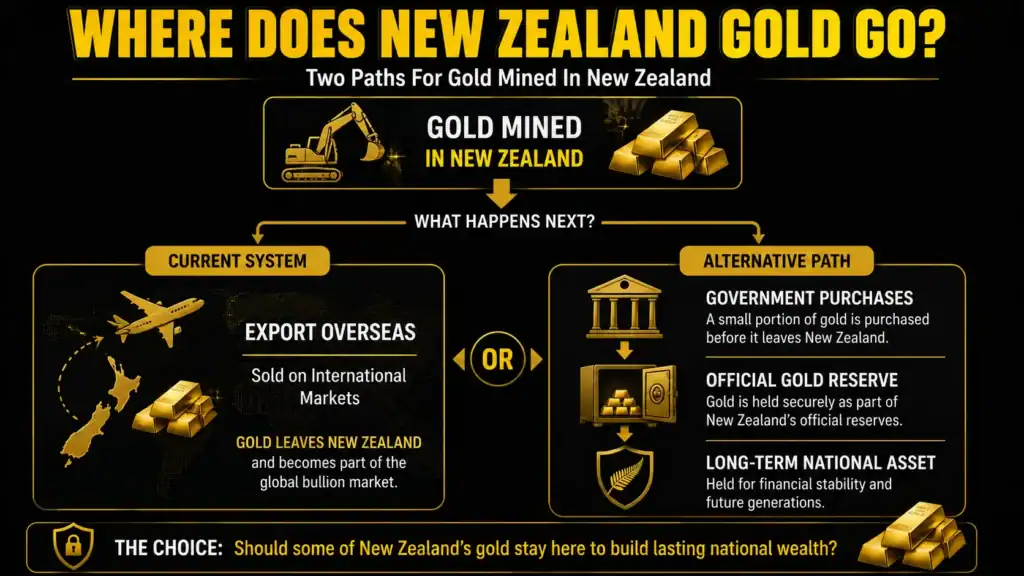
Instead of exporting all domestically mined gold, a small proportion could be sold to the Reserve Bank or another government agency at prevailing market prices.
This would allow New Zealand to gradually build official reserves using gold produced within its own borders, while still ensuring mining companies received full market value for their production.
Unlike a royalty system, this approach would operate through normal commercial transactions rather than changes to tax or mining policy.
3. Building Gold Reserves Through Mining Royalties
A different approach would involve using New Zealand’s existing royalty system.
Mining companies already pay royalties to the government for extracting publicly owned mineral resources. These royalties are typically paid in cash based on the value of the minerals produced.
One option would be for a future government to require that a small proportion of royalties from gold production be settled in physical gold rather than cash. Another would be to continue collecting royalties in cash but use part of that revenue to purchase gold for official reserves.
Under such a system, New Zealand could gradually accumulate gold over many years without needing to make large one-off purchases on international markets.
Supporters might argue this would allow part of the country’s natural wealth to remain within New Zealand as a long-term national asset.
Critics, however, could argue that such a policy might increase costs for mining companies, discourage investment or reduce New Zealand’s international competitiveness as a mining destination. Different royalty structures would produce different outcomes. A small royalty might add only modest amounts to official reserves each year. A larger royalty could build reserves more quickly. However, it could also increase costs for mining companies and affect investment decisions. Any government would need to balance these competing objectives.
Even if New Zealand adopted such a policy, the amounts involved would likely remain modest compared with the Reserve Bank’s existing foreign currency reserves, which total tens of billions of dollars. Gold royalties could gradually build an official reserve over time, but they would not transform New Zealand’s balance sheet overnight.
Recent government support for critical minerals processing suggests New Zealand is taking a more strategic approach to its mineral resources. Current policy focuses on processing more minerals in New Zealand, not on building official gold reserves. It illustrates how resource policy can evolve over time as national priorities change. If gold production expanded substantially over coming decades, royalty receipts could also increase, making this idea more practical than it appears today.
4. Converting Part Of Existing Foreign Currency Reserves
A fourth option would be to gradually exchange a small portion of New Zealand’s existing foreign currency reserves for physical gold.
Rather than increasing the overall size of the country’s reserve assets, this approach would simply change their composition.
Supporters argue this could improve diversification by reducing reliance on foreign currencies and government bonds alone. Others point out that the Reserve Bank has consistently favoured highly liquid foreign assets over gold for operational reasons.
Background: For a more detailed discussion of this approach, see Why the RBNZ Should Turn Its Foreign Currency Reserves Into Gold →
Would Rebuilding Gold Reserves Be Worth It?
Whether rebuilding official gold reserves would be worthwhile ultimately depends on what New Zealand believes its reserve assets are designed to achieve.
If the sole objective is to maintain highly liquid assets that can be deployed quickly during financial market interventions, then foreign currencies and government bonds may continue to meet that need. This has been the Reserve Bank’s long-standing position.
However, governments also hold strategic assets for reasons beyond day-to-day operations.
Recent policy discussions around critical minerals, energy security and domestic resource development illustrate that some assets are viewed as strategically important because they contribute to a country’s long-term resilience, not simply because they generate immediate financial returns.
Gold occupies a unique position.
Unlike critical minerals used in manufacturing and technology, gold’s strategic importance comes from its role as a monetary reserve. It carries no counterparty risk and has been held by central banks for centuries as a store of value during periods of monetary and geopolitical uncertainty.
Whether that justifies New Zealand rebuilding official bullion reserves is ultimately a matter for policymakers and the public to debate.
What this discussion does highlight is that rebuilding gold reserves would not necessarily require discovering new gold deposits or making large one-off purchases. If a future government considered it worthwhile, there are several practical pathways available.
Background
To understand why New Zealand currently holds no official gold reserves, read How Much Gold Does New Zealand Have? Why the Reserve Bank Holds Zero Gold Reserves
What Could Investors Learn?
Most investors will never influence government policy. But they can learn from how governments think about reserves.
One lesson stands out. Reserve assets are typically accumulated gradually over many years rather than all at once. Central banks also diversify their holdings instead of relying on a single asset or currency.
The same principles can be applied at an individual level.
Rather than trying to predict exactly how the international monetary system might evolve, many investors focus on building financial resilience by holding a diversified mix of assets and taking a long-term view.
Gold may form part of that strategy for some investors, while others may prefer different approaches depending on their circumstances and objectives.
The important point is that preparing for uncertainty is often more practical than trying to predict it.
Related: Learn how investors can apply many of the same principles used by central banks in Why You Should Become Your Own Central Bank
Conclusion
New Zealand currently holds no official gold reserves, but that does not mean rebuilding them would be impossible.
Whether through purchases on international markets, domestic production or other policy options, there are several practical ways a future government could gradually accumulate gold if it ever decided doing so was in the country’s long-term interests.
For now, the discussion remains largely theoretical. But as more countries accumulate gold, New Zealand’s decision to hold none is likely to receive increasing attention.
Editor’s note: This article was originally published on 8 August 2023 and was comprehensively updated on 7 July 2026 to reflect recent developments in central bank gold reserves, New Zealand resource policy and current reserve management discussions.

Glenn's dedication to educating individuals on wealth protection through precious metals has helped over 2400 clients from New Zealand, Australia, USA and Europe to safeguard their financial futures. Passionate about financial independence and lifestyle freedom, Glenn’s mission is to empower others with the knowledge and tools to thrive in today’s volatile economic environment. When he's not advising on precious metals, Glenn enjoys spending time with his family and pursuing outdoor adventures.
Education: University of Auckland Bachelor of Science
Linkedin: https://www.linkedin.com/in/glenn-thomas-0984a4310/
- Gold and Silver Coins vs Bars: Which Should You Buy in New Zealand? - October 5, 2026
- Gold and Silver Fall as Shanghai Physical Premiums Rise - September 30, 2026
- How Many People Own Gold? Private Gold Ownership by Country - September 29, 2026
