
Module 4 of 8 The Perfect Storm
“The Gold Survival Guide eCourse: Why Gold is your must have insurance and 9 ways to profit from it”
Today, we’ll discuss several “storms” out on the horizon, the reasons for their existence, and some steps that we might take in the way of “hurricane insurance”, to continue the metaphor.
Module 4 of 8: The Perfect Storm
An interesting aspect of the present moment in history is that it heralds the confluence, if you will, of three major currents, which are coming together to create the perfect storm. For this idea, we are indebted to Chris Martenson, of ChrisMartenson.com and Jim Puplava of FinancialSense.com, two commentators that we highly recommend.
One important concept for understanding what follows is the idea of exponential growth. A quantity is growing exponentially if, at any particular time, the rate of growth, has been, and continues to be, proportional to the amount in existence at that time.
Now exponential growth, so long as it continues, always leads to those “hockey stick” graphs you may have come across. We shall see an example below. The inexorable fact of the matter is that exponential growth of any quantity cannot continue unchecked indefinitely – it must stop at some point. It is important to realize that this is not some possible consequence we are talking about here – it follows inevitably, “as the night the day”, in the words of Shakespeare.
Crisis Number 1. The Expansion of Debt
We have discussed previously the ‘debt as money’ scenario. The situation is that credit and debt have expanded at an ever-increasing rate over the last 30 years. So long as interest has to be paid on the debt, and the amount of debt is not reduced, the rate of growth is exponential. What this is saying is that as more money is borrowed into existence, more interest has to be paid, so more money has to be created to pay the extra interest, and so the vicious cycle continues.
Now consider the US economy. At present, the national debt is over USD 11 trillion. See the US debt Clock for the latest mindboggling number.
The various bailout and stimulus packages add up to trillions, and the unfunded liabilities, mainly Social Security and Medicare, add up to USD 65 trillion at a most conservative estimate, and more realistically to USD 90 trillion. Just to remind ourselves of how much a trillion really is; if you had started at the birth of Christ with one trillion dollars and spent a million dollars every day since then, you would still have money left to spend!
So, from the comments about inevitability above, something has to give.
Crisis Number 2. Expanding Populations and Use of Resources
The world human population continues to expand. From the current 6 plus billion, it is expected to level out between 9 and 12 billion sometime during this millennium (see attached graph below).
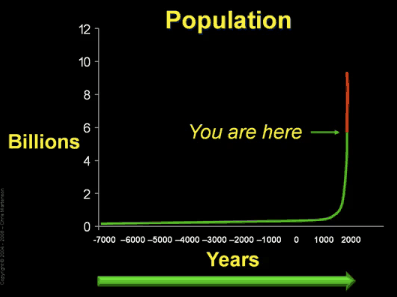
Now the key thing to understand is not just that the world population is growing, it is that the developing world, for example China and India, are doing just that, developing, which means that they have to expand their use of raw materials, energy and water at an ever increasing rate. When you realize that China has the intention of building cities to house the equivalent of the population of Australia, every year, for the next thirty years, you get some idea of the amount of steel, copper, concrete and other building materials that would be required.
Another statistic of interest is that, this last quarter, for the first time ever, more vehicles were sold in China than in the US – and every one requires gasoline.
If you look back over the last century, it is clear that the great enabler of our modern way of life has been the wide availability of cheap energy. That era is now drawing to a close. Future petroleum supplies are going to be more expensive, not only because of higher demand, but also because more energy is being required to extract more energy. (The exponential function hits us again).
The cut-off point comes not when the oil is all used, it is much sooner than that – it is when the amount of energy to be gained from a barrel of oil is as much energy as was required to extract it. At that point, in the words of Stephen Leeb, another astute financial commentator, it’s “Game Over”.
Once again, something has to give.
How about alternatives?
Wind is great. How many windmills would we need? To produce the current energy output of the US would require both coastlines to support a layer of windmills 20 deep all the way along both coasts! How about the cost and the amount of steel required?
There are similar crises building in the supply of other raw materials. The low hanging fruit has all been picked. For example, the extraction rates of many minerals, are now far less than they were in the past, and are continually decreasing. Once again, ever increasing amounts of energy are being used to obtain fewer and fewer resources. If you have seen pictures of the huge machines used in mining these days, imagine them running on solar power or electricity.
Crisis Number 3. Environmental Pressures
Pressures on the environment continue to grow as the world population grows, and development, that we have talked about above, creates even more pressure. It is clear that as environmental pressures increase in a particular locality, then economic growth cannot continue unchecked there. Something has to give.
Considering these three crises boiling up together, it becomes clear that, as Chris Martenson likes to say,
“Our lives are going to be vastly different over the next 20 years than they have been over the last 20 years.”
Gold as Insurance
Now, what should we do, given all of the above, from the point of view of maintaining a reasonable way of life, if we are fortunate enough to have such?
There are two ways of looking at this. We are right in what we say, or we are wrong. If you think we may well be right, then you owe it yourself and your family to take aggressive steps to protect what wealth you have. This means that you should consider carefully what follows. If you think we are wrong, then we still suggest you should invest in some protection, just as insurance.
After all, when you insure your house against fire, it’s not because you think it will burn down; it’s because the result of not having insurance in the rare case that it does is extremely severe.
So we want to impress upon you that the only insurance against financial system breakdown is to own gold, or its equivalent. There are alternative investments, for example, other precious metals, that we will discuss later.
While there are conflicting opinions about whether the global economy faces inflation or deflation (shrinking money supply chiefly through debt default), gold is an insurance against both outcomes.
While gold is the only currency that can’t be debased by inflationary government policies, a significant and extended deflation of the world’s economy would be likely to result in a collapse of what’s left of the global financial system. Gold would likely hold its value better than fiat currencies under this scenario too.
You can read more on this topic here: Why Gold Bullion is Your Financial Insurance
So, in the next module you’ll discover a few methods for valuing gold today and determining its potential future value. Also some thoughts on whether it’s already too late to buy gold. Then in Module 6 we’ll outline 9 different options you have for purchasing your gold insurance, as well as our thoughts on their pros and cons.
Remember knowledge is the key to protection and profits!
David Deutsch, Glenn Thomas and Bill Flinn.
Founders
Gold Survival Guide
Disclaimer: We are not certified investment advisers and you should not construe what we write as personal investment advice but rather information of a general nature and as a basis for you to conduct further research.