
This Week:
Estimated reading time: 7 minutes
Weekly Price Overview – 1 October 2025
Gold and silver prices ripped higher again this week — fueled by strong international buying interest and a weak NZ dollar that continues to amplify local price gains. With USD silver now just shy of $50, and NZD metals carving new highs, the trend remains firmly up.
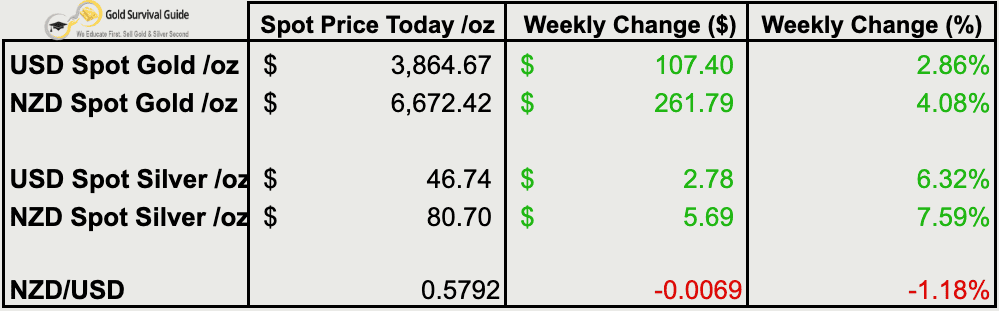
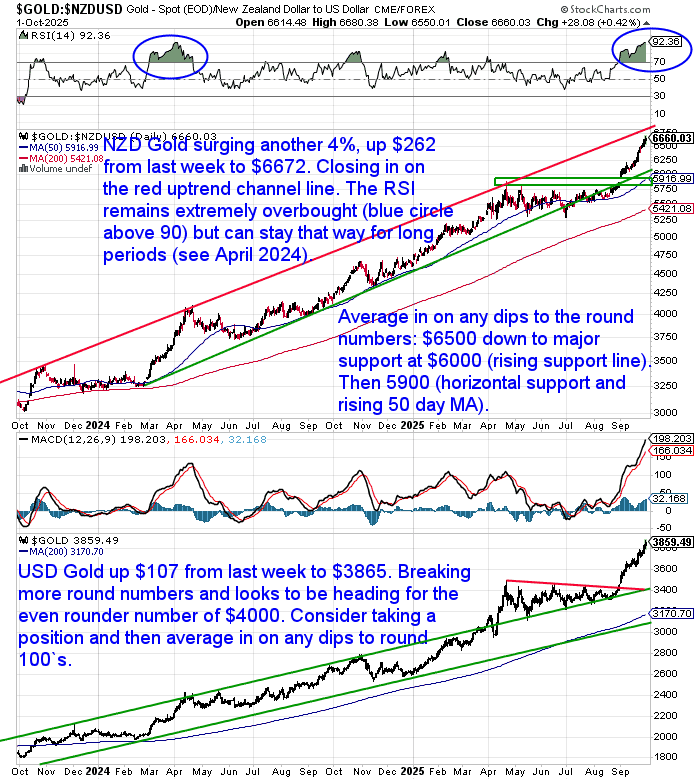
🟡 NZD gold surged $261.79 to $6,672.42 (+4.08%), entering the upper edge of its uptrend channel. USD gold gained $107.40 to $3,864.67 (+2.86%), holding above the key $3800 level and likely targeting the psychological $4000 zone next.
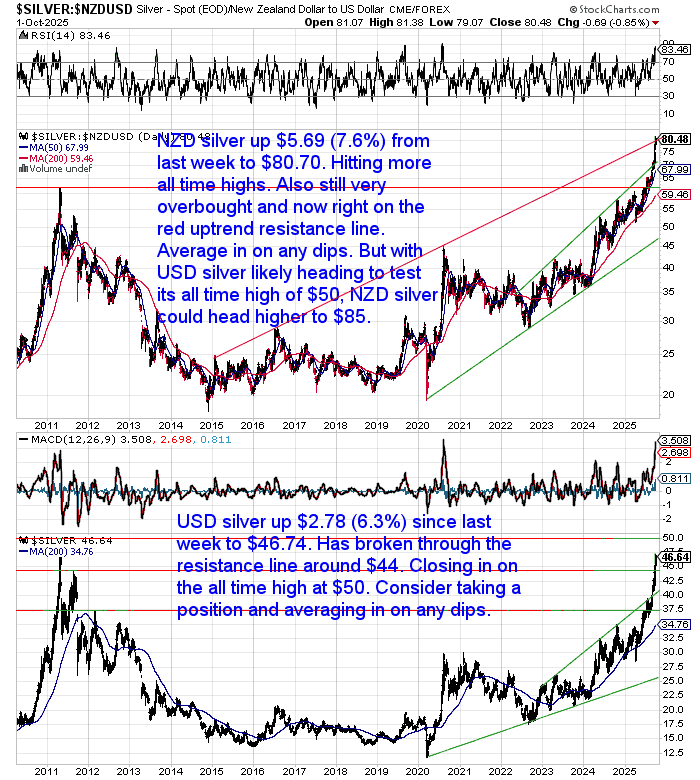
⚪ NZD silver exploded $5.69 to $80.70 (+7.59%), breaking more all-time highs despite being technically overbought. USD silver rose $2.78 to $46.74 (+6.32%) and has broken out cleanly above $44 resistance — now closing in on the long-watched $50 mark.
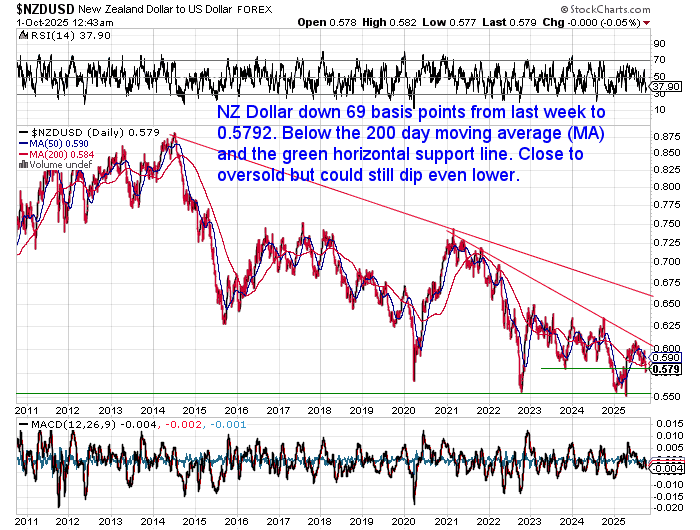
💱 NZD/USD dropped -1.18% to 0.5792. It’s trading below the 200-day MA and hugging horizontal support. While technically oversold, it could still dip lower — continuing to support NZD metal prices.
📈 Momentum is undeniably strong. As long as USD silver stays above $44 and NZD gold holds $6500, the path of least resistance remains higher. Especially with the current high likelihood for a US government shutdown – the first since first since 2018/19. Consider taking or adding to positions on any short-term weakness, especially if silver cools off after its parabolic rise.
Booze, Bullets or Bullion? What Really Works When Society Doesn’t
We often hear talk about bartering as a backup plan… but has anyone stopped to think how that would actually work in the real world? This week, we dig into one of our most-shared topics ever — what people think they’ll trade in a societal breakdown… versus what actually holds value.
You might be surprised by the one simple item history shows was most effective — and it’s not bullets, booze, or baked beans.

In uncertain times — whether societal or financial — one truth keeps coming up: real value survives chaos.
But chaos doesn’t just come from civil unrest — sometimes it’s baked into the system itself…
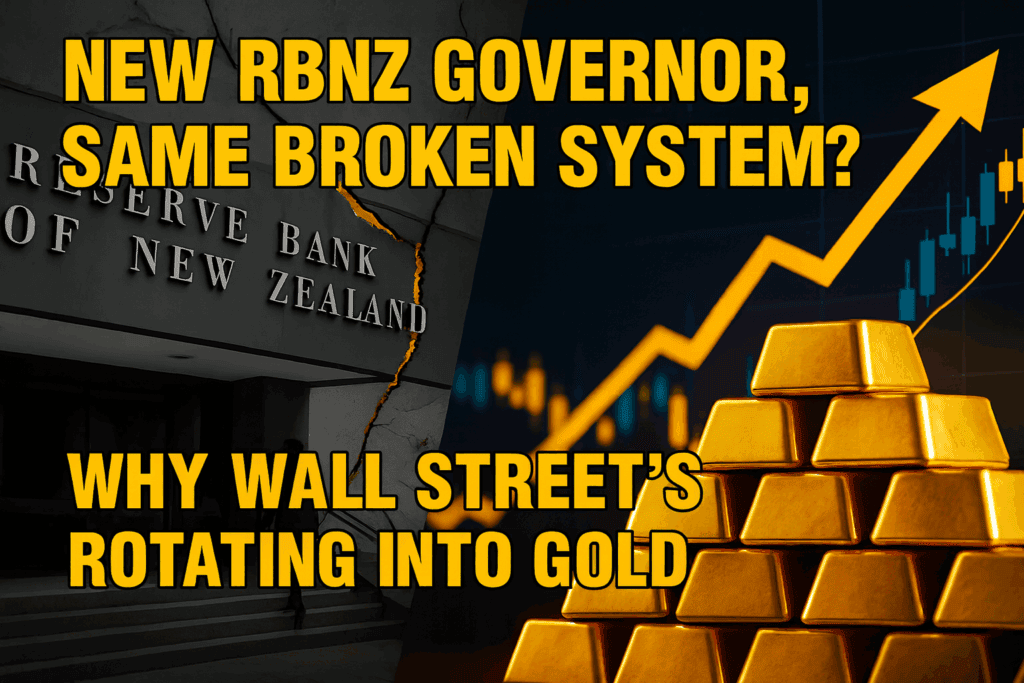
New RBNZ Governor: New Face, Same System?
The Reserve Bank of New Zealand has a new governor — Sweden’s Anna Breman — and the general mood is: “Surely she can’t do worse than the last guy?”
Hard to argue with that.
But even before she’s taken the reins, the RBNZ itself has admitted in a new report that it fumbled the pandemic response. According to its own review, it should’ve hiked rates faster and more aggressively to curb runaway inflation.
The media isn’t holding back either:
- “New boss needs to rebuild trust” (1News)
- “The job ahead is massive” (The Spinoff)
- “Can she even read NZ’s weird little economy?” (Patrick Smellie)
Some worry she’s an outsider. Others say that’s a good thing — that she’ll come in unafraid to break with convention.
But nobody’s asking the real question:
Why do we even have a central bank in the first place?
If price stability is the goal, why do we rely on a handful of unelected people to set the price of our currency (interest rates) behind closed doors?
Even Argentina’s so-called anarcho-capitalist President Javier Milei hasn’t gone as far as scrapping his central bank (yet). But here in NZ, the monetary status quo still reigns.
Meanwhile, the OCR may be slashed as low as 2.25% by Christmas, according to ASB’s latest forecast.
So… more of the same? New face, same broken system?
Maybe.
That’s why, while central banks keep guessing, some of the biggest players in finance are quietly stepping outside the system — and loading up on gold.
Gold’s Growing Respect on Wall Street?
Gold is up 45% year to date, yet a stunning 39% of fund managers still hold zero gold exposure. That’s according to the latest BofA Global Fund Manager Survey.9

Source: Ronni Stoeferle
But the tide might be turning.
👉 Institutional FOMO is setting in.
World Gold Council strategist John Reade says hedge funds are piling into gold ETFs they previously ignored — especially the larger, higher-fee ones typically used by institutions.
👉 Wall Street is rethinking the 60/40 portfolio.
- Morgan Stanley’s CIO now backs a 60/20/20 model (with 20% in precious metals).
- Bond fund legend Jeff Gundlach is pushing for an even split: 25% each in stocks, bonds, metals, and cash.
- BofA has also proposed a new 25% gold allocation in alternative portfolio structures.
As Karl Krueger put it:
“Is this a fundamental shift in thinking, or are they just playing catch-up?”
Either way, this marks a tectonic shift in how the financial world views gold — from barbarous relic to modern portfolio cornerstone. The below charts seem to back that up…
Chart of the Week: A Super Capital Rotation is Brewing
We’ve talked recently about how institutions are starting to up their gold allocations — even Morgan Stanley and BofA are now publicly recommending 20–25% in precious metals.
Now the charts are catching up to the sentiment…
🔶 Chart 1 – Stocks vs Silver:
From Patrick Karim: We may be approaching only the second “SUPER” Capital Rotation Event in over 125 years — where capital flows away from overvalued equities into hard assets like silver.

🔶 Chart 2 – Gold vs Stocks:
According to Karim again, “truly epic” gains could lie beyond this breakout wall, with $8,000–12,000 gold not unrealistic based on past symmetry moves.

🔶 Chart 3 – Gold Adjusted for Money Supply:
That’s not to say there won’t be corrections or longer periods of sideways consolidation. These are healthy. However Tavi Costa of Crescat says: Gold is now breaking a multi-decade downtrend when adjusted for monetary expansion. If you’re watching real purchasing power — gold is still in early innings.
Together, these charts suggest we’re not just seeing a short-term price rally. This looks more like a systemic repositioning of capital — out of financial assets and into real ones.

If the institutions are rotating into gold and silver — shouldn’t you at least consider doing the same?
Whether it’s your first purchase or just topping up, we’re happy to help.

Glenn's dedication to educating individuals on wealth protection through precious metals has helped over 2400 clients from New Zealand, Australia, USA and Europe to safeguard their financial futures. Passionate about financial independence and lifestyle freedom, Glenn’s mission is to empower others with the knowledge and tools to thrive in today’s volatile economic environment. When he's not advising on precious metals, Glenn enjoys spending time with his family and pursuing outdoor adventures.
Education: University of Auckland Bachelor of Science
Linkedin: https://www.linkedin.com/in/glenn-thomas-0984a4310/
- Where Are We in the Silver Market Cycle? - September 15, 2026
- Why the Netherlands Is Moving More of Its Gold Reserves to London - September 9, 2026
- What Is the Gold Silver Ratio? What Is It Telling Us Now? - September 8, 2026
