

This Week:
Estimated reading time: 6 minutes
Weekly Price Overview – 5 Aug 2026
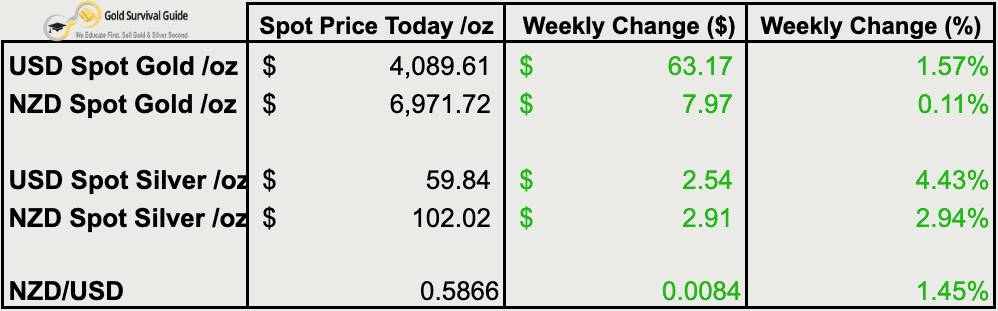
Precious metals rebounded this week, recovering some of last week’s losses while continuing to build what appears to be a base around key long-term support levels. While the final low will only be known in hindsight, averaging in continues to look like a sensible approach.
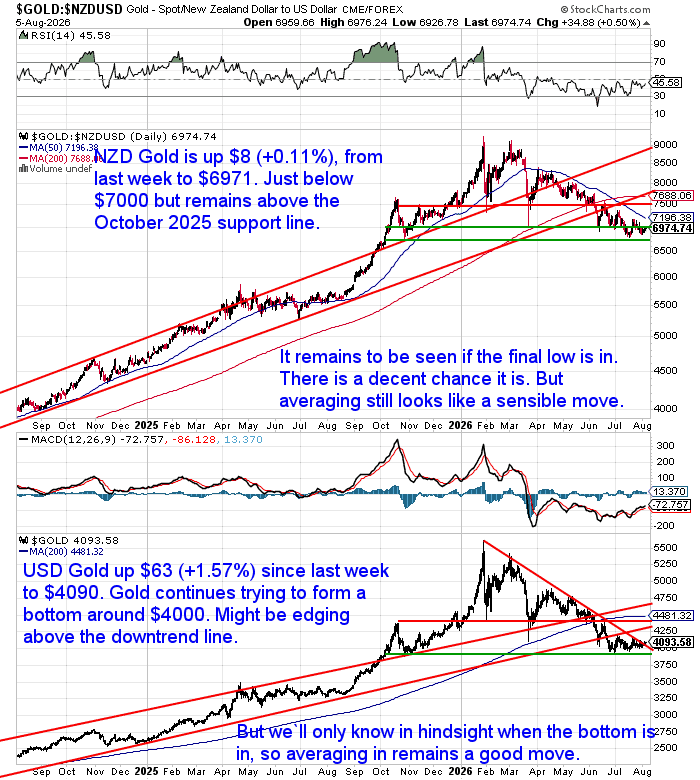
🟡 NZD gold rose $8 (+0.11%) to $6,972
NZD gold edged higher this week, remaining above the October 2025 support level despite a stronger Kiwi dollar. It still appears to be building a base, with averaging in continuing to make sense.
USD gold rose $63 (+1.57%) to $4,090
USD gold rebounded from around the major $4,000 support zone and continues trying to form a bottom. While confirmation will only come in hindsight, the longer-term setup remains encouraging.
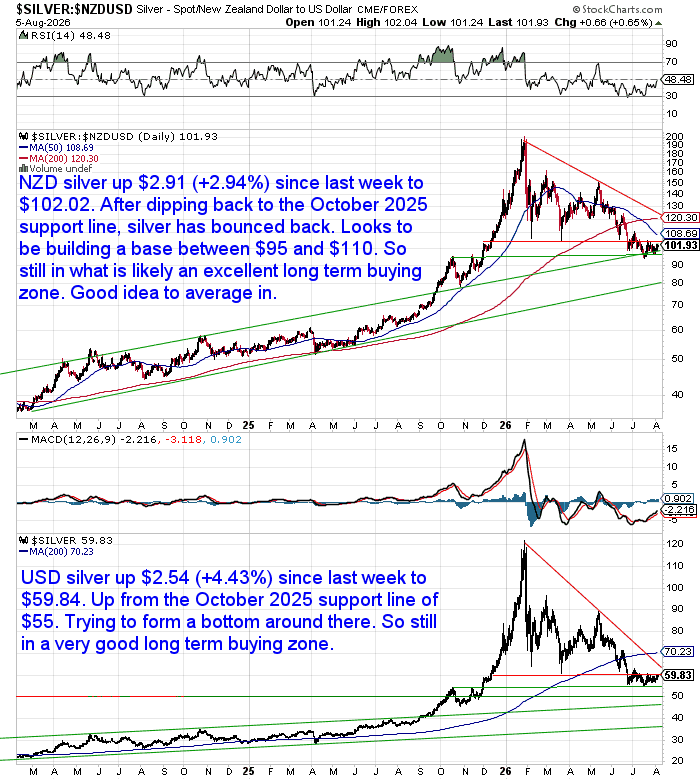
⚪ NZD silver rose $2.91 (+2.94%) to $102.02
NZD silver bounced back above $100 after successfully holding the October 2025 support area. It remains in what looks like an excellent long-term buying zone.
USD silver rose $2.54 (+4.43%) to $59.84
USD silver recovered strongly from support around $55 and continues building a base. It remains in a very attractive long-term buying zone.
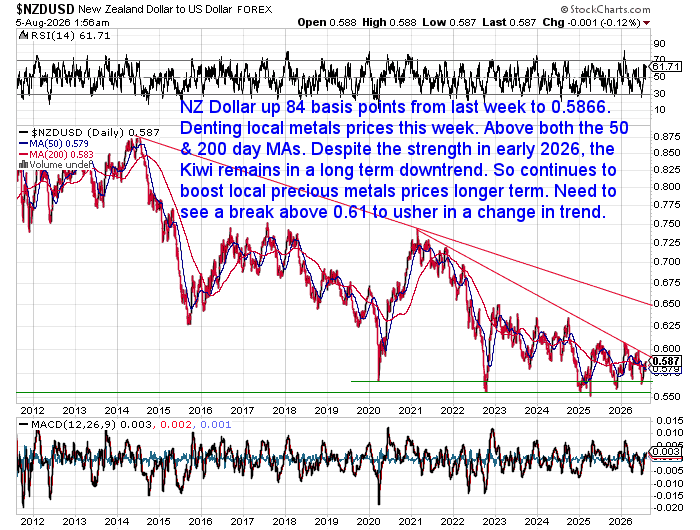
💱 NZD/USD rose 84 basis points (+1.45%) to 0.5866
The Kiwi dollar strengthened again this week but remains within its longer-term downtrend. Until that trend changes, it should continue supporting local precious metals prices.
What Would a Gold-Backed US Dollar Mean for New Zealand?
Gold hasn’t backed the US dollar for more than 50 years.
But what if that changed?
As governments and central banks quietly increase their gold holdings, discussion about gold’s role in the monetary system is growing again. This week we examine what such a shift could mean for New Zealand, and why our lack of official gold reserves may matter more than many people realise.
Read: If the US Dollar Was Linked to Gold Again, What Would It Mean for New Zealand?

This Week’s Wrap
When the Crowd Loses Interest, Who Keeps Buying?
This week’s featured article asks what a return to some form of gold-backed monetary system could mean for New Zealand.
At first glance, that might sound like a purely theoretical question.
Yet this week’s news tells a different story.
Interest in gold has become noticeably quieter over recent weeks. Retail interest has faded, bullion dealers are reporting little activity, and online searches have dropped sharply.
Yet central banks continue adding to their gold reserves. Governments are repatriating gold. Even new institutional buyers are emerging.
The contrast between public sentiment and institutional behaviour may be one of the most important stories in today’s gold market.
The Crowd Has Gone Quiet
One of the most interesting observations this week came from precious metals commentator Ross Norman, who noted that the speculative enthusiasm surrounding gold has largely disappeared. Google search trends have fallen sharply even though gold remains close to historic highs.
Chris Weber reported something similar from the United States. A reader visiting one of Texas’ largest bullion dealers found almost no buying or selling activity, describing the market as “crickets”. Yet during the same period, Weber observed steady buying by wealthy clients in Monaco, including a single purchase of 100 kilograms of silver.
Back home, New Zealand’s bullion market has also been noticeably quieter in recent months.
None of this says prices are about to explode. But it does suggest that much of the speculative money has already left the market. History shows that periods of widespread disinterest are, in hindsight, often very good places to be buying.
The Big Buyers Are Still Buying
While retail interest has faded, institutional demand shows few signs of slowing.
The World Gold Council reported another month of central bank buying, led by China and Poland. South Korea has announced plans to begin rebuilding its gold holdings, initially through ETFs before moving towards purchases of domestically produced gold. France continues the broader trend of countries bringing more of their gold reserves under direct national control.
Perhaps most surprising was the news that Tether purchased around 450,000 ounces of gold during the second quarter – making it one of the largest buyers outside the central banking system.
Each one of these stories is interesting. But together, they point towards something larger. Institutions with long-term objectives continue treating gold as a strategic monetary asset, regardless of whether public interest is high or low.
The Monetary System Is Still Under Pressure
At the same time, the pressures that helped drive gold higher over recent years have not disappeared.
Debate continues over how long interest rates can remain elevated without placing increasing strain on heavily indebted governments. Rising US Treasury yields, intervention to support the Japanese yen, and ongoing questions around government debt all point to the same underlying challenge: balancing inflation, borrowing costs and financial stability.
Several commentators also revisited a question that sits at the heart of this week’s featured article: could gold eventually play a larger role in the international monetary system?
While opinions differ on how that might happen – or whether it will happen at all – the discussion itself reflects a broader trend. Gold is increasingly being viewed as a strategic monetary asset by central banks and governments, even as public interest remains subdued.
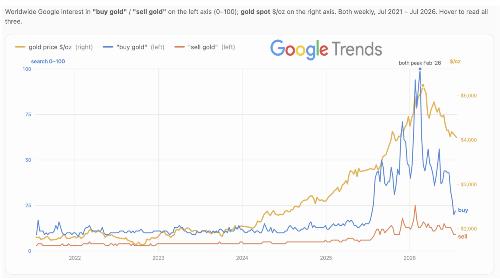
Source: Ross Norman
Whether gold has already formed a bottom remains open to debate.
What matters more is understanding the longer-term forces shaping the monetary system.

Glenn's dedication to educating individuals on wealth protection through precious metals has helped over 2400 clients from New Zealand, Australia, USA and Europe to safeguard their financial futures. Passionate about financial independence and lifestyle freedom, Glenn’s mission is to empower others with the knowledge and tools to thrive in today’s volatile economic environment. When he's not advising on precious metals, Glenn enjoys spending time with his family and pursuing outdoor adventures.
Education: University of Auckland Bachelor of Science
Linkedin: https://www.linkedin.com/in/glenn-thomas-0984a4310/
- When the Crowd Loses Interest, Who Keeps Buying? - August 5, 2026
- If the US Dollar Was Linked to Gold Again, What Would It Mean for New Zealand? - August 3, 2026
- Four Questions Worth Asking Beyond the Gold Price - July 29, 2026
