
Since the end of the gold standard in 1971, the US dollar has been backed by confidence rather than physical gold.
Yet over the past few years, discussion about gold’s role in the global monetary system has returned. Central banks are buying gold at record levels, questions have resurfaced about America’s gold reserves at Fort Knox, and economists are once again debating whether gold could play a larger role in the international financial system.
Few people expect a return to the classical gold standard. However, many now believe gold could become more important as a reserve asset or reference point within the monetary system.
If that happened, what would it mean for New Zealand?
In this article, we explore how a return to some form of gold backing could affect the New Zealand dollar, inflation, gold prices and why New Zealand’s lack of official gold reserves matters.
Quick Answer
A return to some form of gold backing would not necessarily mean a return to the old gold standard. Instead, it would likely increase gold’s importance within the international monetary system.
For New Zealand, the biggest implications could include:
- A higher New Zealand dollar gold price.
- Changes to exchange rates and international capital flows.
- Greater attention on countries with few or no official gold reserves.
- Increased interest in physical gold as a long-term store of wealth.
While nobody knows whether this will happen, understanding the potential consequences helps explain why governments, central banks and investors continue paying close attention to gold today.
| Possible Outcome | Why It Matters |
|---|---|
| Gold plays a larger role in the monetary system | Central banks may continue increasing their gold holdings. |
| US gold reserves are officially revalued | America’s balance sheet could strengthen without acquiring more gold. |
| New Zealand holds no official gold reserves | If official gold reserves became more important globally, New Zealand would begin from a weaker position than countries that already own significant gold reserves. |
| Physical gold attracts greater attention | Investors may place more importance on owning precious metals outside the banking system. |
Table of Contents
Estimated reading time: 14 minutes
Why Are People Talking About Gold Again?
For many years, the idea of linking the US dollar back to gold was largely confined to economists and monetary historians. Today, the conversation has returned to the mainstream for several reasons.
First, central banks have been buying gold at the fastest pace in decades. Rather than reducing their exposure to gold, many countries are increasing it as a strategic reserve asset.
Second, renewed attention has focused on America’s gold reserves. Treasury Secretary Scott Bessent’s recent comments that the gold at Fort Knox is “present and accounted for” helped revive public discussion about the role of US gold holdings and whether they should be independently audited. While those comments reassured many observers, they also prompted renewed interest in how America’s gold reserves are valued and whether gold could play a larger monetary role in the future.
Finally, economists continue to debate whether the official US Treasury valuation of US$42.22 per ounce still makes sense when gold trades at many times that level. Some argue that revaluing America’s gold reserves could strengthen the government’s balance sheet without changing the amount of gold it owns.
Related reading: Fort Knox Gold Audit: Has America’s Gold Ever Been Properly Audited?
Together, these developments have brought discussions about gold, monetary policy and sovereign reserves back into public view—even if a formal return to the gold standard remains unlikely.
Could the US Dollar Really Be Linked to Gold Again?
At first glance, the idea of linking the US dollar back to gold may sound like a return to the old gold standard. In reality, there are several ways gold could play a larger role in the international monetary system without recreating the system that ended in 1971.
Most economists believe a return to the classical gold standard, where currency is formally convertible into gold at a fixed official price, remains unlikely. They argue that modern governments rely on the flexibility of fiat currencies to respond to financial crises, finance budget deficits and manage economic activity without being constrained by fixed gold reserves.
Others disagree. They argue that a modern monetary system linked to gold would not require more gold – only a different official gold price. From this perspective, the challenge is not the quantity of gold available, but the willingness of governments to accept the greater monetary and fiscal discipline that a gold-linked system could impose.
Even so, a return to the classical gold standard is not the only possibility. There are several ways gold could play a larger role in the international monetary system without governments committing to full convertibility.
A Partial Gold Backing
One possibility is that gold could once again be used to strengthen confidence in a currency without fully backing every dollar in circulation.
For example, governments could choose to hold larger gold reserves, revalue their existing gold holdings, or use gold as part of a broader reserve framework. Rather than replacing fiat money, gold would support it.
This is one reason recent discussions about gold revaluation have attracted attention. Revaluing America’s official gold reserves would not create new gold, but it could significantly increase the reported value of those reserves on the government’s balance sheet.
Related reading: Gold Revaluation: Why the Debate Is Heating Up Again.
Gold as an International Reserve Asset
Another possibility is that gold becomes increasingly important in settling international trade or strengthening central bank reserves.
This trend is already underway. Central banks around the world have been buying gold at record levels, suggesting many countries continue to view physical gold as an important monetary asset alongside foreign currencies and government bonds.
Rather than replacing the US dollar, gold could play a complementary role within the international financial system.
Could the IMF or SDR Play a Role?
Some analysts, including Jim Rickards, have suggested that the International Monetary Fund (IMF) and its Special Drawing Rights (SDRs) could play a greater role in any future monetary reset.
While this remains one possible scenario, there is currently no evidence that the IMF plans to formally back SDRs with gold or replace the US dollar as the world’s primary reserve currency.
Today, discussions are more commonly focused on central bank gold reserves, sovereign balance sheets and the role of gold within the existing monetary system than on creating an entirely new global currency.
The Bigger Picture
Whether or not the US dollar is ever formally linked to gold again, one trend is already clear: governments are paying far more attention to gold than they were a decade ago.
Record central bank purchases, renewed interest in America’s gold reserves and ongoing discussions around gold revaluation all point to one conclusion:
Gold is increasingly being treated as a strategic monetary asset – not simply another commodity.
What Would It Mean for New Zealand?
If the United States ever linked the dollar to gold again—whether through a formal gold standard, a partial gold backing or a revaluation of its official gold reserves—the effects would extend well beyond America.
As a small, trade-dependent economy that relies on the international monetary system, New Zealand would almost certainly feel the impact, even though it would have little influence over the outcome.
Some of the effects could include the following.
New Zealand’s Official Gold Reserves
One important difference between New Zealand and many developed countries is that the Reserve Bank no longer owns official gold reserves.
We’ll return to why that matters shortly.
The New Zealand Dollar
A significant change to the international monetary system would almost certainly affect exchange rates, including the New Zealand dollar.
Exactly how the NZ dollar responded would depend on the nature of the changes and how financial markets interpreted them. Exchange rates are influenced by many factors, including interest rates, trade flows and investor confidence.
Rather than attempting to predict the outcome, it is more useful to recognise that any major change to the world’s reserve currency would almost certainly create a period of adjustment across global currency markets.
Inflation and Interest Rates
Changes to the international monetary system could also influence inflation and interest rates over time.
If a gold-linked monetary system placed greater discipline on money creation, inflationary pressures could eventually ease. However, the transition itself could also create periods of market uncertainty as governments, central banks and investors adjusted to the new system.
Because so many factors would be involved, the precise economic effects would depend on how any reforms were implemented.
Physical Gold Ownership
While governments debate monetary policy, individual investors face a much simpler decision.
If gold became more important within the international financial system, owning physical gold could become increasingly relevant – not because it generates income, but because it has historically served as a long-term monetary asset outside the banking system.
Owning physical gold isn’t about predicting the future. It’s about recognising that if governments continue treating gold as a strategic monetary asset, private investors may also see value in holding some outside the banking system.
Related reading: Why You Should Become Your Own Central Bank.
What About the Reserve Bank of New Zealand?
If gold regained a larger monetary role internationally, questions would inevitably be asked about New Zealand’s own reserve strategy.
Unlike many central banks, the Reserve Bank of New Zealand currently holds no official gold reserves. Whether that policy would remain appropriate under a changing international monetary system would ultimately become a matter for future governments and the Reserve Bank itself.
Related reading: Could the New Zealand Government Rebuild Its Gold Reserves?
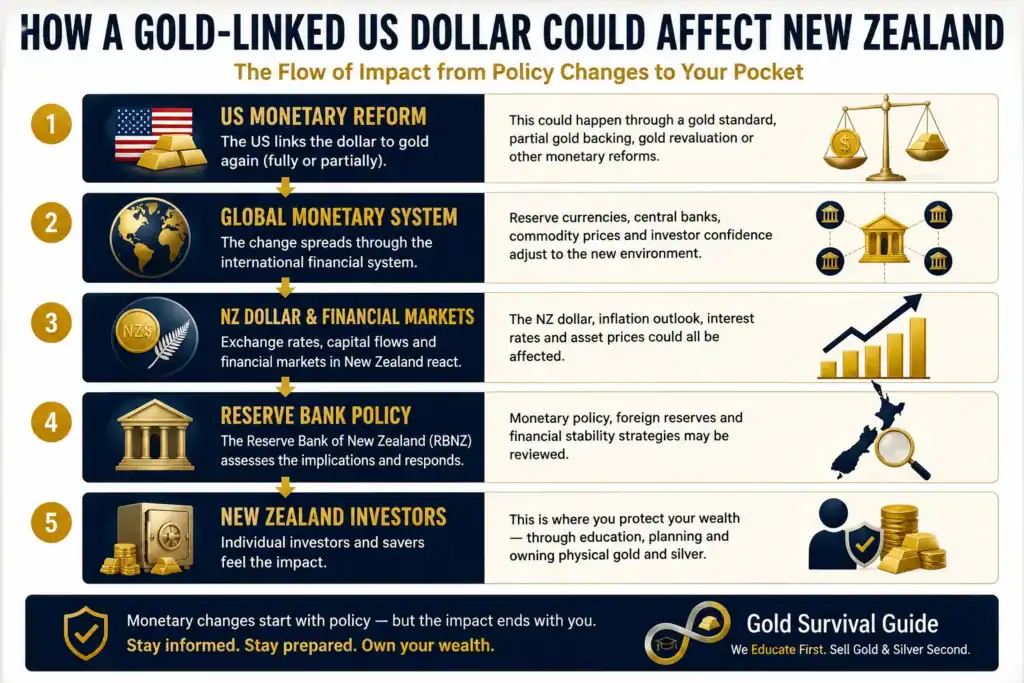
Source: Gold Survival Guide illustration based on the potential transmission of international monetary policy changes through the global financial system.
Why New Zealand’s Gold Reserves Matter
If gold were to regain a more prominent role in the international monetary system, countries that already own large official gold reserves could find themselves in a stronger position.
The United States, Germany, Italy, France and many other nations continue to hold thousands of tonnes of gold as part of their national reserves. Those holdings could become more strategically valuable if gold once again played a larger role in the global financial system.
New Zealand is different.
The Reserve Bank of New Zealand no longer owns any official gold reserves, having sold its remaining holdings decades ago. That means New Zealand would have little direct exposure to any increase in the value or monetary importance of official gold reserves.
Whether New Zealand should once again hold official gold reserves is a question receiving renewed attention as central banks continue adding gold to their balance sheets.
Related reading: How Much Gold Does the Reserve Bank of New Zealand Have?
Would Gold Prices Rise?
No one knows whether gold prices would rise if the international monetary system changed.
However, many economists, investors and monetary historians argue that if governments wanted gold to once again support currencies or international settlements, the official price of gold would likely need to be substantially higher then it is today.
The reason is straightforward.
Since the United States abandoned the gold standard in 1971, the supply of dollars has grown dramatically while the amount of official gold held by governments has changed relatively little. If gold were expected to support a meaningful share of today’s much larger money supply, a higher valuation could be required.
That idea is commonly referred to as gold revaluation.
Rather than governments acquiring dramatically more gold, some analysts argue they could instead assign a higher official value to the gold they already own. Others disagree and believe the current fiat monetary system is likely to continue.
Either way, the discussion is not simply about the market price of gold. It is about the role gold could play within the international monetary system.
Related reading: Gold Revaluation: Why the Debate Is Heating Up Again
Key idea
Gold revaluation isn’t primarily a prediction about the gold price.
It’s a discussion about what official gold would need to be worth if governments ever chose to give gold a larger monetary role again.
Does This Mean a Return to the Old Gold Standard?
Not necessarily.
When people hear discussions about linking currencies to gold, many immediately think of the old gold standard. But today’s debate is much broader than that.
Over the past century, the international monetary system has gone through several major changes.
The Classical Gold Standard (before World War I)
Under the classical gold standard, currencies were directly convertible into a fixed amount of gold. Governments and central banks were expected to maintain enough gold reserves to support their currencies, which helped keep exchange rates relatively stable but also limited how much money could be created.
Bretton Woods (1944–1971)
After World War II, a different system emerged.
Rather than every currency being backed by gold, the U.S. dollar became the world’s reserve currency and foreign governments could exchange U.S. dollars for gold at US$35 per ounce.
This became known as the Bretton Woods system.
The Fiat Monetary System (1971–Today)
In 1971, President Richard Nixon suspended the dollar’s convertibility into gold.
Since then, the global financial system has operated using fiat currencies. Their value comes from government authority, economic confidence and central bank policy rather than a fixed link to precious metals.
This flexibility allows governments and central banks to respond more easily to economic crises, but it also enables much greater expansion of the money supply than was possible under previous gold-backed systems.
Could a Future System Look Different?
Many analysts believe that if gold ever returned to the monetary system, it probably wouldn’t be a simple return to the nineteenth-century gold standard.
Instead, they suggest a future system could combine elements of today’s fiat currencies with a larger role for gold in international settlements, reserve assets or central bank balance sheets.
Others have proposed that institutions such as the IMF and its Special Drawing Rights (SDRs) could play a greater role in any future monetary framework.
No one knows whether any of these ideas will be adopted. However, they help explain why discussions about gold, official reserves and gold revaluation have become more common in recent years.
Further reading: What Could A Global Currency Reset Mean For New Zealand?

What Should Investors Watch?
Rather than trying to predict whether the United States will formally link the dollar to gold again, it is more useful to watch the trends that could shape the international monetary system.
These include:
- Continued central bank gold buying
- Changes to how governments value their gold reserves
- Any moves towards greater transparency around Fort Knox
- Discussion of gold revaluation
- IMF and SDR developments
- Changes in sovereign reserve policy
Individually, none of these confirms a return to gold-backed money. Together, they help build a picture of how the international monetary system may continue to evolve.
Final Thoughts
No one knows whether the U.S. dollar will ever be formally linked to gold again.
What is already happening is that gold is becoming increasingly important to governments and central banks around the world.
That helps explain why discussions about Fort Knox, gold revaluation, central bank buying and official gold reserves have all returned to the spotlight in recent years.
For New Zealanders, the most important lesson isn’t to predict exactly what comes next. It’s to understand how changes in the global monetary system could affect the New Zealand dollar, inflation, savings and long-term wealth protection.
FAQs
A full return to the classical gold standard is generally considered unlikely. However, some economists and market analysts believe gold could play a larger role in a future monetary system through partial backing, reserve revaluation or international settlement mechanisms. While no formal proposal has been adopted, the topic has returned to discussion in recent years.
Nobody knows for certain. However, if governments wanted gold to play a larger role in the international monetary system, many analysts believe a significantly higher official gold price would likely be required. This idea is commonly referred to as gold revaluation.
No. New Zealand sold its official gold reserves decades ago. Today, the Reserve Bank of New Zealand does not hold monetary gold as part of its foreign exchange reserves, making New Zealand unusual among developed economies.
Gold revaluation is the idea that governments could officially value their gold reserves at a much higher price than the current statutory value. Supporters argue this could strengthen government balance sheets or support changes to the international monetary system. It is different from the everyday market price of gold.
If gold once again played a larger role in the international monetary system, it could influence exchange rates, interest rates, inflation and the New Zealand dollar. Because New Zealand holds no official gold reserves, any changes would likely be indirect rather than through gains on government-owned gold.
Further Reading
- Why New Zealand Doesn’t Hold Official Gold Reserves – Why the Reserve Bank sold its gold and how that differs from many other countries.
- Gold Revaluation Explained – Why some economists believe governments could revalue their gold reserves.
- Why You Should Become Your Own Central Bank – Why central banks continue accumulating gold and what individuals can learn from that strategy.
- Fort Knox Gold Audit: Has America’s Gold Ever Been Properly Audited? – The history of America’s gold reserves and why calls for an audit continue.
- Why Are Central Banks Buying Gold? – Recent trends in official gold purchases and what they may signal about the global monetary system.
Editors Note: This article was first published on 2 August 2017. It was comprehensively updated on 3 August 2026 to reflect recent developments in the international monetary system, including central bank gold buying, Fort Knox, gold revaluation and the potential implications for New Zealand.

Glenn's dedication to educating individuals on wealth protection through precious metals has helped over 2400 clients from New Zealand, Australia, USA and Europe to safeguard their financial futures. Passionate about financial independence and lifestyle freedom, Glenn’s mission is to empower others with the knowledge and tools to thrive in today’s volatile economic environment. When he's not advising on precious metals, Glenn enjoys spending time with his family and pursuing outdoor adventures.
Education: University of Auckland Bachelor of Science
Linkedin: https://www.linkedin.com/in/glenn-thomas-0984a4310/
- Why Own Gold When It Pays No Interest or Dividends? - August 12, 2026
- Why Buy Gold? A New Zealand Guide to Protecting Your Wealth - August 11, 2026
- When the Crowd Loses Interest, Who Keeps Buying? - August 5, 2026

OK since the SDR is ‘controlled’ by the IMF what sort of trouble can we expect in this scenario. Remember that the IMF and the World Bank are instruments of the US used to put us lesser folk into place usually thru loans that are unpayable.
The main trouble would be that we’d be in a possibly even more centrally controlled world. Although there is an argument to be made if we had a basket of currencies arrangement and a more multi-polar world, that perhaps the world would have a better balance to it. Then again maybe just more conflict? What would be almost certain is that the current currencies being used would be significantly devalue from their current purchasing power. This would be a necessity to balance out all the currency and debt that has been created in past decades. So this would seem to be one thing we can all prepare for, even if the ins and outs of what the new world order might be is far from clear.
Some form of international financial revaluation / reset is inevitable, the question is timing and structure? As stated, NZ $ is backed only by faith, it seem logical to me that as individuals we should become our own Central Banks. If nothing more, its sound insurance, plain and simple.