
This Week:
- 📊 Weekly Price Overview – 12 August 2026
- Why Own Gold When It Pays No Interest or Dividends?
- Gold Pays No Interest. So Why Does It Keep Showing Up Everywhere?
- Currency Intervention Offers Another Clue
- Is Gold Really Just Another Commodity?
- Gold Is Rising Despite High Interest Rates
- And Finally… Did Rand Paul Audit Fort Knox?
- What Does All This Mean for a New Zealander?
Estimated reading time: 9 minutes
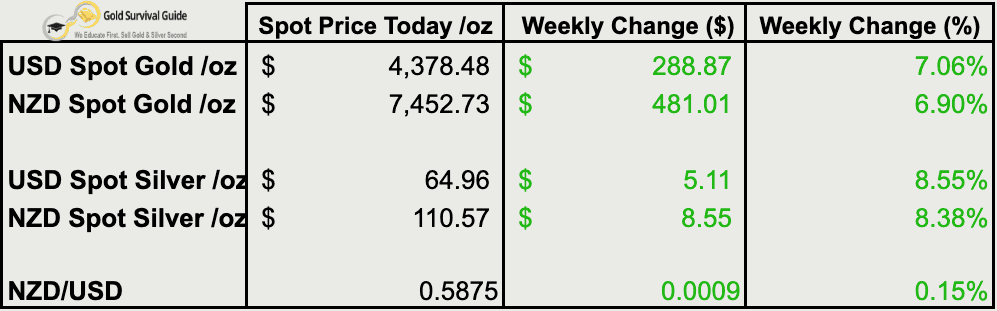
📊 Weekly Price Overview – 12 August 2026
Precious metals surged this week, with gold and silver breaking above their recent downtrends and 50-day moving averages. Evidence that the lows may be in is strengthening, although averaging in on dips remains sensible.
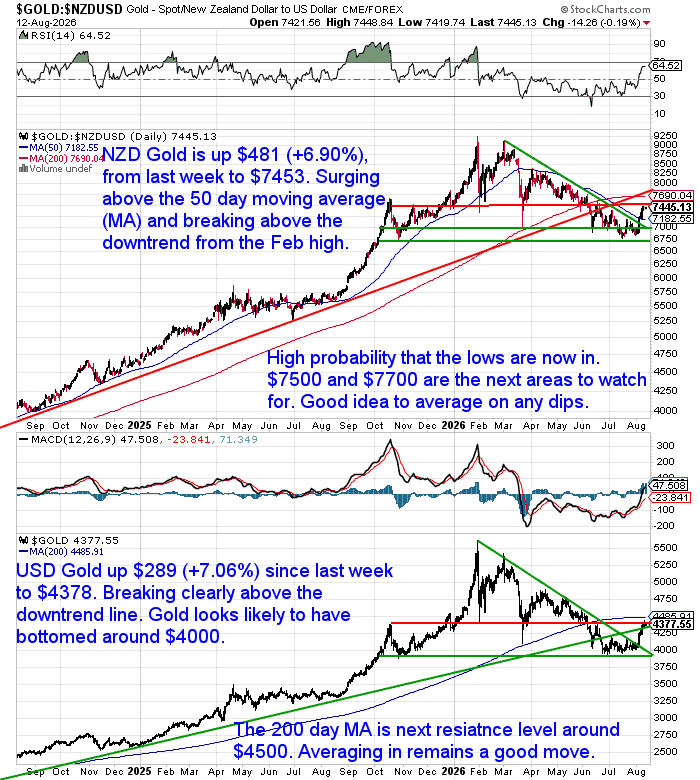
🟡 NZD gold rose $481 (+6.90%) to $7,453
NZD gold surged above its 50-day moving average and broke its downtrend from the February high. $7,500 and $7,700 are the next areas to watch.
USD gold rose $289 (+7.06%) to $4,378
USD gold also broke clearly above its downtrend, strengthening the case that it bottomed around $4,000. The 200-day moving average near $4,500 is the next resistance level.
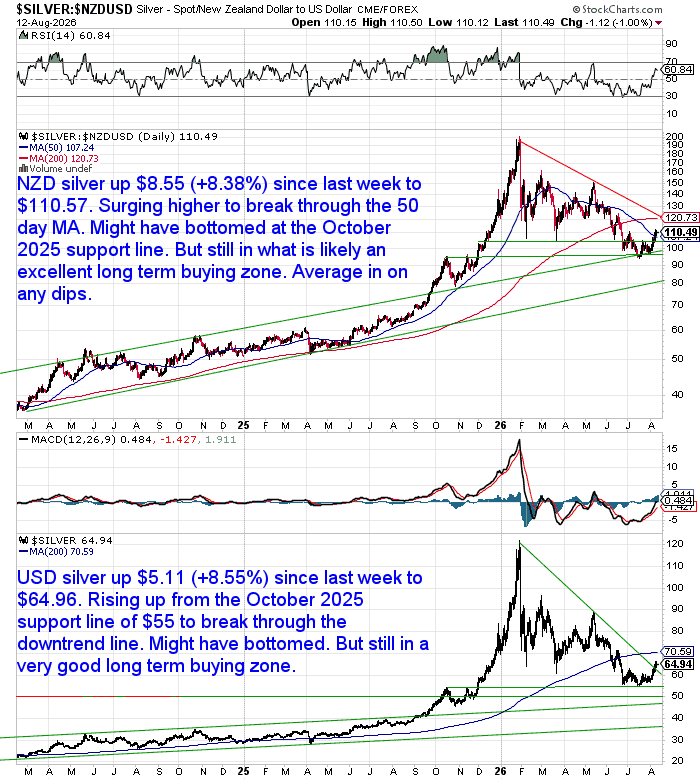
⚪ NZD silver rose $8.55 (+8.38%) to $110.57
NZD silver broke through its 50-day moving average after holding long-term support. It remains in an attractive long-term buying zone, with averaging in on dips still looking sensible.
USD silver rose $5.11 (+8.55%) to $64.96
USD silver broke its downtrend after holding support around $55. This strengthens the case that a bottom may be in, while it remains in a good long-term buying zone.
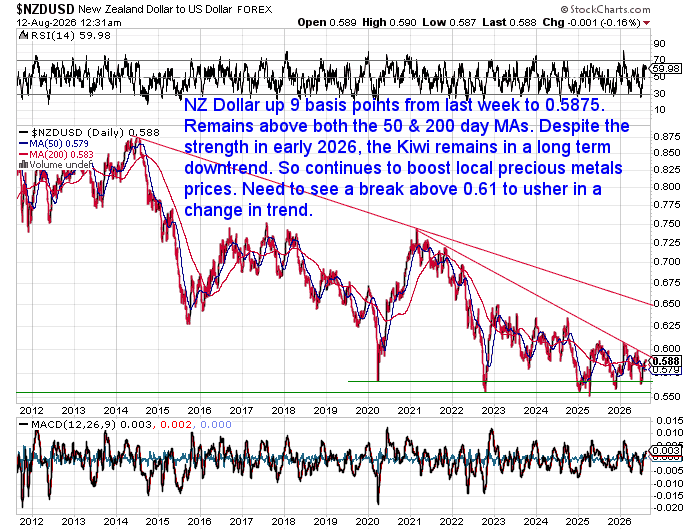
💱 NZD/USD rose 9 basis points (+0.15%) to 0.5875
The Kiwi dollar was little changed and remains within its long-term downtrend. A break above 0.61 is still needed to signal a meaningful change in trend.
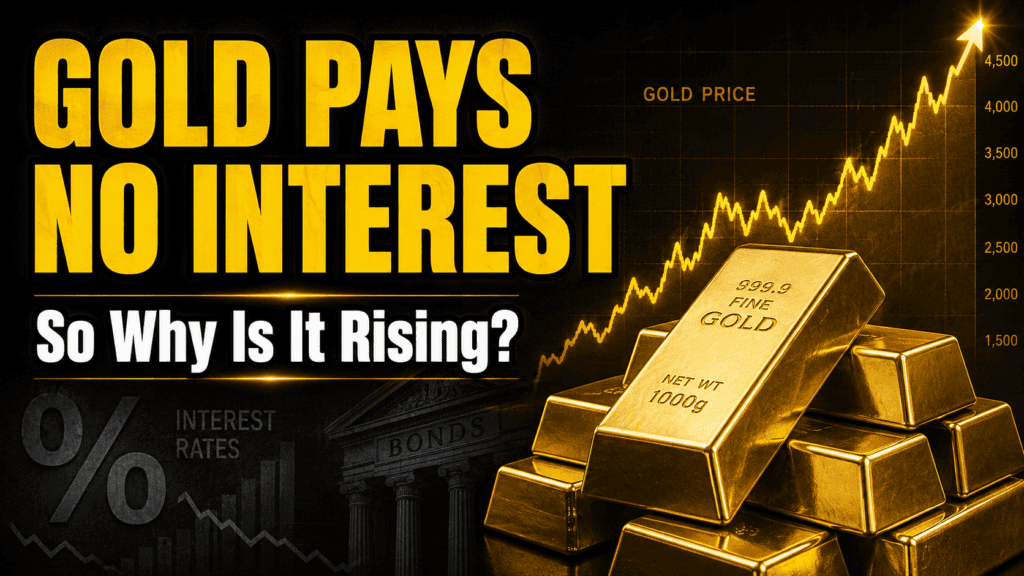
Why Own Gold When It Pays No Interest or Dividends?
Why own gold?
It pays no interest. It produces no income. And unlike shares or property, there is no business or tenant generating a return behind it.
Yet central banks continue to hold and buy it, while investors have used gold to preserve wealth for centuries.
Perhaps the problem is that we’re asking gold to do the wrong job.
We’ve completely rewritten one of our oldest guides to explore why people own gold, its role alongside shares, property and cash, and why the answer can differ for New Zealanders.
We also dig into our own long-term New Zealand data — with a few results that may surprise you.
Read: Why Buy Gold? A New Zealand Guide to Protecting Your Wealth
Gold Pays No Interest. So Why Does It Keep Showing Up Everywhere?
This week’s featured article starts with a simple question:
Why own gold when it pays no interest or dividends?
It’s a fair criticism. Cash can pay interest. Shares can pay dividends. Property can generate rent. Gold just sits there.
Shares, Cash and the Risks We Don’t Always See
One of the main reasons for owning gold is diversification.
But diversification only works when the assets you own don’t all depend on the same things going right.
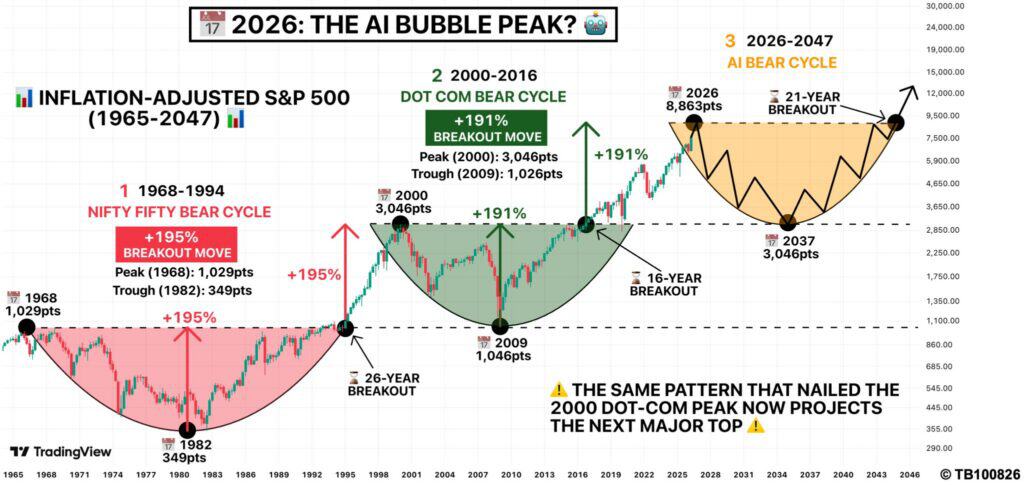
Macro strategist Tom Bradshaw highlighted a highly speculative long-term cycle suggesting the S&P 500 could be approaching the latter stages of its bull market.
We wouldn’t put too much weight on a chart projecting the S&P 500 decades ahead. But it’s a useful reminder that sharemarkets have cycles.
Then there is cash.
Ray Dalio recently told Steven Bartlett on The Diary of a CEO that people often hold cash because it feels safe, while overlooking the purchasing power lost to inflation.
Cash has an important job. It provides liquidity and covers short-term expenses.
But short-term price stability and long-term purchasing-power stability aren’t the same thing.
The latest In Gold We Trust material provides a striking comparison. It says that since 2000, the Indian rupee has lost 96.8% of its value measured in gold.
Perhaps more surprising is the Swiss franc — often considered one of the world’s soundest currencies — which it says has lost 86% against gold over the same period.
Cash and shares perform jobs gold cannot. But that also explains why some investors want an asset that behaves differently from both.
Central Banks Aren’t Asking Whether Gold Pays Interest
The People’s Bank of China reportedly added 20 tonnes of gold in July, its largest monthly purchase since October 2023.
That followed 15 tonnes in June and 10 tonnes in May, marking 21 consecutive months of reported increases.
As we noted last week, central-bank buying has continued even as demand from everyday gold buyers has quietened.
Central banks need reserves that remain liquid and useful in a wide range of circumstances.
Gold also has an unusual characteristic: it isn’t somebody else’s liability.
Government bonds and bank deposits are someone else’s liability. An ounce of physical gold owned outright has no issuer on the other side.
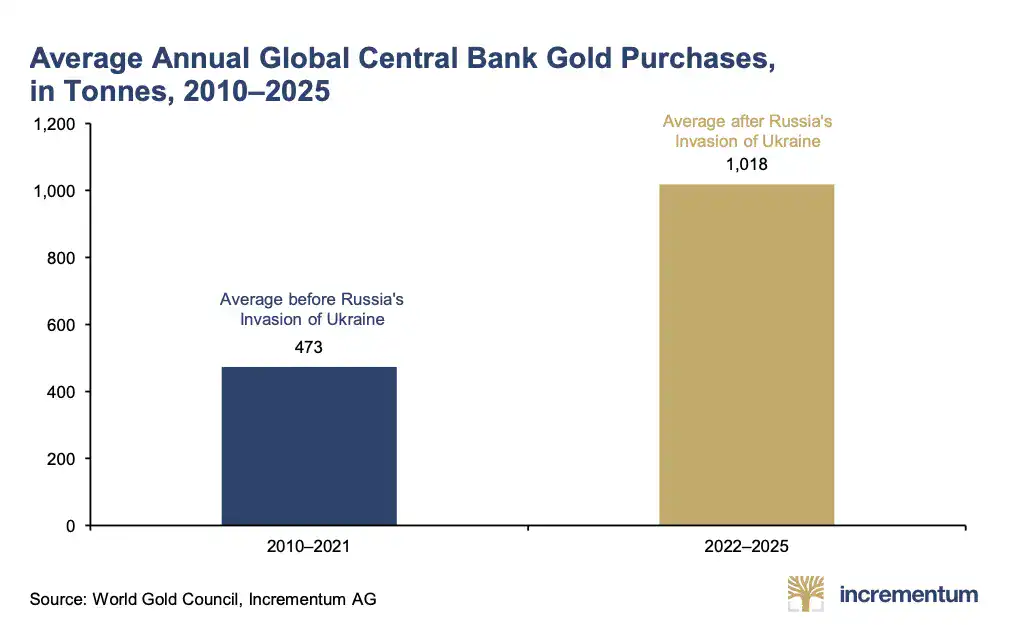
As we noted in this week’s featured article, average annual central-bank gold purchases more than doubled from 473 tonnes in 2010–2021 to 1,018 tonnes between 2022 and 2025.
Currency Intervention Offers Another Clue
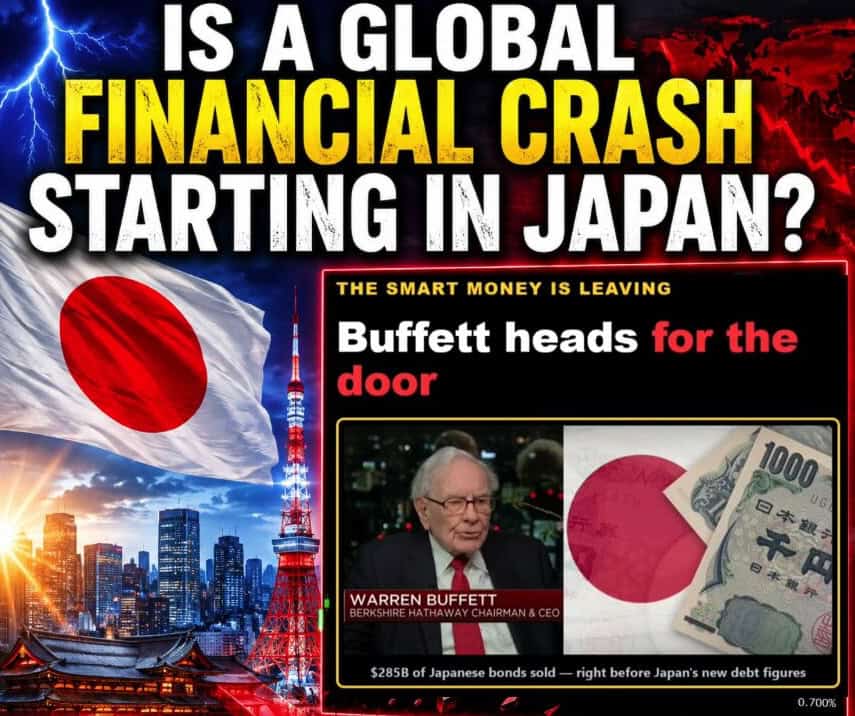
Recent intervention to support the Japanese yen has highlighted the links between currencies, government bonds and central-bank reserves.
Japan is a major holder of US Treasuries. Defending a weak yen can create pressure to sell foreign assets, although policymakers are reportedly looking at alternatives, including greater use of the Federal Reserve’s FIMA Repo Facility.
We wouldn’t take this as evidence that the US dollar is about to lose its reserve-currency status.
But currencies are influenced by interest rates, government borrowing, central-bank policy and sometimes direct intervention.
Gold sits outside those national currency systems.
Source: Brian Byrne
Is Gold Really Just Another Commodity?
Jesse Colombo has highlighted the Goldman Sachs Commodity Index approaching a major resistance area. He believes a break above it could signal the beginning of another major commodities cycle.
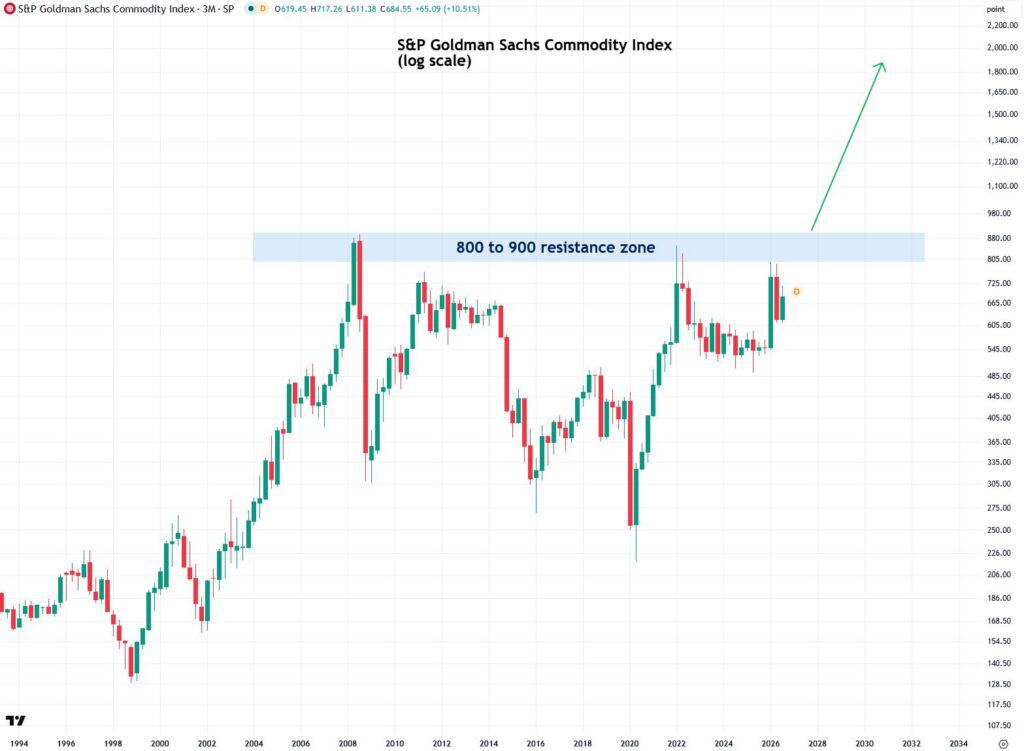
Meanwhile, new World Gold Council research argues that gold can be a more effective portfolio diversifier than a broad commodities allocation.
Oil is burned. Copper is used in buildings, electrical grids and electronics. Agricultural commodities are consumed.
Gold is different. Central banks hold it as reserves and investors hold it as wealth, so its demand is also influenced by currencies, interest rates, monetary policy and financial risk.
So even if another commodity cycle is beginning, gold can still perform a different job within a portfolio.
Gold Is Rising Despite High Interest Rates
One of the standard arguments against gold is straightforward:
If cash and bonds are paying attractive interest rates, why own something that pays nothing?
Normally, higher real interest rates — interest rates after allowing for inflation — increase the opportunity cost of holding gold.
Yet gold has remained remarkably resilient despite elevated real yields.
Charles-Henry Monchau highlighted what appears to be a technical breakout in gold. While Brandon White noted that gold has been rising even though rates remain high. Meanwhile, BCA Research reportedly believes real yields may have peaked and has shifted from neutral on gold towards recommending accumulation.
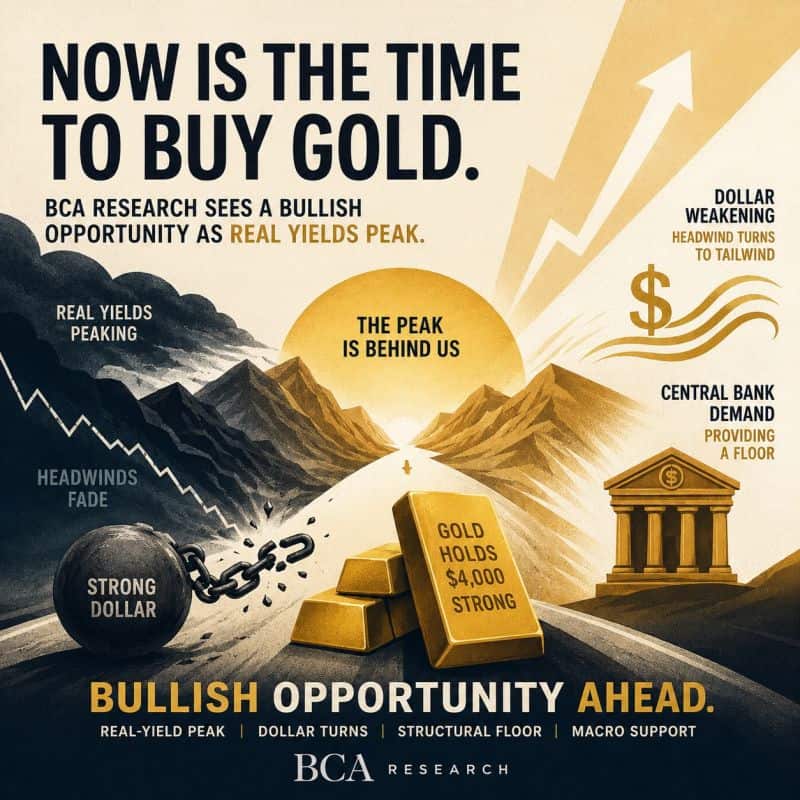
If real yields do begin falling, one of gold’s traditional headwinds would start to weaken.
Some commentators are even speculating that heavily indebted governments could eventually push central banks towards yield curve control to contain borrowing costs.
That’s a much bigger leap, and we’re not there today.
But high government debt and high interest rates leave central banks trying to control inflation without pushing borrowing costs and financial-system pressures too high.
And Finally… Did Rand Paul Audit Fort Knox?
Regular readers may remember we’ve recently been following renewed calls for an audit of America’s gold reserves at Fort Knox.
US Senator Rand Paul has now visited the depository and emerged saying:
“Yes, the gold is there.”
But seeing gold and auditing gold are two different things.
A proper audit involves verifying quantities, records and ownership — not simply seeing gold bars inside a vault.
Paul’s visit confirms there is plenty of gold in Fort Knox. But it doesn’t settle the questions behind calls for a comprehensive independent audit.
Read our previous coverage: Fort Knox Gold Audit: Has America’s Gold Ever Been Properly Audited?
What Does All This Mean for a New Zealander?
Most of this week’s stories come from overseas. But the underlying question is very relevant here.
Most New Zealanders already have considerable exposure to New Zealand through their income, bank deposits, KiwiSaver and property — all largely measured in New Zealand dollars.
Gold adds something different.
Its NZ dollar price reflects both the international gold price and the NZD/USD exchange rate. So NZ gold owners can have a very different experience from the US-dollar charts we usually see.
Gold doesn’t pay interest or dividends. Nor should it replace productive assets such as shares, businesses or property.
Shares bring market risk. Cash brings inflation and currency risk. Bonds bring interest-rate and issuer risk. Property brings concentration and liquidity risks.
Gold brings risks too.
But they’re different risks.
For New Zealanders, perhaps the better question isn’t whether gold is better than all those other assets.
It’s whether owning some wealth outside them — and outside the New Zealand dollar — makes your overall position more resilient.

Glenn's dedication to educating individuals on wealth protection through precious metals has helped over 2400 clients from New Zealand, Australia, USA and Europe to safeguard their financial futures. Passionate about financial independence and lifestyle freedom, Glenn’s mission is to empower others with the knowledge and tools to thrive in today’s volatile economic environment. When he's not advising on precious metals, Glenn enjoys spending time with his family and pursuing outdoor adventures.
Education: University of Auckland Bachelor of Science
Linkedin: https://www.linkedin.com/in/glenn-thomas-0984a4310/
- Why Own Gold When It Pays No Interest or Dividends? - August 12, 2026
- Why Buy Gold? A New Zealand Guide to Protecting Your Wealth - August 11, 2026
- When the Crowd Loses Interest, Who Keeps Buying? - August 5, 2026
