
Storing Gold and Silver
Fort Knox Gold Audit: Has America’s Gold Ever Been Properly Audited?
Jul
Fort Knox has safeguarded much of America’s official gold reserves for almost ninety years. Yet despite its legendary status, one question refuses to disappear:
Has the gold ever been independently audited?
The debate returned to the headlines in July 2026 after U.S. Treasury Secretary Scott Bessent stated that America’s gold was “present and accounted for”.
For many people, that appeared to settle the matter.
For others, it raised a different question.
If America’s gold reserves are so important, how thoroughly have they actually been verified?
The answer is more nuanced than many headlines suggest.
The U.S. Treasury says the gold is securely stored and regularly inspected. However, critics point out that no comprehensive independent audit of every bar has ever been publicly completed.
So what do we actually know about the gold inside Fort Knox — and why has the debate returned now?
Quick Answer
No comprehensive independent audit of every gold bar stored at Fort Knox has ever been made public.
The U.S. Treasury maintains that America’s gold reserves are secure and says regular inspections and accounting procedures confirm they are present and accounted for. However, some economists, investors and politicians argue that a full independent audit — including physical verification, assays and published bar lists — would improve transparency and public confidence.
This article explains what has — and hasn’t — been audited, why the debate has returned, and what it means for investors today.
Fort Knox at a Glance
| Gold stored at Fort Knox | ~147 million troy ounces |
| Official Treasury valuation | US$42.22 per ounce |
| Approximate market value (July 2026) | ~US$1 trillion |
| Independent public audit completed? | No |
Table of contents
- Quick Answer
- Fort Knox at a Glance
- Why Has the Fort Knox Audit Debate Returned?
- Has America’s Gold Ever Been Properly Audited?
- A Brief History of Fort Knox Inspections
- Why Do Some People Still Want a Full Audit?
- What Did Scott Bessent Actually Say About Fort Knox?
- How Much Gold Is Stored at Fort Knox?
- What Does the Fort Knox Debate Mean for Gold Investors?
- Frequently Asked Questions (FAQ)
Estimated reading time: 12 minutes
Why Has the Fort Knox Audit Debate Returned?
For decades, Fort Knox attracted little public attention. Although questions about America’s gold reserves surfaced from time to time, they rarely became part of the mainstream financial conversation.
That changed in 2025 and 2026. America’s gold reserves were back in the spotlight due to:
- Growing government debt,
- record central bank gold buying,
- renewed interest in the role of gold in the international monetary system,
- and discussions around possible gold revaluation
Public attention intensified after President Donald Trump renewed calls for greater transparency around Fort Knox during 2026.
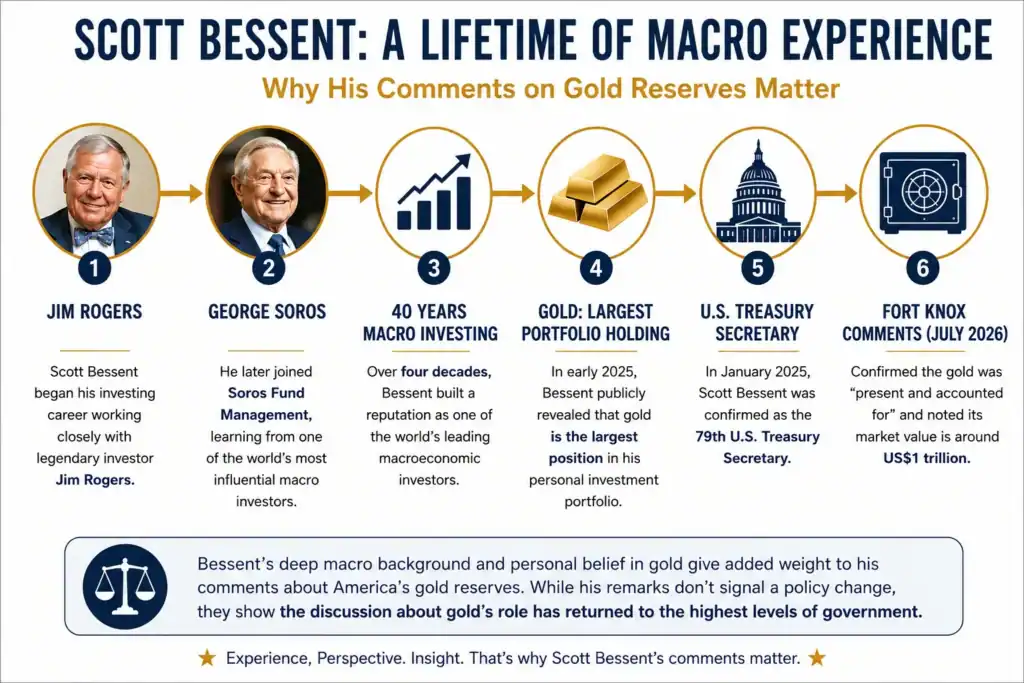
More recently, Treasury Secretary Scott Bessent added fresh momentum to the discussion after publicly stating that America’s gold reserves were “present and accounted for.” His remarks reignited interest in how the nation’s gold reserves are verified and whether existing inspection procedures provide enough transparency.
Why Scott Bessent’s Comments on Fort Knox Matter
Has America’s Gold Ever Been Properly Audited?
The short answer is no—not in the way many people imagine.
America’s gold reserves are subject to regular government oversight, inventory procedures and accounting checks. However, there has never been a single comprehensive, independent public audit in which every gold bar has been physically inspected, weighed, assayed and reconciled against a publicly released inventory.
That distinction helps explain why the debate continues today.
Supporters of the current system argue that regular inspections and internal controls are sufficient to verify the nation’s gold reserves. Critics argue that greater transparency would strengthen public confidence and put decades of speculation to rest.
So what has actually happened over the years?
A Brief History of Fort Knox Inspections
Rather than a single full audit, Fort Knox has undergone a series of inspections and inventory checks over many decades.
| Year | What Happened | Why It Matters |
|---|---|---|
| 1953 | Treasury officials conducted a verification of selected gold and silver bullion holdings following President Eisenhower’s inauguration. | This verified portions of the reserves but was not a comprehensive independent audit of every gold bar. |
| 1974 | Treasury Secretary William Simon invited members of Congress and journalists inside Fort Knox. | First public inspection following years of speculation. |
| 1986–Present | Treasury and U.S. Mint officials conduct continuing inventory and seal verification programmes. | Designed to ensure custody and detect discrepancies over time. |
| 2026 | Treasury Secretary Scott Bessent stated the gold is “present and accounted for.” | Renewed debate about whether existing procedures provide enough transparency. |
In 1953, Treasury officials conducted a verification of selected gold and silver bullion holdings following President Eisenhower’s inauguration. While sometimes cited as evidence that Fort Knox was audited, the Treasury’s own report makes clear this was a verification exercise rather than a comprehensive independent audit of every gold bar. Readers can review the original 1953 Treasury Annual Report via the Federal Reserve Bank of St. Louis’ FRASER archive.
In 1974, Treasury Secretary William Simon invited members of Congress and a small group of journalists inside Fort Knox during a widely publicised inspection. The visit was intended to reassure the public that America’s gold reserves remained secure, but it was not a comprehensive independent audit of every gold bar. The U.S. Mint’s official account of the inspection here.
In 2017 Fort Knox was opened again for a second historic visit by Treasury Secretary Steve Mnuchin, Kentucky Governor Matt Bevin and members of Congress. Like the 1974 inspection, however, this was not a comprehensive independent audit of every gold bar.
The history of America’s gold reserves has been extensively researched over the years. One of the best-known works is Chris Weber’s Good as Gold? How We Lost Our Gold Reserves and Destroyed the Dollar, which explores the history of Fort Knox inspections, audits and U.S. gold policy in greater detail. We also host an archived guest article by Chris Weber discussing many of these historical questions from his perspective.
- Good As Gold?: How We Lost Our Gold Reserves and Destroyed the Dollar
- Chris Weber’s 2011 Perspective on the Fort Knox Gold Debate
Why Do Some People Still Want a Full Audit?
For many observers, the issue isn’t whether the gold exists.
It’s whether the public has enough information to independently verify that it exists exactly as reported.
Some critics have also questioned whether portions of America’s gold reserves could have been leased or swapped over the years. Or whether multiple claims could exist against some gold bars. No public evidence has demonstrated this has occurred. But supporters of a comprehensive audit argue that publishing detailed bar lists and verification records would help answer those questions.
Another point sometimes raised is that much of the gold stored at Fort Knox originated from gold coins collected during the 1933 gold confiscation. Those coins were melted into bars that may not meet today’s London Good Delivery standard. Even if the Treasury’s reported gold holdings are accurate, some observers argue that greater transparency about the composition and purity of the bars would also be valuable.
Supporters argue that these measures would improve transparency and help resolve many of these long-standing questions.
Others believe the existing inspection and accounting procedures are adequate, pointing out that no evidence has emerged suggesting America’s official gold reserves are missing.
As a result, the debate has gradually shifted away from conspiracy theories and towards one of transparency.
The focus of the debate has evolved.
For many years, discussion centred on whether America’s gold reserves were really there.
Today, much of the conversation is about transparency—whether the existing inspection and inventory process is sufficient, or whether a comprehensive independent audit would provide greater public confidence.
What Did Scott Bessent Actually Say About Fort Knox?
Recent attention on Fort Knox intensified after U.S. Treasury Secretary Scott Bessent discussed America’s gold reserves during an interview on Fox News.
During the interview, Bessent confirmed that America’s gold reserves are “present and accounted for.” He also noted that, at current market prices, they are worth around US$1 trillion—making them the largest official gold reserve in the world. That enormous market value received far less attention than his “present and accounted for” comment, yet it highlights the difference between the gold’s current worth and the much lower statutory valuation of US$42.22 per troy ounce still carried on the Treasury’s books. Readers interested in why this matters can explore our guide to Gold Revaluation.
Related reading: Gold Revaluation: Why the Debate Is Heating Up Again.
Bessent also acknowledged that he has not personally visited Fort Knox. However, he said members of his staff had visited the facility and that the U.S. Treasurer had also been there.
Those comments reassured many observers that the Treasury remains confident in the security of America’s gold reserves. However, they did not address the separate question of whether every gold bar has ever been independently audited and publicly verified.
What Would a Full Independent Audit Involve?
Calls for a full independent audit of Fort Knox mean different things to different people. However, most proposals include several common elements designed to independently verify both the quantity and authenticity of America’s gold reserves.
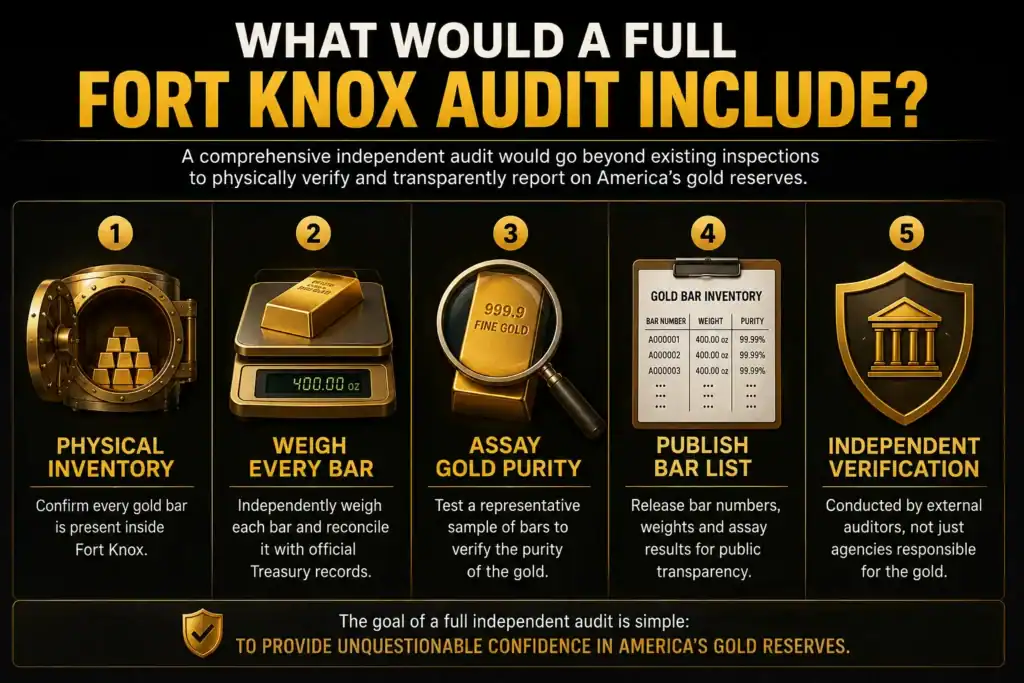
A comprehensive audit would typically involve:
- A full physical inventory to confirm every gold bar is present.
- Weighing each bar and reconciling it with official Treasury records.
- Assaying a representative sample to verify the purity of the gold.
- Publishing bar lists, including serial numbers and weights, to allow independent verification.
- Independent oversight by external auditors rather than relying solely on government agencies responsible for safeguarding the gold.
Supporters argue that these steps would improve transparency and help strengthen public confidence in one of America’s most important financial assets.
Critics, however, question whether the cost and logistical challenges of such an exercise would produce meaningful new information, given the Treasury’s long-standing inventory and inspection procedures.
Ultimately, the debate is less about whether audits are possible and more about what level of public verification is appropriate for a national asset of this significance.
How Much Gold Is Stored at Fort Knox?
According to the U.S. Mint, Fort Knox stores approximately 147 million troy ounces of gold, making it the largest single repository of the United States’ official gold reserves. [Source: US Mint].
However, Fort Knox does not hold all of America’s official gold reserves. Additional gold is stored at the United States Bullion Depository at West Point and the Denver Mint, while the Federal Reserve Bank of New York also safeguards gold on behalf of the U.S. government and foreign central banks.
The chart below shows how official U.S. Mint-held gold reserves are distributed between Fort Knox, West Point, Denver and working stock.
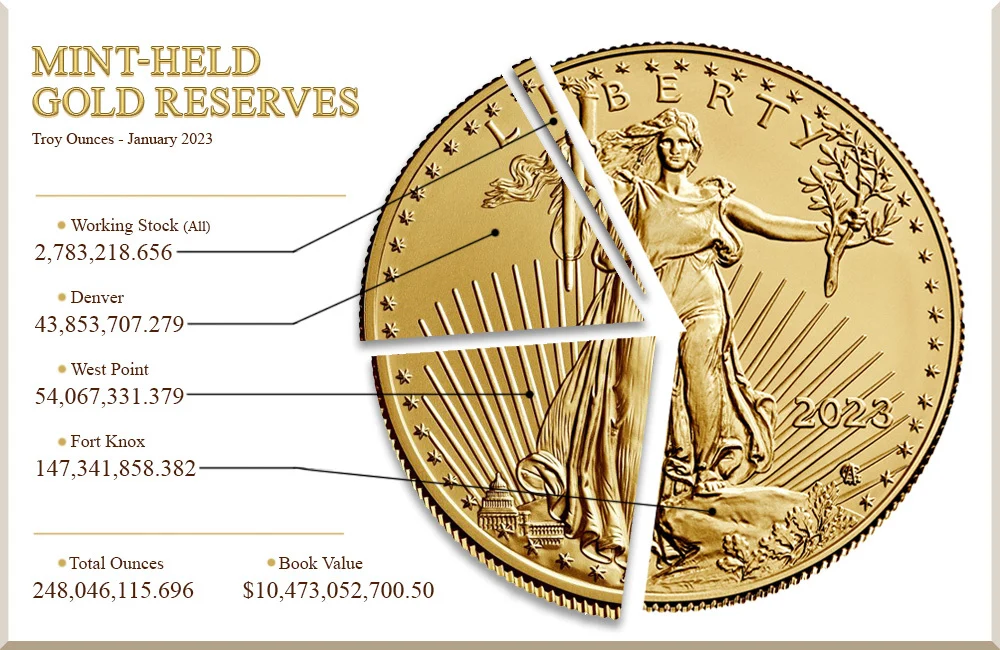
At current market prices, the gold stored at Fort Knox alone is worth hundreds of billions of dollars, while America’s total official gold reserves are worth around US$1 trillion.
Any future comprehensive audit of America’s official gold reserves would likely need to consider all official U.S. gold storage locations, rather than Fort Knox alone, to provide a complete picture of the nation’s gold holdings.
What Does the Fort Knox Debate Mean for Gold Investors?
Whether or not a comprehensive independent audit of Fort Knox ever takes place, the renewed attention on America’s gold reserves highlights a broader point: governments still regard physical gold as an important monetary asset.
Gold no longer backs the U.S. dollar in the way it once did, yet central banks around the world continue to hold thousands of tonnes of gold and, in recent years, have been adding to their reserves. That alone is a reminder that gold still plays a unique role in the international monetary system.
For individual investors, the Fort Knox debate is less about trying to prove or disprove what is inside one vault. It is an opportunity to better understand why governments continue to hold gold, why transparency around official reserves matters, and why discussions about gold’s role in the financial system continue to resurface.
At Gold Survival Guide, we’ve long argued that gold should be viewed first as wealth insurance and second as an investment. The headlines surrounding Fort Knox may come and go, but the reasons many people choose to own physical gold—wealth preservation, diversification and reducing counterparty risk—remain the same.
Whether future governments decide to increase transparency, conduct a comprehensive independent audit or simply continue with the existing inspection process, the debate itself serves as a reminder that gold remains strategically important.
For investors, that’s perhaps the most significant takeaway of all.
Frequently Asked Questions (FAQ)
No. While the U.S. Treasury says America’s gold reserves are regularly inspected and accounted for, no comprehensive independent public audit has been conducted in which every gold bar has been physically verified, weighed, assayed and reconciled against a publicly released inventory.
According to the U.S. Mint, Fort Knox stores approximately 147 million troy ounces of gold. It is the largest of the United States’ official gold depositories, although additional gold is also held at West Point and the Denver Mint.
Although gold trades at current market prices, the U.S. Treasury continues to value its gold reserves at the statutory price of US$42.22 per troy ounce for accounting purposes. This difference has led to renewed discussion about the possibility of a future gold revaluation.
Supporters of a full audit argue that independently verifying every gold bar, publishing bar lists and confirming the purity of the reserves would improve transparency and public confidence. Others believe the Treasury’s existing inspection and inventory procedures are sufficient and point out that no evidence has emerged showing the gold is missing.
The gold stored at Fort Knox is owned by the United States government and forms part of the nation’s official gold reserves. It is held by the U.S. Department of the Treasury through the United States Mint.
Further Reading
- Gold Revaluation: Why the Debate Is Heating Up Again
- A New Gold Standard or a Free Market For Money?
- Could Gold Confiscation Happen Again?
- Become Your Own Central Bank: Why Central Banks Keep Buying Gold
Editor’s Note: Originally published on 4 March 2025. This article was comprehensively updated on 27 July 2026 to reflect the latest developments, including Treasury Secretary Scott Bessent’s comments, additional historical research and expanded educational content.

Glenn's dedication to educating individuals on wealth protection through precious metals has helped over 2400 clients from New Zealand, Australia, USA and Europe to safeguard their financial futures. Passionate about financial independence and lifestyle freedom, Glenn’s mission is to empower others with the knowledge and tools to thrive in today’s volatile economic environment. When he's not advising on precious metals, Glenn enjoys spending time with his family and pursuing outdoor adventures.
Education: University of Auckland Bachelor of Science
Linkedin: https://www.linkedin.com/in/glenn-thomas-0984a4310/
- What Are The Different Types of Gold Bars? - October 13, 2026
- Should I Buy Gold Now or Wait? (2026 NZ Update) - October 12, 2026
- Trump Says Inflation Can Reduce US Debt “Very Rapidly” — What Does It Mean for Gold? - October 7, 2026

Great artical to the Fort Knox reserves
Thanks for reading Paul.It is amazing to see some of these things that have been discussed in the gold community for a long time potentially starting to happen.