
Gold
Should I Buy Gold Now or Wait? (2026 NZ Update)

Oct
Is now a good time to buy gold in New Zealand, or should you wait for prices to fall further?
After reaching record highs earlier in 2026, gold has undergone a substantial correction. Prices are well below their peak, but further falls remain possible.
We’ve also seen a sharp fall in retail buying activity during this correction. Based on our experience in the New Zealand precious-metals market, that could be a useful contrarian signal.
Quick Answer: Is Now a Good Time to Buy Gold in New Zealand?
If you’re buying gold for long-term wealth protection, buying some now may make more sense than waiting indefinitely for the perfect price. Gold has already experienced a substantial correction in 2026, although further falls remain possible.
If you’re concerned about buying too early, consider spreading your purchases over time rather than committing everything at once.
For those who already own a substantial amount of gold, waiting may be more appropriate.
The best approach depends on your existing holdings, your financial circumstances and why you want to own gold.
Table of contents
- Quick Answer: Is Now a Good Time to Buy Gold in New Zealand?
- What’s Happening With Gold Prices in New Zealand in October 2026?
- Should You Buy Gold Now or Wait for a Lower Price?
- What Could Push Gold Prices Higher or Lower From Here?
- What Are New Zealand Gold Buyers Doing During the 2026 Correction?
- How to Decide Whether to Buy Gold Now
- Frequently Asked Questions
- Final Thoughts: Buying Gold Without Predicting the Bottom
Estimated reading time: 10 minutes
What’s Happening With Gold Prices in New Zealand in October 2026?
Gold has experienced a much deeper and longer correction in 2026 than the brief pullback we saw towards the end of 2025.
After reaching a peak above NZ$9,000 an ounce earlier this year, the NZ dollar gold price fell sharply. It has since spent several months moving between recovery attempts and renewed selling.
As of 12 October 2026, gold is trading around NZ$7,490 an ounce.
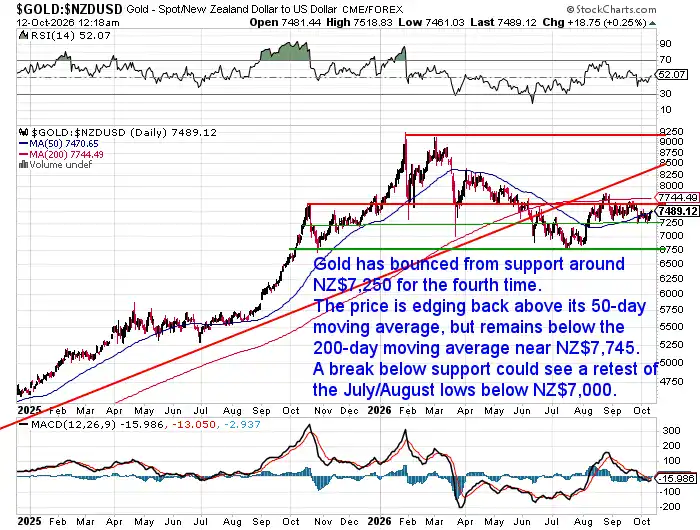
The NZ$7,250 area has provided support several times during the correction. Gold is now just above its 50-day moving average of NZ$7,471, but remains below its 200-day moving average near NZ$7,745.
If support at NZ$7,250 fails, gold could revisit its July/August lows below NZ$7,000. A sustained move above the 200-day moving average would provide stronger evidence of a recovery.
The Weak New Zealand Dollar Is Supporting Local Gold Prices
Gold is priced internationally in US dollars. When the Kiwi dollar weakens, it takes more NZ dollars to buy each US dollar. This can support the local gold price even when the international price falls.
On 12 October 2026, the NZD/USD exchange rate is around US$0.561, near its recent lows.
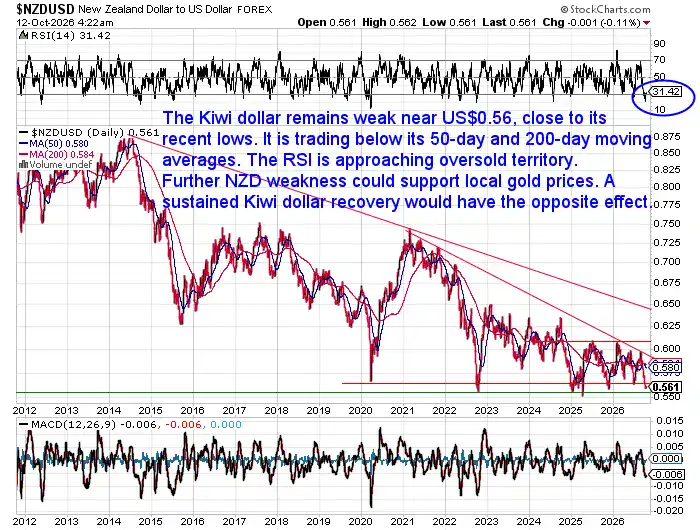
The Kiwi dollar remains below its 50-day and 200-day moving averages.
A stronger NZ dollar could lower the local gold price even if the US dollar gold price stays unchanged. Further NZD weakness could have the opposite effect.
See our analysis of how a strong NZ dollar affects gold and silver prices in New Zealand.
Should You Buy Gold Now or Wait for a Lower Price?
Gold could revisit its recent lows, or recover before those waiting for a lower price decide to buy.
Your decision depends on why you’re buying, how much gold you already own and whether you could comfortably hold through further falls.
The Case for Buying Gold Now
If you’re buying physical gold as long-term wealth insurance, the exact purchase price may be less important than establishing a holding.
Gold is an asset you can own outside the banking system. For many New Zealanders, its main purpose is to help preserve purchasing power and provide protection against financial or monetary instability.
For more on gold’s role in protecting wealth, see Why Gold Bullion Is Your Financial Insurance.
Buying after a correction also means paying less per ounce than someone who bought near the recent highs. That doesn’t guarantee a good entry price, but it may be more appealing than buying after a sharp rally.
There is also the risk of waiting too long. Gold can recover quickly, and buyers hoping for one more dip may find themselves facing higher prices instead.
The Case for Waiting
There are reasonable arguments for waiting, particularly if you already own a meaningful amount of gold.
The current correction may not be over. Gold could retest its recent lows or fall further, especially if investment demand weakens, real interest rates rise or the NZ dollar strengthens.
Waiting may also make sense if you’re uncomfortable with short-term price swings or would struggle financially if the money you’ve invested was needed elsewhere.
Physical gold also has a spread between the buying and selling price. If you might need to sell soon, a modest rise in the spot price may not be enough to cover that spread.
Buying in Stages Instead of Trying to Pick the Bottom
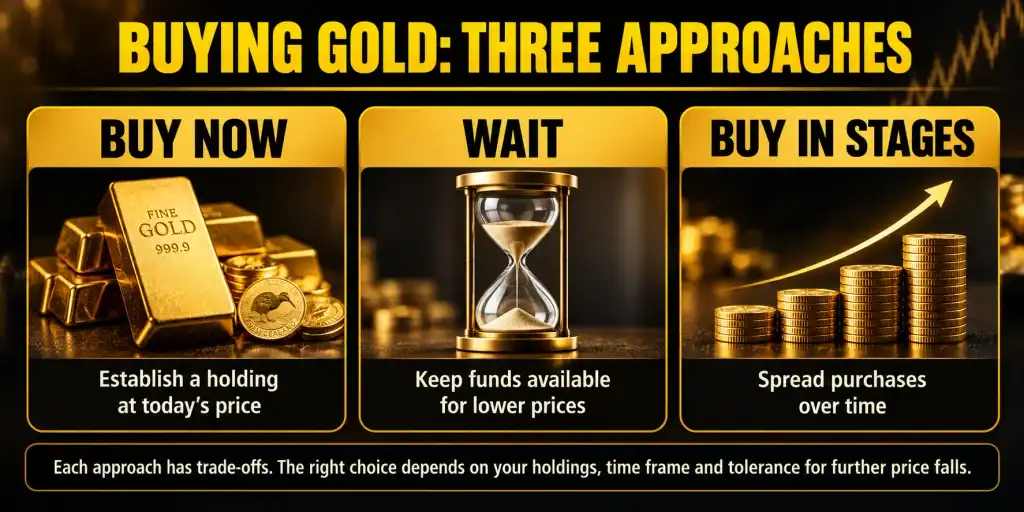
Rather than buying your entire planned holding at once, you could divide it into several purchases. For example, you might buy an initial amount now, keep some funds available for further price falls and add more later.
This approach means you won’t get the lowest possible price on every purchase. But it also reduces the risk of committing everything just before another sharp fall.
You can buy at regular intervals, set price levels at which you’ll add to your holding, or use a combination of both.
There are practical costs to consider. Smaller bullion purchases can carry higher premiums, and delivery costs may add up. For some buyers, fewer purchases of larger amounts will be more economical.
For a broader look at purchase timing and different buying strategies, see our guide: When Should You Buy Gold or Silver?
What Could Push Gold Prices Higher or Lower From Here?
Central Banks Continue to Buy Gold
According to the World Gold Council, central banks added a net 39 tonnes to their reserves in August 2026. China accounted for around 20 tonnes, its largest monthly addition since October 2023.
China reportedly bought another 21 tonnes in September, extending its buying streak to 23 consecutive months (Source: Kitco).
Central banks buy gold to diversify their reserves and reduce reliance on foreign currencies and government debt.
However, some central banks have sold gold this year. Continued buying by others may support prices over the longer term, but it hasn’t prevented the current correction.
Interest Rates and Investment Demand
Gold pays no interest. When inflation-adjusted interest rates rise, cash and bonds can become more attractive by comparison.
Falling real rates can favour gold, although the relationship isn’t always consistent. Concerns about debt, currencies or financial stability can also influence demand.
For a New Zealand perspective, see our research on real interest rates and when to buy gold.
Economic and Monetary Uncertainty
High government debt, inflation concerns and geopolitical tensions can increase demand for gold as protection against financial and monetary instability.
But gold doesn’t always rise during periods of uncertainty. In a sharp market sell-off, investors may sell gold to raise cash or cover losses elsewhere.
Gold can also begin rising before an economic crisis becomes obvious. Waiting for a recession or financial shock to confirm the need for protection may mean buying at a higher price.
Does Gold Seasonality Offer Any Clues?
Gold has shown seasonal patterns over long periods, with some months historically stronger than others. But these patterns vary from year to year and can be overwhelmed by interest rates, currency movements and investor demand.
See our research on gold seasonality in New Zealand dollars.
What Are New Zealand Gold Buyers Doing During the 2026 Correction?
When gold first fell sharply earlier in 2026, we saw considerable buying interest. But as the correction continued, transaction numbers steadily declined.
They’re now well below the busy period at the start of the year, and below the more typical levels we’ve seen over the previous couple of years.
Fewer Retail Buyers, But Some Larger Purchases
Despite the fall in transaction numbers, some wealthier customers have continued buying larger amounts of gold and silver, particularly over the past couple of months.
Fewer transactions don’t necessarily mean the total value of purchases has fallen by the same amount.
Could Weak Buying Interest Be a Contrarian Signal?
Based on our experience in the New Zealand precious-metals market, unusually weak retail buying has often been a useful contrarian signal near potential turning points.
When gold prices have been falling for some time, many potential buyers appear reluctant to buy. Our interpretation is that they’re waiting for even lower prices.
We’ve also seen the opposite: unusually strong buying interest after a substantial rally can sometimes precede a correction.
Neither pattern reliably identifies the exact top or bottom. Gold could still revisit its July/August lows below NZ$7,000, but the sharp decline in retail transactions may be a useful signal if prices approach those lows again.
How to Decide Whether to Buy Gold Now
Rather than trying to predict the next move in gold, start with your own circumstances.
| Your situation | An approach to consider |
|---|---|
| You own no gold and want long-term wealth protection | Consider establishing an initial holding rather than waiting indefinitely for the perfect price. |
| You already own gold and want to increase your holding | Consider adding in stages or setting price levels for future purchases. |
| You expect further falls but don’t want to miss a recovery | Divide your planned purchase so you’re not relying on a single entry price. |
| You may need the money in the near future | Consider whether gold’s price swings and buying/selling spread make it suitable for that money. |
Consider how much gold you want to hold, how long you expect to own it and whether further price falls would affect your peace of mind.
The aim is to own an amount you’re comfortable holding through both rallies and corrections — what we’ve previously called your “Sleep Soundly at Night” level.
Frequently Asked Questions
Not necessarily. A correction means gold is cheaper than it was at its recent highs, but prices could still fall further.
For long-term buyers, a substantial correction may offer an opportunity to establish or increase a holding at a lower price.
However, a lower price alone isn’t a reason to buy. Consider how much gold you already own, why you’re buying it and whether you could comfortably hold through further falls.
Waiting may make sense if you already own plenty of gold or believe the correction has further to run.
But gold could recover before reaching your target. Buying in stages is one way to keep some funds available for further falls without waiting to make your entire purchase.
The market value of your gold will fall, but you’ll still own the same amount of physical metal.
If you’re holding gold for long-term wealth protection, a short-term decline may be less significant than it would be for someone planning to sell soon.
Remember that physical bullion also has a difference between its buying and selling price. You may need more than a small recovery in the spot price to break even on a sale.
Buying all at once may work well if prices rise afterwards. But it also exposes your entire purchase to any immediate fall.
Buying in stages spreads your entry points over time. It won’t guarantee a lower average price, but it reduces your reliance on getting the timing right on one particular day.
For physical bullion, remember that multiple smaller purchases can mean higher premiums and delivery costs.
Final Thoughts: Buying Gold Without Predicting the Bottom
Gold’s 2026 correction has given New Zealand buyers an opportunity to purchase well below the earlier highs. But prices could still fall further.
Our experience suggests unusually weak retail buying can be a useful contrarian signal near potential turning points. However, that alone isn’t a reason to buy.
If you’re buying gold for long-term wealth protection, choose an approach that suits your circumstances. That could mean buying now, waiting or spreading your purchases over time.
Learn More About Buying Gold in New Zealand
If you’ve decided to buy gold, these guides can help with the next steps:
- Should I Buy Gold or Silver? — Compare the two metals to decide which better suits your goals.
- What Type of Gold Bar Should I Buy? — Compare gold bar sizes and options available to New Zealand buyers.
- Gold and Silver Coins vs Bars — Understand the differences in premiums, flexibility, storage and resale.
Editor’s note: this blog post was published in August 2018. Fully updated 12 October 2026.

Glenn's dedication to educating individuals on wealth protection through precious metals has helped over 2400 clients from New Zealand, Australia, USA and Europe to safeguard their financial futures. Passionate about financial independence and lifestyle freedom, Glenn’s mission is to empower others with the knowledge and tools to thrive in today’s volatile economic environment. When he's not advising on precious metals, Glenn enjoys spending time with his family and pursuing outdoor adventures.
Education: University of Auckland Bachelor of Science
Linkedin: https://www.linkedin.com/in/glenn-thomas-0984a4310/
- What Are The Different Types of Gold Bars? - October 13, 2026
- Should I Buy Gold Now or Wait? (2026 NZ Update) - October 12, 2026
- Trump Says Inflation Can Reduce US Debt “Very Rapidly” — What Does It Mean for Gold? - October 7, 2026

Hi, Are the gold coin prices you advertise include gst?
Regards Thomas.
The gold coins we sell do not have GST on them as they are 99.9% or 99.99% pure.
See this post for more: https://goldsurvivalguide.co.nz/gold-purity-silver-purity/#h-gst-on-gold-and-silver-in-new-zealand-depends-on-the-purity
It’s important to be aware that some very well known coins are not GST exempt in New Zealand due to their purity being less than 99.5% pure gold.
So when these types of coins are purchased in New Zealand they will cost 15% more than other gold bullion coins that are 99.99% pure. Because GST is added to the sale price.
For example:
The South African Krugerrand – 22 Carat or 91.67% Pure
The American Gold Eagle – 22 Carat or 91.67% Pure
The British Gold Sovereign – 22 Carat or 91.67% Pure