
If you’ve spent time around precious metals markets, you’ve probably heard investors talk about “gold seasonality”.
The idea is simple:
At certain times of the year, gold prices have historically tended to perform better than others.
But does this seasonal pattern also apply to the New Zealand dollar gold price?
That question matters for Kiwi investors because the local gold price is influenced by two moving parts:
- the international gold price in US dollars,
- and the NZD/USD exchange rate.
As a result, gold seasonality in New Zealand can behave differently from gold seasonality in the United States.
In this guide, we’ll look at:
- what gold seasonality actually is,
- why it happens,
- whether it affects NZ dollar gold prices,
- how silver compares,
- and how investors can use seasonal trends alongside broader market conditions.
Table of Contents
- What is Gold Seasonality?
- Why Does Gold Show Seasonal Patterns?
- What Does Gold Seasonality Look Like in USD Terms?
- Why NZ Dollar Gold Prices Behave Differently
- Does Gold Seasonality Affect the NZ Dollar Gold Price?
- What the Historical Data Suggests
- Does Silver Show Seasonal Patterns Too?
- Why Waiting Until Next Year Can Be Risky
- How Investors Can Use Gold Seasonality
- Frequently Asked Questions
- Final Thoughts
Estimated reading time: 9 minutes
What is Gold Seasonality?
Gold seasonality refers to recurring periods during the year when gold prices have historically tended to strengthen or weaken.
Historically, gold has often:
- softened during the northern hemisphere summer months,
- then strengthened from around July or August into the end of the year.
This pattern is not guaranteed.
But it has appeared often enough over long periods that many investors and traders pay attention to it.
Importantly, seasonality is not unique to gold.
Many financial markets display recurring seasonal behaviour due to:
- investor psychology,
- institutional trading patterns,
- cultural buying cycles,
- and shifts in liquidity throughout the year.
Gold simply happens to have some particularly well-known seasonal tendencies.
Why Does Gold Show Seasonal Patterns?
Several factors may contribute to gold’s seasonal behaviour.
1. Indian Gold Demand
India is one of the world’s largest gold-consuming nations.
Gold demand in India often rises sharply ahead of:
- the wedding season,
- Diwali,
- and other cultural festivals.
This increased physical demand can help support gold prices during the second half of the year.
2. Chinese New Year Demand
Gold buying also tends to increase ahead of Chinese New Year celebrations.
This can further boost physical demand during late-year and early-year periods.
3. Institutional Trading Cycles
Trading activity in financial markets often slows during the northern hemisphere summer.
This is where the old sharemarket saying comes from:
“Sell in May and go away.”
Lower trading activity during mid-year can sometimes contribute to weaker momentum in precious metals markets.
4. Investor Psychology and Momentum
Once seasonal trends become widely watched, they can sometimes become partially self-fulfilling.
Investors anticipating stronger late-year performance may begin buying earlier, reinforcing momentum.
However, seasonality should never be viewed as a guarantee.
Macro events, interest rates, currency movements, central bank policy, and financial crises can all override seasonal patterns.
What Does Gold Seasonality Look Like in USD Terms?
Historically, gold priced in US dollars has often shown:
| Period | Typical Historical Tendency |
|---|---|
| May–July | Weaker or sideways |
| July/August–December | Stronger |
| September–November | Often among the strongest periods |
Again, these are historical tendencies — not rules.
Some years completely ignore seasonal patterns.
But over long periods, the second half of the year has often been stronger for gold than the first half.
That raises an important question for New Zealand investors:
Does the same pattern hold true in NZ dollars?
Why NZ Dollar Gold Prices Behave Differently
New Zealand investors also need to understand that the local gold price is influenced not only by the international gold market, but also by movements in the NZ dollar exchange rate.
This is why NZD gold prices can sometimes rise even when the US dollar gold price is flat — or vice versa.
In simple terms:
NZD Gold Price = USD Gold Price × NZD/USD Exchange Rate
For example:
- A falling NZ dollar can push local gold prices higher
- A rising NZ dollar can offset gains in the USD gold price
- Global crises often strengthen gold while weakening smaller currencies like the NZD
This is why NZ investors should focus on the NZ dollar gold price rather than only watching the US dollar gold price.
Does Gold Seasonality Affect the NZ Dollar Gold Price?
To test whether seasonality also affects NZ dollar gold prices, we analysed the historical performance of gold from the July/August period through to the end of each year.
The results are surprisingly strong.
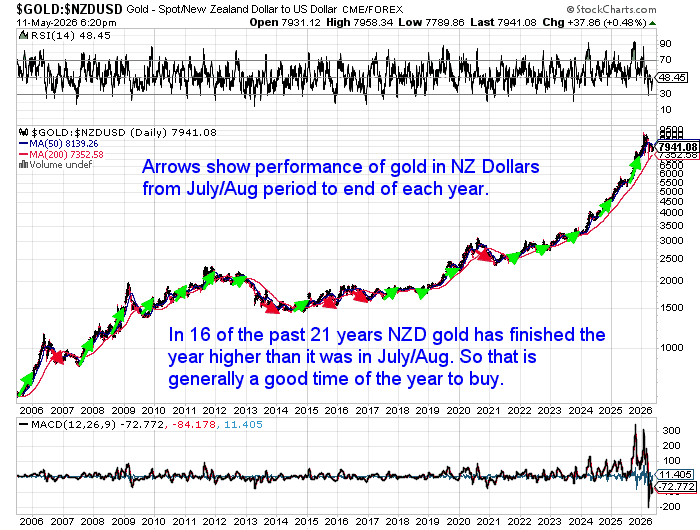
Over the past 21 years:
- NZ dollar gold finished the year higher than its July/August level in 16 out of 21 years.
- The strongest gains often occurred after mid-year corrections.
- Only a minority of years saw weaker second-half performance.
That suggests seasonality has historically remained relatively strong even after accounting for NZ dollar currency movements.
However, it is important to understand:
seasonality is probabilistic, not predictive.
It improves odds historically.
But it does not guarantee outcomes.
What the Historical Data Suggests
Looking at the long-term NZ dollar gold chart, several themes stand out.
1. Mid-Year Weakness Has Often Created Opportunity
Gold has frequently experienced:
- corrections,
- consolidations,
- or weaker momentum during mid-year periods.
Historically, these phases have often been followed by stronger second-half performance.
2. Currency Movements Matter
Some years saw NZD gold outperform USD gold due to NZ dollar weakness.
In other years, NZ dollar strength reduced gains.
This is why Kiwi investors should never look only at the US dollar gold chart.
3. Major Macro Events Can Override Seasonality
Financial crises, interest rate shocks, geopolitical instability, and central bank policy can dominate seasonal tendencies.
For example:
- 2008,
- 2020,
- and the inflation surge of 2022–2024
all created unusually volatile market conditions.
Seasonality still existed — but broader macro forces became far more important.
Does Silver Show Seasonal Patterns Too?
Silver also appears to show seasonal tendencies.
However, silver’s behaviour is generally:
- more volatile,
- less consistent,
- and more heavily influenced by industrial demand.
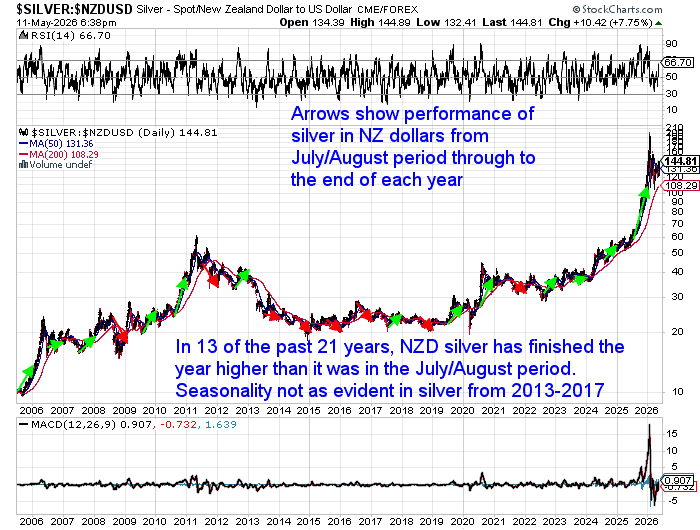
Over the past 21 years:
- NZ dollar silver finished the year higher from July/August to December in 13 out of 21 years.
That is still positive — but noticeably weaker than gold’s historical pattern.
Silver’s price movements also tend to be larger.
When silver rises, it often rises faster than gold.
But the reverse is also true during corrections.
This makes silver seasonality less reliable, but potentially more powerful during strong bull markets.
The “Holiday Dip” Effect
Another seasonal tendency we have observed over the years is the so-called “holiday dip” effect.
During the low-volume Christmas and New Year period, gold and silver prices sometimes experience temporary pullbacks.
Thin trading conditions, year-end profit taking, and reduced institutional participation can occasionally create short-term weakness near year-end.
Historically, this has often created attractive accumulation opportunities for long-term investors.
However, this pattern is not guaranteed — especially during strong bull markets where momentum remains powerful into year-end.
Why Waiting Until Next Year Can Be Risky
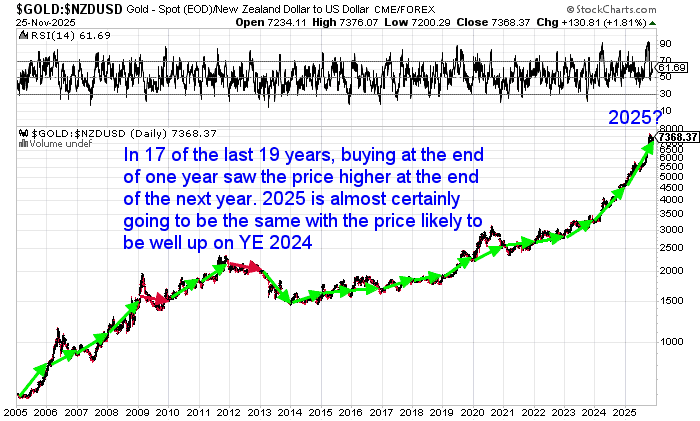
While investors often wait for a “better entry point next year”, historical NZ dollar gold price trends suggest that delaying purchases can sometimes backfire.
Looking at year-end NZD gold prices over the past two decades, gold has frequently finished the following year higher than where it ended the previous year.
In other words:
waiting for a cheaper future price has often left investors paying even more later.
Summary: What to Watch For
| Month | Gold Seasonality (USD) | NZD Effect | Smart Move |
|---|---|---|---|
| March-April | Often lower | Neutral | Buy the dip |
| June | Common dip | Depends on NZD | Good entry month |
| Dec | Holiday volume dip | Watch NZD | Top-up opportunity |
| Jan | Often rallies | Stronger NZD may help | Be ready before Jan |
Strategy Tip: Use this seasonal knowledge to plan your buying schedule in advance — especially if you’re dollar-cost averaging or looking to rebalance.
How Investors Can Use Gold Seasonality
Long-term investors sometimes use seasonality as one factor within a broader strategy.
For example, some investors may:
- gradually accumulate during weaker mid-year periods,
- layer purchases over time,
- or combine seasonal analysis with market sentiment and technical levels.
However, relying solely on seasonality is risky.
Gold prices are influenced by many larger forces, including:
- inflation,
- interest rates,
- currency markets,
- central bank buying,
- debt levels,
- and financial system risk.
Seasonality works best as:
a supporting indicator — not a standalone strategy.
For many investors, a consistent long-term accumulation approach remains more important than trying to perfectly time the market.
Frequently Asked Questions
No.
Gold seasonality reflects historical tendencies, not guarantees.
There have been multiple years where gold weakened during the second half of the year.
Historically, weaker periods have often occurred during the northern hemisphere summer months.
But market conditions vary significantly from year to year.
Historically, yes — although currency movements can alter the pattern.
Over the past 21 years, NZ dollar gold prices have often strengthened from July/August into December.
Yes, although silver’s seasonality has historically been less consistent than gold’s.
Silver is generally more volatile due to its industrial demand component.
Absolutely.
The NZ dollar exchange rate can significantly affect local gold prices.
A falling NZ dollar can boost NZD gold prices even if USD gold is flat.
No.
Seasonality should be viewed as one factor among many.
Long-term fundamentals and broader economic conditions matter far more.
Final Thoughts
Gold seasonality appears to exist not only in US dollar gold prices, but also in New Zealand dollar gold prices.
Historically, NZD gold has often performed well during the second half of the year — even after accounting for currency fluctuations.
However, seasonality is not a prediction tool.
It is simply one historical tendency within a much larger and more complex market.
For New Zealand investors, understanding both:
- gold itself,
- and the NZ dollar exchange rate
is critical when evaluating precious metals markets.
For a complete guide to timing gold and silver purchases, see:
“When Should You Buy Gold or Silver?”
Read more:
- [Should I Buy Gold Now or Wait?]
- [Gold vs Silver: Which Is Better?]
- [Live NZ Gold and Silver Price Charts]
If you’d like a buy gold or buy silver head over to our online bullion shop. Or simply give us a call on 0800 888 465 (+64 9 281 3898 outside NZ). We’re always happy to have a chat about precious metals markets.
(Editors Note: This article was first published in August 2014. Fully updated 12 May 2026).

Glenn's dedication to educating individuals on wealth protection through precious metals has helped over 2400 clients from New Zealand, Australia, USA and Europe to safeguard their financial futures. Passionate about financial independence and lifestyle freedom, Glenn’s mission is to empower others with the knowledge and tools to thrive in today’s volatile economic environment. When he's not advising on precious metals, Glenn enjoys spending time with his family and pursuing outdoor adventures.
Education: University of Auckland Bachelor of Science
Linkedin: https://www.linkedin.com/in/glenn-thomas-0984a4310/
- Physical Gold vs Paper Gold – Which Should You Own? - August 18, 2026
- Why Own Gold When It Pays No Interest or Dividends? - August 12, 2026
- Why Buy Gold? A New Zealand Guide to Protecting Your Wealth - August 11, 2026
