
Monetary System
Why New Zealand Gold Buyers Should Focus on the NZD Gold Price

Oct
If you follow gold prices in the news, you’ll often see them quoted in US dollars. That’s true even here in New Zealand.
But the international US dollar gold price is only half the story for Kiwi buyers.
The price of gold in New Zealand also depends on the NZD/USD exchange rate. So gold can rise in US dollars without rising by the same amount in New Zealand dollars. It can even fall in NZD while the international gold price is going up.
Understanding this difference can help you make better decisions when buying, holding or selling physical gold.
Quick Answer: Why Should NZ Buyers Follow the NZD Gold Price?
If you earn, save and spend in New Zealand dollars, the NZD gold price is usually the most useful price to follow.
Two factors determine the local spot price:
The international gold price, usually quoted in US dollars per troy ounce.
The NZD/USD exchange rate, which determines how many US dollars one New Zealand dollar buys.
A weaker Kiwi dollar makes gold more expensive in NZD if the USD gold price stays the same. A stronger Kiwi makes it cheaper.
That doesn’t mean you should completely ignore the US dollar gold price. It means you need to consider both factors together.
Table of contents
- Quick Answer: Why Should NZ Buyers Follow the NZD Gold Price?
- Why the US Dollar Gold Price Can Be Misleading in New Zealand
- How Is the Gold Price in New Zealand Calculated?
- Does the NZ Dollar Affect Silver Prices Too?
- How Does the NZ Dollar Affect Gold Prices?
- NZD vs USD Gold Prices: What the Long-Term Chart Shows
- Would Buying Gold in US Dollars Be Cheaper?
- Which Gold Price Should New Zealand Buyers Follow?
- The Bottom Line: Follow the Price That Matters to You
Why the US Dollar Gold Price Can Be Misleading in New Zealand
A reader named Lisa once sent us this question:
I am a little confused about the difference between the NZD and USD pricing though. Can you explain how the USD affects the NZD and why the values are different when calculated back to NZD.
Would we be better off buying gold in the US? Or buying with USD?
It’s a useful question because it gets to the heart of how gold is priced.
International gold market reports usually quote gold in US dollars. New Zealand news reports often do the same.
But when you buy gold from a New Zealand bullion dealer using NZ dollars, the international price must first be converted into our currency.
That exchange-rate conversion can make a substantial difference.
For example, you might hear that gold has risen 5% in US dollars. But if the Kiwi dollar has also strengthened, the NZD gold price may have risen by less than 5%.
That’s why a US dollar gold price headline doesn’t necessarily tell you what has happened to the value of your gold in New Zealand.
How Is the Gold Price in New Zealand Calculated?
The basic calculation is straightforward:
NZD gold spot price = USD gold spot price ÷ NZD/USD exchange rate
The NZD/USD exchange rate tells you how many US dollars one New Zealand dollar buys.
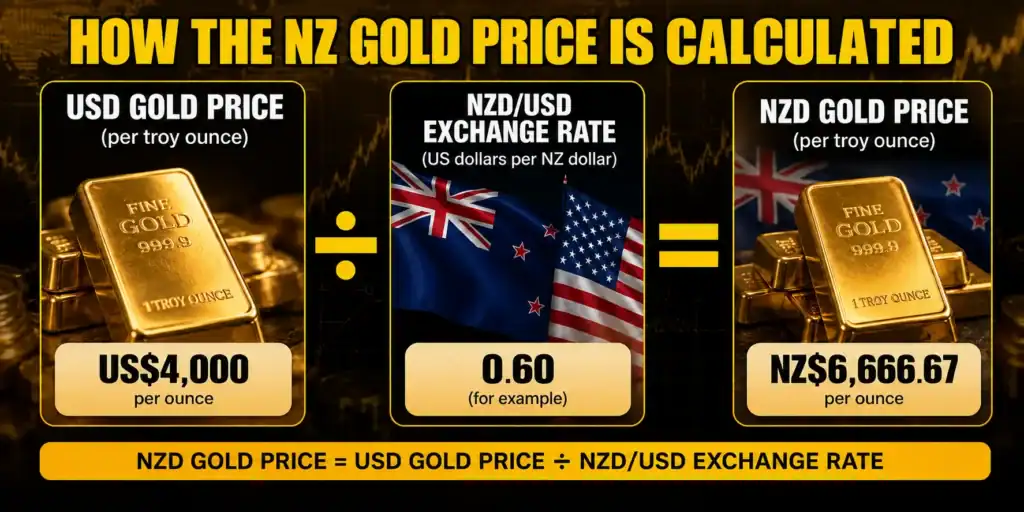
Now let’s see how the NZD gold price changes at different exchange rates, while the international gold price stays at US$4,000 per ounce.
| NZD/USD exchange rate | Gold price in USD | Gold price in NZD |
|---|---|---|
| 0.55 | US$4,000 | NZ$7,272.73 |
| 0.60 | US$4,000 | NZ$6,666.67 |
| 0.65 | US$4,000 | NZ$6,153.85 |
Illustrative prices, not live market quotes. Figures are rounded.
The US dollar gold price stays at US$4,000, yet the NZD price varies by more than NZ$1,100 an ounce across these three hypothetical exchange rates.
That’s the effect of currency conversion alone.
Important: This calculation gives an approximate NZD spot price, not the retail price of a physical gold bar or coin.
A dealer’s selling price also reflects the product premium and other applicable costs. The price a dealer offers when buying gold back will usually be lower than its selling price.
Does the NZ Dollar Affect Silver Prices Too?
Yes. The same exchange-rate calculation applies to silver.
Like gold, the international silver spot price is usually quoted in US dollars per troy ounce. To calculate the price in New Zealand dollars, you divide the USD silver price by the NZD/USD exchange rate.
So when the Kiwi dollar strengthens, it can reduce the NZD silver price, even if the international silver price stays unchanged. When the Kiwi weakens, the opposite happens.
However, gold and silver don’t always move in the same direction or by the same amount in US dollars. Silver has different supply and demand drivers, including its industrial uses.
And when buying physical silver in New Zealand, you also need to consider GST and dealer premiums. That means the retail price can differ substantially from the converted spot price.
How Does the NZ Dollar Affect Gold Prices?
When the New Zealand dollar strengthens against the US dollar, each NZ dollar buys more US dollars.
If the international gold price stays unchanged, that means it takes fewer NZ dollars to buy an ounce of gold.
The opposite happens when the Kiwi weakens.
But both prices can move at the same time.
For example, the US dollar gold price might rise while the Kiwi dollar strengthens. One movement pushes the NZD gold price up, while the other pulls it down.
The final result depends on the size of each move.
This helps explain why a New Zealand gold price chart can look quite different from a US dollar chart covering the same period.
NZD vs USD Gold Prices: What the Long-Term Chart Shows
The NZD/USD exchange rate is influenced by many factors, including interest rates, economic conditions and investor confidence. The international gold price has its own drivers, such as inflation concerns, central bank demand and financial uncertainty.
Over the long term, gold can also be viewed as a measure of a currency’s purchasing power. When gold rises in a currency, it means that currency buys less gold than it did before.
The chart below compares gold prices in New Zealand and US dollars over time. Notice how the two lines broadly follow the same long-term trend, but sometimes move apart. That’s the effect of changes in the NZD/USD exchange rate.
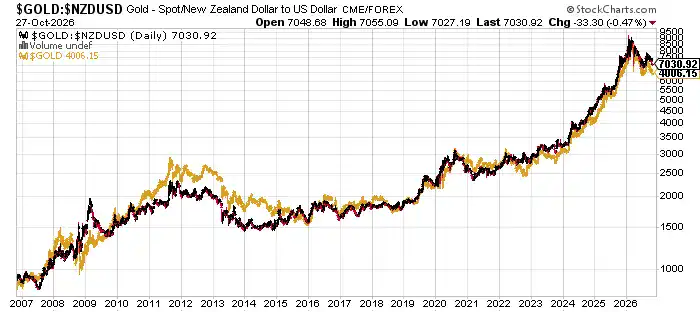
That’s why it’s worth following the NZD gold price, even when the international headlines focus on US dollars.
For a closer look at how exchange-rate movements affect both gold and silver, see our article on how a strong New Zealand dollar affects gold and silver prices.
Would Buying Gold in US Dollars Be Cheaper?
Buying gold in US dollars doesn’t automatically make it cheaper for someone whose money is in NZD.
If you have New Zealand dollars and want to pay a US dealer, you’ll first need to convert those dollars into USD.
The exchange rate still applies.
You may also face currency conversion fees, international shipping, insurance and other costs.
So buying overseas doesn’t remove the effect of the NZD/USD exchange rate. It simply changes where the conversion takes place.
That said, the total cost of buying from a particular overseas dealer could be lower or higher than buying locally. To make a fair comparison, you’d need to account for the exchange rate, all fees, the dealer’s premium and the cost of getting the gold to where you want it.
The same principle applies if you plan to store gold overseas.
You might buy or store gold in another country, but if you measure your wealth in New Zealand dollars, its NZD value will still reflect exchange-rate movements.
If you already hold foreign currency, you may not need to convert NZD at the time of purchase. But currency movements still affect the value of that holding when measured in NZ dollars.
If you already have US dollars or another foreign currency, you may also be able to use those funds to buy bullion from a New Zealand dealer. We explain how this works in our guide to buying gold and silver in New Zealand using foreign currency.
Which Gold Price Should New Zealand Buyers Follow?
For most New Zealanders, we’d suggest starting with the NZD gold price per troy ounce.
It’s the clearest way to see what gold is worth in the currency you use every day.
The international USD gold price is still worth watching. It helps explain what’s happening in the global gold market.
But if you’re deciding whether to buy physical gold in New Zealand, you should also check:
- The current NZD spot price.
- The actual selling price of the bar or coin you’re considering.
- The difference between the dealer’s buying and selling prices.
The spot price isn’t the same as the price you’ll pay for a physical product.
You can follow the local gold price using our NZ gold and silver price charts.
Want to follow both prices without checking the charts every day? Sign up for our free Daily Gold and Silver Price Alerts. You’ll get gold and silver spot prices in NZD and USD, plus our commentary on what the charts are showing.
And if you’re trying to decide whether to buy now or wait, see our separate guide: Should I Buy Gold Now or Wait? (2026 NZ Update).
Frequently Asked Questions
The US dollar is the main international currency used to quote and trade gold. That gives markets around the world a common reference price, even though buyers can purchase gold using other currencies.
No. If the NZ dollar strengthens enough against the US dollar, the local gold price can stay flat or fall even while gold rises in USD.
Not if you measure the value of your gold in NZ dollars. Buying overseas may change your payment and storage arrangements, but it doesn’t remove the effect of currency movements on the NZD value of your gold.
Yes. The NZD/USD exchange rate affects silver prices in the same way as gold, although the two metals have different supply and demand drivers.
The Bottom Line: Follow the Price That Matters to You
If you live in New Zealand and use NZ dollars, don’t judge gold’s performance by US dollar headlines alone.
The NZD gold price reflects both the international gold price and the exchange rate.
Understanding those two moving parts makes it easier to compare prices, assess your existing holdings and avoid confusing a change in the US dollar gold price with a change in the value of your gold at home.
At Gold Survival Guide, we see physical gold as wealth insurance first and an investment second.
You don’t need to predict the next exchange-rate move to benefit from understanding how your gold is priced. You just need to know which numbers matter when you buy, hold or sell.
Editor’s note: This article was first published 25 July 2017. Fully updated 27 October 2026.

Glenn's dedication to educating individuals on wealth protection through precious metals has helped over 2400 clients from New Zealand, Australia, USA and Europe to safeguard their financial futures. Passionate about financial independence and lifestyle freedom, Glenn’s mission is to empower others with the knowledge and tools to thrive in today’s volatile economic environment. When he's not advising on precious metals, Glenn enjoys spending time with his family and pursuing outdoor adventures.
Education: University of Auckland Bachelor of Science
Linkedin: https://www.linkedin.com/in/glenn-thomas-0984a4310/
- Gold and Silver Purity Explained: What NZ Bullion Buyers Need to Know - November 2, 2026
- NZ Housing Wealth Down 6% Since 2022 – Gold Up 138% - October 28, 2026
- Why New Zealand Gold Buyers Should Focus on the NZD Gold Price - October 27, 2026
