
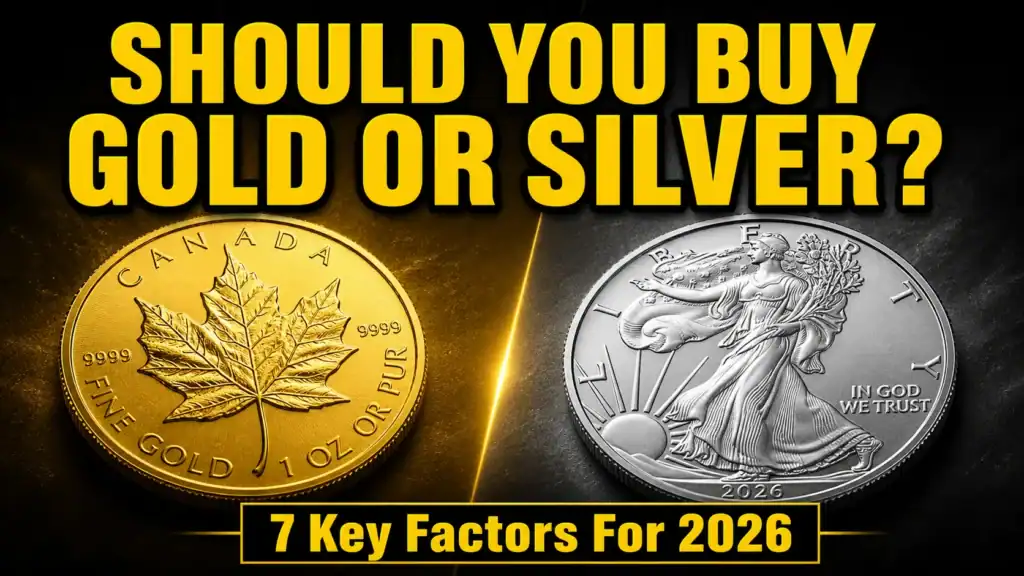
Should I Buy Gold or Silver?
If you’re deciding between gold and silver, the right choice depends on your goal:
- Choose gold if you want stability and long-term wealth protection
- Choose silver if you want higher upside and can handle volatility
- Many investors choose both to balance risk and opportunity
If you’ve already decided to buy precious metals — but are unsure whether gold or silver is the better fit — this guide will help.
If instead you’re wondering about timing, market cycles, or whether now is a good time to buy, read:
“When Should You Buy Gold or Silver?”
In this guide, we’ll break down exactly when gold is better, when silver is better, and how to decide based on your situation.
Table of Contents
- Should I Buy Gold or Silver?
- Gold vs Silver: Quick Comparison
- Why More Investors Are Comparing Gold vs Silver in 2026
- Should You Buy Gold or Silver? (Based on Your Situation)
- Is Gold or Silver Better for Your Situation in 2026?
- Gold Silver Ratio: Which Metal is Better Value?
- 1. Gold or Silver as a Crisis Hedge
- 2. Volatility
- 3. Affordability
- 4. Premiums Over Spot Price
- 5. Storage and Transport
- 6. Borrowing Against Your Metals
- 7. Potential Upside
- Final Verdict: Gold or Silver?
- Ready to Buy Gold or Silver in New Zealand?
- Further Reading
- Frequently Asked Questions
Estimated reading time: 10 minutes
Gold vs Silver: Quick Comparison
| Factor | Gold | Silver |
|---|---|---|
| Stability | ✅ High | ❌ Lower |
| Volatility | Low | High |
| Affordability | ❌ Expensive | ✅ Cheaper |
| Storage | ✅ Easy | ❌ Bulky |
| Upside Potential | Moderate | ✅ Higher |
| Crisis Protection | ✅ Strong | Mixed |
| Borrowing Potential | ✅ More widely accepted | More limited |
👉 Quick takeaway:
- Gold = protection
- Silver = growth
Why More Investors Are Comparing Gold vs Silver in 2026
Interest in gold and silver has grown significantly in recent years as investors respond to:
- persistent inflation,
- rising government debt,
- banking instability,
- geopolitical tensions,
- and concerns about long-term currency debasement.
At the same time, many traditional assets — including shares, bonds, and property — have become increasingly expensive and volatile.
This has led more investors to reconsider the role of tangible hard assets in a diversified portfolio.
Gold is often viewed as the more stable monetary metal and a form of long-term financial insurance.
Silver, meanwhile, combines monetary demand with industrial demand — giving it greater upside potential, but also more volatility.
That’s why the question is no longer simply:
“Should I buy gold or silver?”
Instead, it’s:
“Which metal best suits my goals, risk tolerance, and stage of life?”
For some investors, that means prioritising stability and wealth protection.
For others, it means pursuing higher upside potential and accepting greater volatility.
The right choice depends less on price predictions — and more on your personal financial goals.
Should You Buy Gold or Silver? (Based on Your Situation)
Buy Gold if:
- You want to protect wealth long-term
- You are concerned about financial crises
- You prefer lower volatility
- You want easier storage
Gold is often chosen for stability and long-term wealth protection.
👉 Learn more about the key reasons to buy gold
Buy Silver if:
- You want higher potential returns
- You have a smaller budget
- You are comfortable with price swings
- You want flexibility in smaller transactions
Silver tends to outperform during strong bull markets but comes with higher volatility.
👉 Learn more about the key reasons to buy silver
Consider Both if:
- You want a balanced portfolio
- You want both protection and growth
- You are investing for the long term
Many conservative investors favour a higher gold allocation such as:
- 70/30 (gold/silver)
or - 60/40 (gold/silver)
to reduce volatility while still maintaining silver exposure.
More aggressive investors may choose a larger silver allocation for higher upside potential. Particularly during periods when silver appears historically undervalued relative to gold.
Learn more about precious metals portfolio allocation here: How Much Gold and Silver Should Be in Your Portfolio?
Is Gold or Silver Better for Your Situation in 2026?
Gold is generally better for preserving wealth and protecting against financial crises.
Silver is often better for growth, especially in the later stages of a bull market.
For most investors, a mix of both provides the best balance between stability and upside.
Gold often behaves differently from shares, property, and bonds.
That means adding precious metals can potentially reduce overall portfolio risk through diversification.
Silver can also play this role, although its price tends to be more volatile due to industrial demand.
For many investors, owning both gold and silver creates a balance between stability, liquidity, and upside potential.
Whether you choose gold or silver, many long-term investors prefer physical bullion because it removes reliance on financial counterparties. See: Paper Gold vs Physical Gold – What Should You Buy
Gold Silver Ratio: Which Metal is Better Value?
The gold silver ratio shows how many ounces of silver it takes to buy one ounce of gold.
- When the ratio is high → silver is typically undervalued
- When the ratio is low → gold is typically undervalued
This makes it one of the most useful tools for deciding which metal offers better value right now.
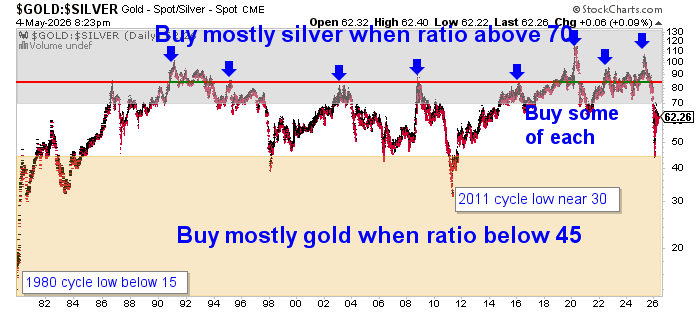
Here’s more on how to use the gold silver ratio.
1. Gold or Silver as a Crisis Hedge
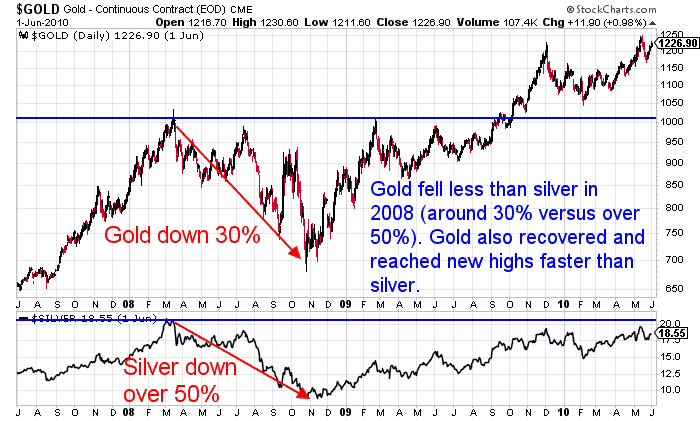
Gold performs better during financial crises because it is a pure monetary metal. Silver, on the other hand, has industrial demand, which can cause it to fall during economic downturns.
So gold is less likely to fall in a crisis or will likely not fall as far as silver and will recover faster as it did in 2009. See the chart below for 2008/09. Gold at the top, silver below:
Winner: Gold
What this means for you:
If your priority is protecting wealth during financial crises, gold is usually the better choice.
If you are investing for long-term growth, silver may outperform over a full bull market.
👉 Quick rule:
Crisis protection → Gold
Bull market positioning → Silver
2. Volatility
Gold is much less volatile than silver because its market is larger. Silver prices can rise faster — but also fall harder.
Winner: Gold (for stability)
What this means for you:
- Choose gold if you want stability and smaller price swings
- Choose silver if you are comfortable with larger ups and downs for higher potential gains
👉 Quick rule:
Low stress → Gold
Higher risk / higher reward → Silver
3. Affordability
Silver is far more affordable than gold. You can buy small amounts of silver easily, while gold requires a larger upfront investment.
Winner: Silver
What this means for you:
- Start with silver if you have a smaller budget
- Use gold once you are ready to store larger amounts of wealth more efficiently
👉 Quick rule:
Getting started → Silver
Storing serious wealth → Gold
4. Premiums Over Spot Price
Silver typically has higher premiums over the spot price than gold. However, for smaller purchases, gold premiums can become expensive, making silver more competitive.
Winner: Depends on purchase size
What this means for you:
- For smaller purchases, silver can be more practical despite higher premiums
- For larger purchases, gold is usually more cost-efficient
👉 Quick rule:
Small buys → Silver
Large buys → Gold
5. Storage and Transport
Gold is far more compact and easier to store. Silver takes up significantly more space for the same value and can be more expensive to store.
Winner: Gold
What this means for you:
- Choose gold if you want compact, easy-to-store wealth
- Choose silver only if you’re comfortable managing larger physical volume
👉 Quick rule:
Limited storage → Gold
Plenty of space → Silver
6. Borrowing Against Your Metals
While we view gold and silver as financial insurance with no counter-party risk, there are times when some people would like to be able to borrow against their precious metals.
Both gold and silver can now be used as collateral in certain cases. However, gold is still more widely accepted.
Winner: Tie (with slight advantage to gold)
What this means for you:
- Gold is more widely accepted if you want to borrow against your holdings
- Silver can still work, but options may be more limited
👉 Quick rule:
Flexibility and liquidity → Gold
7. Potential Upside
Silver has historically shown greater upside during bull markets. It tends to outperform gold later in the cycle.
Winner: Silver
What this means for you:
- Choose silver if your goal is maximum upside in a bull market
- Choose gold if you prefer steady, reliable performance
👉 Quick rule:
Growth focus → Silver
Wealth preservation → Gold
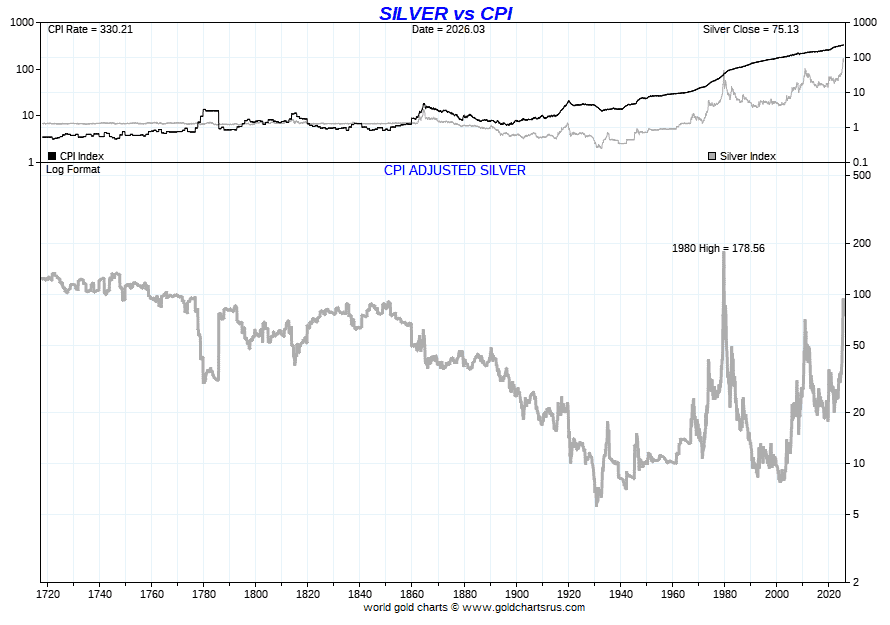
Inflation-Adjusted Gold vs Silver (Long-Term View)
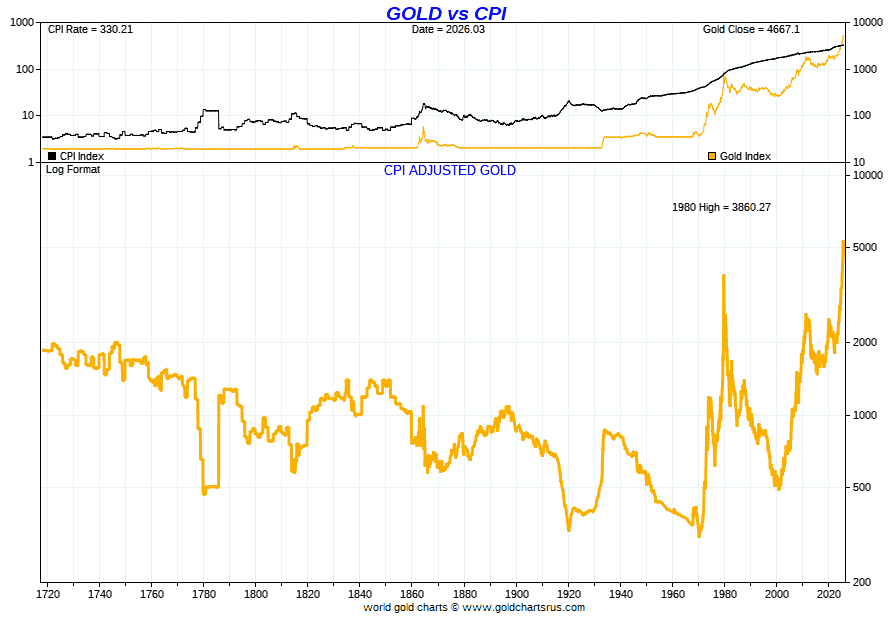
When comparing gold and silver, it’s important to look beyond short-term price moves.
The charts below show inflation-adjusted prices over the long term — giving a clearer picture of true value and historical peaks.
Key takeaway:
Gold has already moved beyond its previous highs in real terms, while silver still has further to go.
Alternative Inflation Measures (ShadowStats)
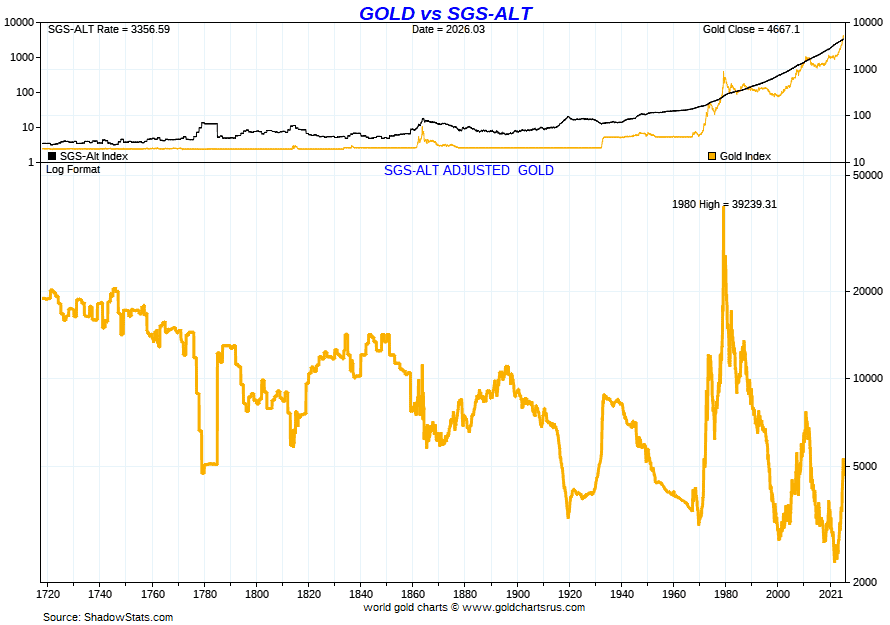
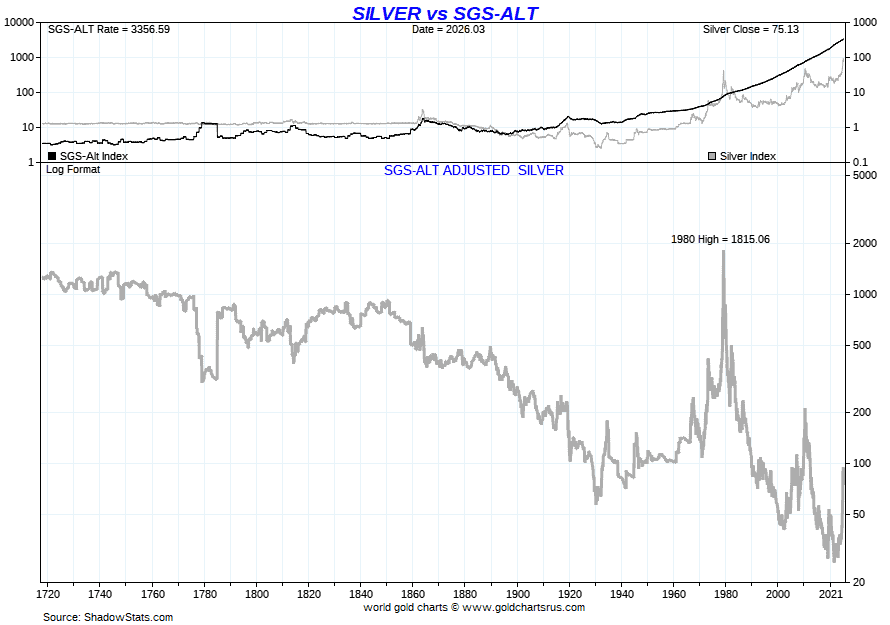
Official CPI data is commonly used to adjust historical prices for inflation. However, some analysts argue that modern CPI calculations may understate true inflation over time due to methodological changes.
Shadow Government Statistics (ShadowStats) provides an alternative measure based on earlier inflation calculation methods.
Key takeaway:
Using alternative inflation measures, both gold and silver remain well below their previous inflation-adjusted highs — particularly silver.
Charts care of GoldChartsRUs.com
Final Verdict: Gold or Silver?
There is no one-size-fits-all answer.
- Gold is better for stability and protection
- Silver offers greater upside but more volatility
For most investors, a combination of both provides the best balance.
A simple approach:
- Start with gold for stability
- Add silver for growth over time
Ready to Buy Gold or Silver in New Zealand?
If you’ve decided which metal suits your goals, the next step is choosing the right products and storage option.
- View the current gold and silver spot prices
- Learn when to buy gold or silver
- Compare coins vs bars
- Explore physical gold and silver bullion options in New Zealand
Further Reading
- Why Buy Gold?
- Why Buy Silver?
- What Percentage of Gold and Silver Should Be in Your Portfolio?
- What is the Gold Silver Ratio?
- Paper Gold vs Physical Gold
Editors Note: This post was first published 2 May 2018. Fully updated 5 May 2026 including updated charts.
Frequently Asked Questions
It depends on your goals. Gold is generally better for stability and wealth preservation, while silver offers higher potential returns but with greater volatility. Many investors choose to hold both for balance.
Many beginners start with silver due to its lower cost, then add gold over time.
Yes. Owning both can balance risk and reward in your portfolio.
Gold has historically performed better as a wealth preservation asset during major financial crises because it is less volatile and more widely held by central banks and institutional investors.
Silver can also perform very well, but it tends to experience larger price swings due to its smaller market size and industrial demand.
Many investors choose to own both:
– gold for stability,
– silver for affordability and growth potential.

Glenn's dedication to educating individuals on wealth protection through precious metals has helped over 2400 clients from New Zealand, Australia, USA and Europe to safeguard their financial futures. Passionate about financial independence and lifestyle freedom, Glenn’s mission is to empower others with the knowledge and tools to thrive in today’s volatile economic environment. When he's not advising on precious metals, Glenn enjoys spending time with his family and pursuing outdoor adventures.
Education: University of Auckland Bachelor of Science
Linkedin: https://www.linkedin.com/in/glenn-thomas-0984a4310/
- Why Own Gold When It Pays No Interest or Dividends? - August 12, 2026
- Why Buy Gold? A New Zealand Guide to Protecting Your Wealth - August 11, 2026
- When the Crowd Loses Interest, Who Keeps Buying? - August 5, 2026
