
Oct
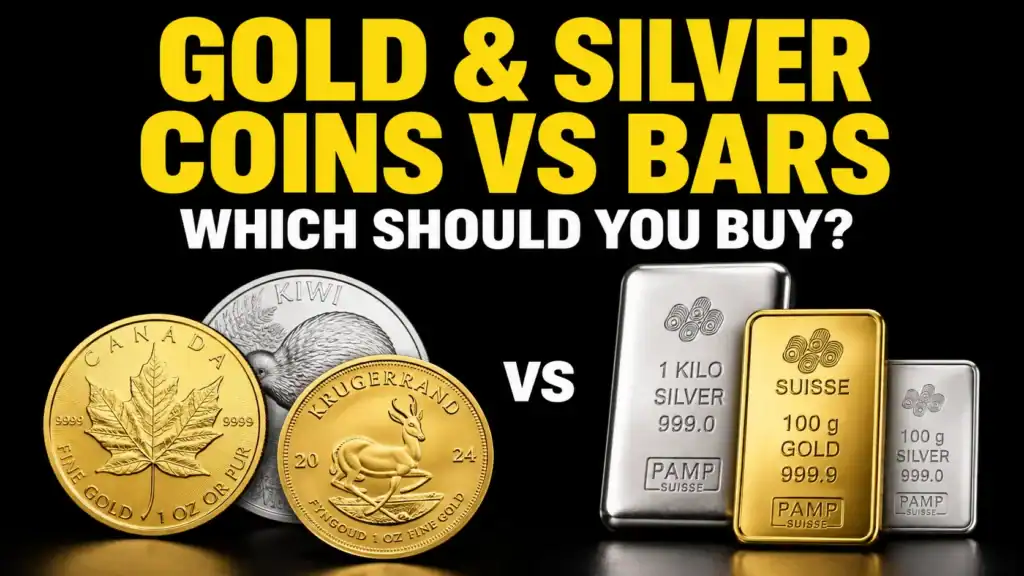
If you’ve decided to buy physical gold or silver, the next question is often whether to buy coins or bars.
Both give you direct ownership of precious metals. But there are differences in the premiums you’ll pay, the amount of space they’ll take up, and how easily you can sell part of your holding later.
For many New Zealand buyers, bars are the most cost-effective option. Coins can make more sense when you value smaller units, private resale, international recognition or possible barter use.
The choice also differs between gold and silver. With silver in particular, bars can offer significant advantages in both premiums and storage.
In this guide, we’ll compare gold and silver coins and bars based on more than 15 years of helping New Zealanders buy and sell precious metals.
Still deciding which metal to buy? See our separate guide to Should I Buy Gold or Silver?
Quick Answer: Are Coins or Bars Better?
For most New Zealanders buying gold or silver for wealth protection, bars offer more precious metal for your money because they usually have lower premiums.
Coins cost more but offer greater flexibility, particularly if you want smaller units for private resale or possible barter.
In our experience, reputable bars are generally just as easy to sell through the New Zealand bullion market as recognised coins. With silver, we tend to favour bars more strongly because coin premiums are higher and silver takes up considerably more storage space.
Table of contents
- Quick Answer: Are Coins or Bars Better?
- Coins vs Bars at a Glance
- What’s the Difference Between a Bullion Coin and a Bar?
- Why Buy Bullion Coins?
- Why Buy Bullion Bars?
- Gold Coins vs Gold Bars
- Silver Coins vs Silver Bars
- Are Coins Easier to Sell Than Bars in New Zealand?
- What Size Coins or Bars Should You Buy?
- Does a Mix of Coins and Bars Make Sense?
- NZ-Made vs International Bullion: Does It Matter?
- So, Should You Buy Coins or Bars?
- FAQs: Gold and Silver Coins vs Bars
Coins vs Bars at a Glance
There isn’t one format that’s best for every buyer. The main trade-off is between cost and storage efficiency on one side, and flexibility on the other.
| Consideration | Bullion Coins | Bullion Bars |
|---|---|---|
| Premium over spot | Usually higher | Usually lower |
| Metal for your money | Usually less | Usually more |
| Divisibility | Good, especially with 1oz and smaller coins | Depends on bar size |
| Storage efficiency | Lower | Higher |
| Resale through NZ bullion market | Generally straightforward | Generally straightforward |
| Private resale | Can have an advantage due to recognition | Depends more on the product and buyer |
| International recognition | High for major bullion coins | High for recognised international brands |
| Possible barter use | Smaller recognised units can be useful | Smaller bars can also be useful |
| Generally suits | Flexibility and smaller transactions | Lower premiums and efficient wealth storage |
Don’t choose on premium alone. Larger bars can reduce your buying cost, while smaller bars and coins give you more flexibility if you later want to sell only part of your holding.
What’s the Difference Between a Bullion Coin and a Bar?
Bullion coins and bars both give you direct ownership of physical precious metals. Their value comes mainly from the gold or silver they contain.
Bullion coins are produced by government or private mints in set weights and designs. Well-known examples include the Canadian Maple Leaf and Perth Mint Kangaroo. Some are legal tender, although their face value is usually far below the value of the metal they contain.
Bullion bars are produced by mints and refiners in a wider range of sizes, from small gram bars through to one-ounce, kilogram and larger bars. They may be cast or minted, but either way their main purpose is to provide a cost-effective way to own physical metal.
This guide is concerned with bullion coins rather than collectible or numismatic coins, whose value can depend on rarity, condition and collector demand as well as their metal content.
If you’re considering collectible coins, see our guide to Bullion Coins vs Numismatic Collectible Coins.
Why Buy Bullion Coins?
The main advantage of bullion coins is flexibility.
Smaller Units Give You More Flexibility
Most bullion coins come in relatively small units. That makes it easier to sell part of your holding without having to sell a large amount of metal at once.
Recognisability Can Help With Private Sales
Well-known bullion coins have standard weights, designs and specifications.
That familiarity can help when selling privately, although it’s less important when selling through the New Zealand bullion market.
Coins May Suit Buyers Thinking About Barter or Emergency Use
Some buyers also want precious metals they could potentially use during a serious monetary or financial disruption.
Smaller, easily recognised coins may be more practical for direct trade or barter.
The trade-off is price. Coins usually carry higher premiums than equivalent bars, and you shouldn’t assume you’ll recover that extra premium when you sell.
Why Buy Bullion Bars?
For buyers primarily interested in storing wealth efficiently, bars often provide the simplest and most cost-effective option.
Lower Premiums Mean More Metal for Your Money
Bars generally have lower premiums than coins. As bar size increases, the premium per ounce will often fall further.
Bars Are More Efficient to Store
Bars pack together efficiently and are available in larger sizes.
This matters most with silver, where a sizeable investment can involve a substantial weight and volume of metal.
Larger Bars Can Reduce Flexibility Later
The trade-off is divisibility. If you own a large bar and later want to sell only a small amount of metal, you generally need to sell the whole bar.
That’s why the lowest-premium product isn’t automatically the best choice. A mix of sizes can provide a better balance between cost and flexibility.
Gold Coins vs Gold Bars
With gold, the choice between coins and bars is often fairly close.
Gold stores a large amount of value in a small amount of metal, so storage space is rarely a major factor. The decision tends to come down to premium, divisibility and how you expect to use or eventually sell your gold.
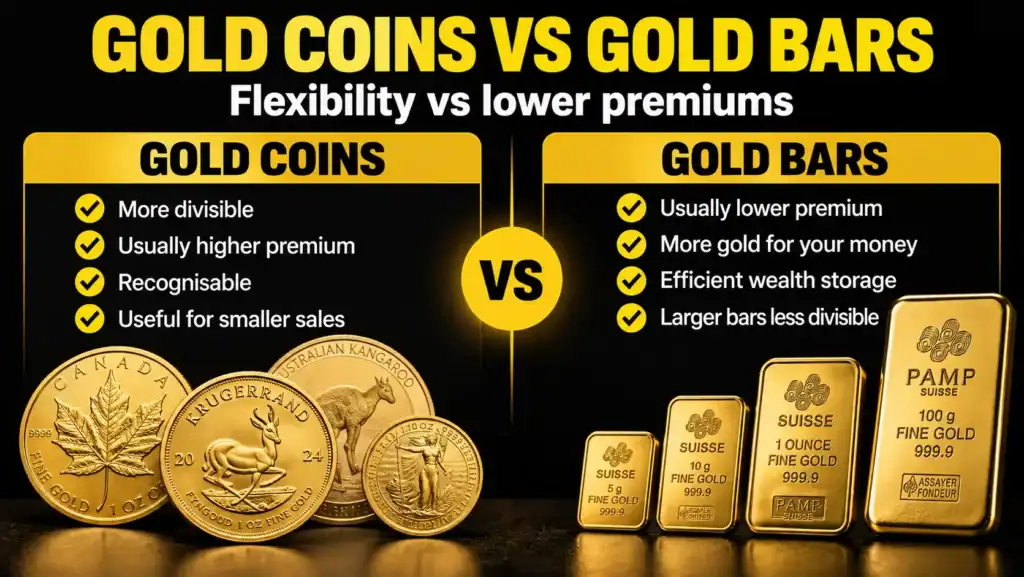
Gold Bars Usually Offer a Lower Premium
If your main aim is to own as much gold as possible for your money, bars will often have the advantage.
A one-ounce gold bar will generally have a lower premium than a one-ounce bullion coin. Larger bars can reduce the premium per ounce further.
Gold Coins Offer More Flexibility
One-ounce bullion coins provide a useful balance between holding a meaningful amount of gold and keeping your holding divisible.
Fractional gold coins offer even greater flexibility, although the premium per ounce usually rises as the coin gets smaller.
Recognised bullion coins may also appeal if private resale, international recognition or possible use during a currency crisis matters to you.
For that last scenario, see Best Gold for Trading in a Currency Collapse.
If bars better suit your needs, What Type of Gold Bar Should I Buy? compares sizes, brands, cast and minted bars and other practical considerations.
Silver Coins vs Silver Bars
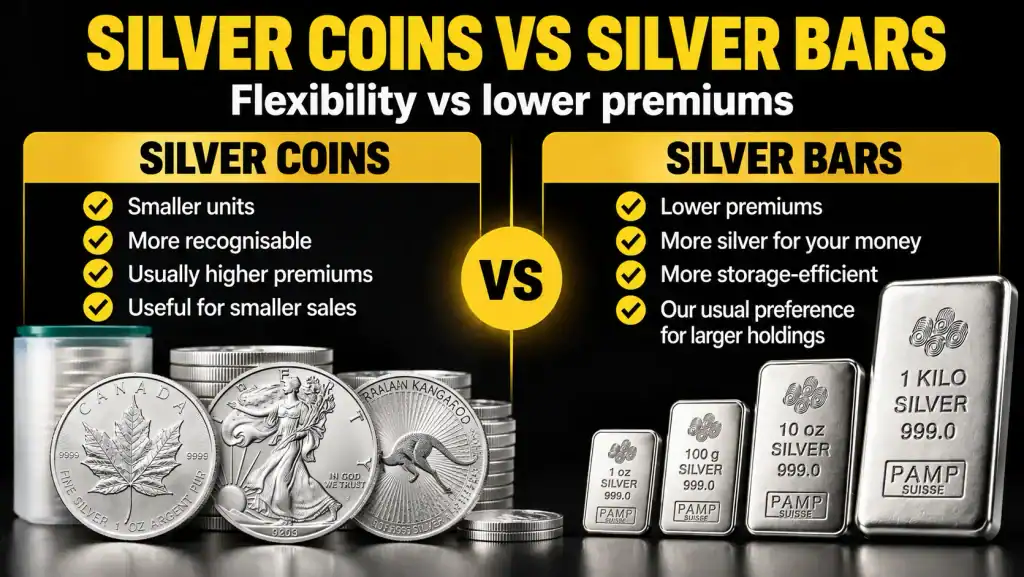
With silver, we generally lean more towards bars for straightforward wealth protection.
That’s because the premium and storage differences between coins and bars tend to matter more with silver than they do with gold.
Silver Bars Can Offer a Bigger Premium Advantage
Silver bullion coins commonly carry noticeably higher premiums over spot than larger silver bars.
For someone buying a modest number of coins, the extra cost may be worthwhile for the flexibility they provide. But as the holding grows, the additional premium can become significant.
Silver Bars Are More Efficient to Store
Silver’s lower value per kilogram means a sizeable investment requires much more physical metal than the equivalent value in gold.
Bars allow that metal to be stored more efficiently.
When Silver Coins Can Make More Sense
Silver coins become more attractive when divisibility and recognisability matter more than obtaining the lowest possible premium.
This can include buyers who want small units for private transactions or possible direct trade during a currency or banking crisis.
We’ve covered that scenario separately in How Silver Coins Could Be Used in a Currency Collapse in New Zealand.
For buyers leaning towards bars, see What Type of Silver Bar Should I Buy?
Are Coins Easier to Sell Than Bars in New Zealand?
This is one area where our experience differs from some common advice online.
We don’t generally see a significant difference in the ease of selling a reputable bullion bar compared with a recognised bullion coin through the New Zealand bullion market.
In either case, the price offered is generally driven by the underlying value of the gold or silver. Some products may receive slightly less if they aren’t readily resalable and require further processing or refining.
Will You Get the Higher Coin Premium Back?
Usually, you shouldn’t assume so.
A coin that cost considerably more than an equivalent bar won’t necessarily attract the same additional premium when you sell it through the bullion market.
That doesn’t make the higher premium a waste if you value the coin’s smaller size or recognisability. But buy coins for those benefits rather than assuming the extra purchase premium will automatically be returned later.
Private Sales Can Be Different
A well-known bullion coin may be easier for a private buyer to recognise and authenticate. That can make them more comfortable with the transaction and may allow you to recover more of the retail premium.
So when people say “coins are easier to sell”, the sales channel matters.
Through the bullion market, we haven’t found coins to have a major liquidity advantage over reputable bars. In a private sale, recognisable coins can have an advantage.
What Size Coins or Bars Should You Buy?
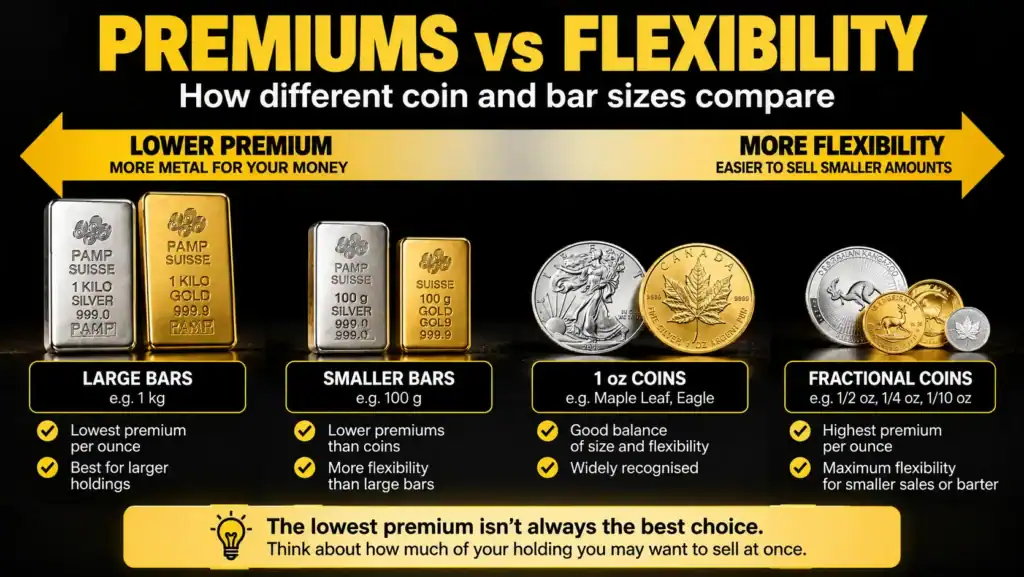
It’s tempting to choose the product with the lowest premium per ounce. But size affects what you can do with your metal later.
A larger bar can be cost-effective when buying, but you generally have to sell the whole bar at once. Several smaller bars or coins let you sell part of your holding while keeping the rest.
We’ve occasionally seen customers with larger bars later want to exchange them for smaller units because their circumstances changed. That’s possible, but it can be more expensive than choosing suitable sizes when you first buy.
Your likely future needs should therefore be part of the decision alongside today’s premium.
Does a Mix of Coins and Bars Make Sense?
It can. You don’t have to choose exclusively between coins and bars.
A larger holding might combine larger bars for lower premiums and efficient storage with smaller bars or coins for flexibility.
The balance can also differ between metals. With silver, higher coin premiums and greater storage requirements can favour bars for the bulk of a holding. With gold, a mixture of coins and bars can be easier to justify.
NZ-Made vs International Bullion: Does It Matter?
New Zealand buyers can choose from locally produced bullion as well as coins and bars from major overseas mints and refiners.
For most people who expect to buy and eventually sell their bullion in New Zealand, a reputable local bar can be just as practical as a well-known international product.
Local Bullion Can Make Sense if You’re Buying and Selling in NZ
In our experience, buyers sometimes place more importance on international recognition than they need to.
If you’re likely to sell through the New Zealand bullion market, a reputable local bar doesn’t necessarily need worldwide brand recognition to be readily saleable.
For a closer comparison of local bullion and a major international brand, see PAMP vs Local Bullion – Which Should You Buy?
International Recognition Can Matter if You Move Overseas
If there’s a reasonable chance you’ll relocate overseas, internationally recognised bullion can provide extra familiarity in your destination country.
But recognition is only part of the equation. You also need to consider the precious-metal and tax rules of the country you’re moving to.
We’ve seen this from the opposite direction, with people moving from the United Kingdom to New Zealand and wanting to bring their existing gold with them.
British gold sovereigns, for example, are widely recognised coins. But at 91.67% (22-carat) gold, they fall below the purity threshold required for investment precious metals to qualify for GST-free treatment in New Zealand. That can make selling them before moving and buying qualifying bullion after arriving a more practical option.
Other internationally recognised coins, including South African Krugerrands and American Gold Eagles, are also 91.67% gold and don’t meet New Zealand’s investment-precious-metal purity requirement. By contrast, products such as Canadian Gold Maple Leafs and many Perth Mint bullion coins meet the required gold purity threshold.
So a globally recognised coin isn’t automatically the most portable choice in every situation.
For more detail, see Gold & Silver Purity and GST Rules in New Zealand.
Check the Rules Before Moving Bullion Between Countries
Australia provides a useful contrast. Its investment-precious-metal purity requirements are similar to New Zealand’s, so qualifying bullion owned here may also meet the relevant purity requirements there.
If international portability matters to you, consider the destination country’s tax and bullion rules as well as product recognition.
Rules can change, so check the requirements in both countries before moving precious metals across a border.
So, Should You Buy Coins or Bars?
For most New Zealanders buying physical gold or silver for wealth protection, bars are a good starting point because they generally offer lower premiums.
Coins make more sense when you’re willing to pay more for divisibility, recognisability or flexibility in a private sale.
With silver, we tend to lean more strongly towards bars because coin premiums are generally higher and storage becomes more important as the holding grows. With gold, the choice is often closer.
And you don’t have to choose one format exclusively. The right balance depends on how much you’re buying and how you might eventually sell or use it.
FAQs: Gold and Silver Coins vs Bars
Neither is automatically better. Gold bars generally offer lower premiums, while coins provide greater divisibility and recognition. Your choice depends on whether you place more value on buying efficiency or flexibility.
For straightforward silver wealth storage, we generally favour bars because they tend to have lower premiums and are more efficient to store. Coins can suit buyers who specifically want smaller, recognisable units.
Not necessarily. In our experience, reputable bars and recognised bullion coins are both straightforward to sell through the New Zealand bullion market. Coins can have an advantage in private sales because they’re often easier for another individual to recognise.
Sometimes in a private sale. But when selling through the bullion market, you shouldn’t assume you’ll recover the higher retail premium originally paid for a coin. The underlying metal value is usually the main factor.
Coins generally cost more to manufacture and can carry additional premiums for minting, design and recognition. That doesn’t mean a coin contains more precious metal than a bar of the same weight and purity.
A large bar will often have a lower premium per ounce. Smaller bars provide more flexibility because you can sell part of your holding without selling everything at once.
In our experience, reputable locally produced bullion is generally straightforward to sell through the New Zealand bullion market. International recognition becomes more relevant if you expect to move your bullion overseas.
Editor’s Note: This article was originally written 26 January 2011. Fully updated 5 October 2026.

Glenn's dedication to educating individuals on wealth protection through precious metals has helped over 2400 clients from New Zealand, Australia, USA and Europe to safeguard their financial futures. Passionate about financial independence and lifestyle freedom, Glenn’s mission is to empower others with the knowledge and tools to thrive in today’s volatile economic environment. When he's not advising on precious metals, Glenn enjoys spending time with his family and pursuing outdoor adventures.
Education: University of Auckland Bachelor of Science
Linkedin: https://www.linkedin.com/in/glenn-thomas-0984a4310/
- What Are The Different Types of Gold Bars? - October 13, 2026
- Should I Buy Gold Now or Wait? (2026 NZ Update) - October 12, 2026
- Trump Says Inflation Can Reduce US Debt “Very Rapidly” — What Does It Mean for Gold? - October 7, 2026

immigrating from the states to NZ. bringing my wealth converted to gold. should i buy it here first in the states and carry it with me or waite and but it from nz mint? if i buy here the american gold eagles can i sell them there later? thanks for your help.
Hi Curt, Sorry about the slow reply – seems we somehow missed your comment. Thats a tough one to answer as it could depend on how much you are trying to leave the states with as to how the US authorities might treat the coins. Could be safer to buy here unless you can get an answer from US immigration before leaving.
One scenario I have thought of is- why would I sell my collection of bullion and to whom, really would depend on the prevailing economic circumstances. e.g. a world wide reset of the monetary system effecting NZD and every other fiat currency or simply trading your PM on say trademe.I could easily see the latter being an excellent way of maximising the value in the appreciating gold/silver one has salted away for such a time and eliminating the middlemen if confidence was lost in the kiwi dollar. Also a discreet way of selling small amounts for essentials.
Hi Mick, Thanks a lot for sharing your thoughts. Much appreciated.
I’ve seen online that silver is undervalued by a factor of 20 when measured against historic value. What are your thoughts on this and is it likely to change in the short term?
Hi Tim, thanks for the question. I’m not sure if you noticed but we have a blog post from a week or 2 back that covers this exact topic: https://goldsurvivalguide.co.nz/wages-ancient-greece-nz-housing-say-silver-undervalued-factor-20/ And we come up with a number of around 20 too compared to housing and ancient wages. These have come down a little in recent years. Our guess is these ratios could fall a bit further in the next year or so too. It won’t be a straight line but we think the odds favour a return to similar levels in the next number of years/this decade.