
Monetary System
Trump Says Inflation Can Reduce US Debt “Very Rapidly” — What Does It Mean for Gold?

Oct
This Week:
- 📊 Weekly Price Overview – 7 October 2026
- Coins vs Bars: Which Is Better for Gold and Silver Buyers?
- Gold Buyers Turn Cautious After the Latest Price Drop
- Gold Is Holding Up Better Than High Bond Yields Suggest It Should
- Trump Says Inflation Can Reduce America’s Debt “Very Rapidly”
- Chart of the Week: America’s Debt Has Grown Far Faster Than Its Gold
- Central Banks Are Buying Gold for Some of the Same Reasons
- If You Want to Own Physical Gold, What Should You Actually Buy?
Estimated reading time: 8 minutes
📊 Weekly Price Overview – 7 October 2026
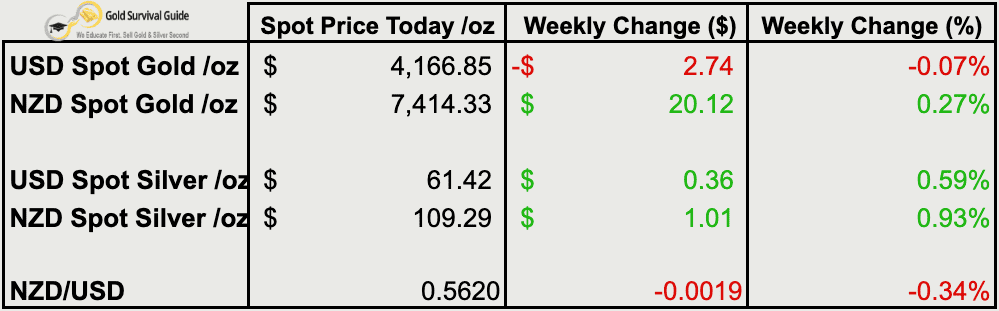
Precious metals were little changed this week. A weaker Kiwi dollar helped lift gold and silver in NZ dollar terms.
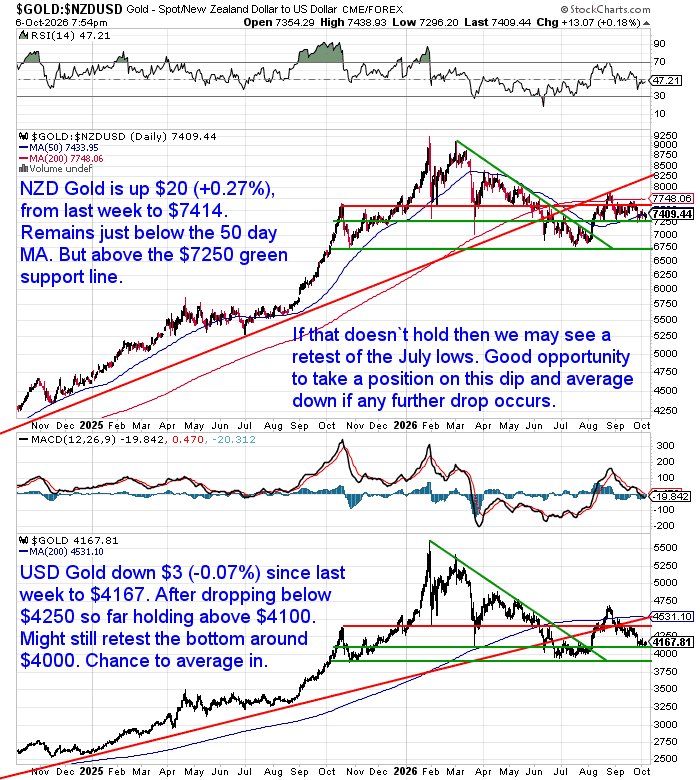
🟡 NZD gold rose $20 (+0.27%) to $7,414
NZD gold remains below its 50-day moving average, but above support near $7,250.
USD gold fell $3 (-0.07%) to $4,167
USD gold remains above $4,100. A further fall could see support near $4,000 tested.
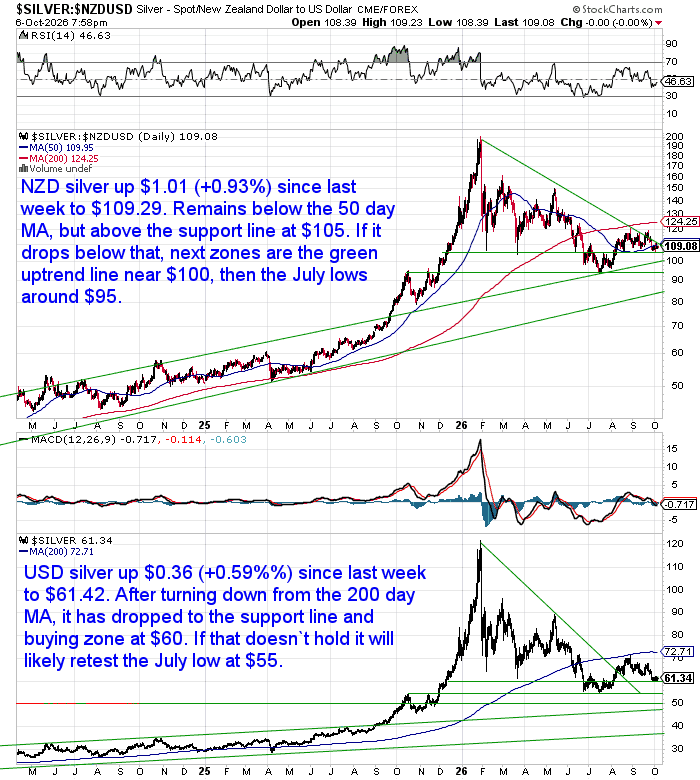
⚪ NZD silver rose $1.01 (+0.93%) to $109.29
NZD silver remains below its 50-day moving average, but above support near $105. Below that, support sits near $100 and $95.
USD silver rose $0.36 (+0.59%) to $61.42
USD silver remains near support around $60. A break below could see a retest of the July low near $55.
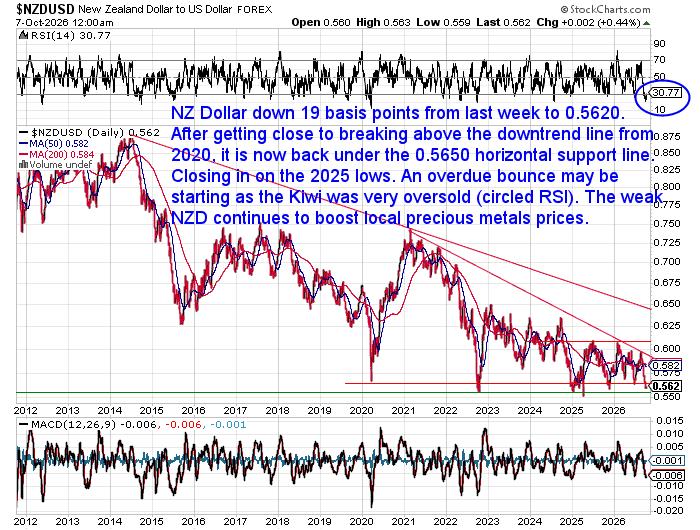
💱 NZD/USD fell 19 basis points (-0.34%) to 0.5620
The Kiwi dollar remains near its 2025 lows and below long-term resistance around 0.5850. It is approaching oversold levels.
Coins vs Bars: Which Is Better for Gold and Silver Buyers?
If you’re buying physical precious metals, choosing gold or silver is only half the decision.
Should you buy coins or bars? Is locally made bullion the better option, or are internationally recognised products worth paying more for? And could what you buy today affect how easily (and where) you can sell it later?
There isn’t one right answer for everyone.
In this week’s featured article, we compare the options for New Zealand buyers and look at how your goals, budget and future plans can help determine which combination makes the most sense.
Read: Gold and Silver Coins vs Bars — Which Should You Buy in New Zealand?
Gold Buyers Turn Cautious After the Latest Price Drop
The recent pullback in gold and silver has taken some of the enthusiasm out of the market.
Kitco’s latest survey found only 23% of Wall Street analysts expected gold to rise this week, while 46% expected it to fall. Its Main Street survey wasn’t much more optimistic. Just 47% remained bullish, the first time the bulls have lost their majority since July.
That’s not too different from what we’re seeing here in New Zealand.
Smaller retail buyers remain relatively quiet despite the pullback, while we’ve continued to see some sizeable purchases. So we’re still seeing a clear difference between smaller buyers and those allocating larger amounts to physical metal.
Chris Weber also warned in his latest report that gold, silver and the miners could have more consolidation ahead after their strong run. That’s despite remaining bullish on the longer-term outlook.
Gold Is Holding Up Better Than High Bond Yields Suggest It Should
For decades, higher real interest rates have generally been considered bad news for gold. Gold pays no interest, so higher returns on bonds should make them relatively more attractive.
Yet gold has remained remarkably resilient even as bond yields have risen.
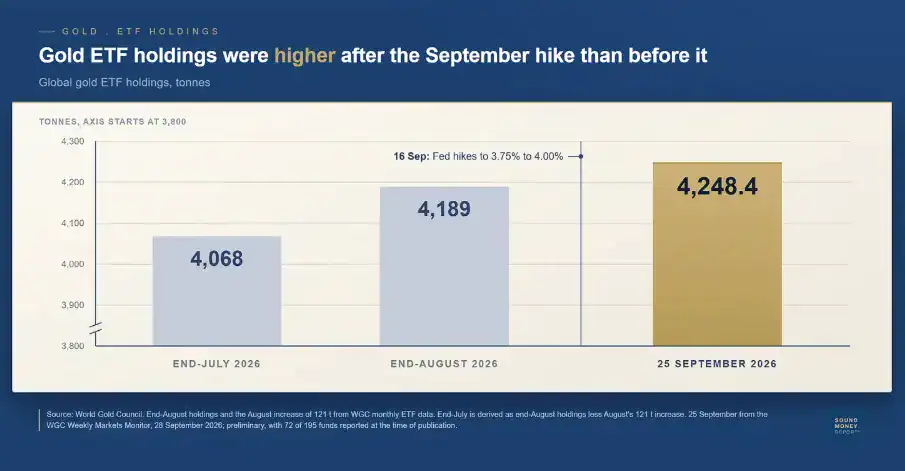
The Sound Money Report had said a US 10-year yield above 2.47% and a September Fed hike would challenge the bullish case for gold. Both happened.
Yet global gold ETFs held more gold after the Fed hike than before it.
The same issue came up at this week’s LBMA precious metals conference in Italy.
MKS PAMP’s Nicky Shiels estimates there is now around US$840 per ounce in gold’s price that cannot be explained by its traditional relationship with real yields and the US dollar. Before 2022, that unexplained component was closer to US$120.
Gold’s traditional relationship with interest rates and the US dollar appears to have weakened.
Reserve diversification, central bank buying, geopolitical risk and concerns over government debt may now be playing a larger role.
Trump Says Inflation Can Reduce America’s Debt “Very Rapidly”
President Trump put America’s debt problem into unusually blunt terms last week.
Speaking about America’s US$40 trillion-plus national debt, Trump said:
“Certain levels of inflation will also pay off that debt very rapidly. Very rapidly.”
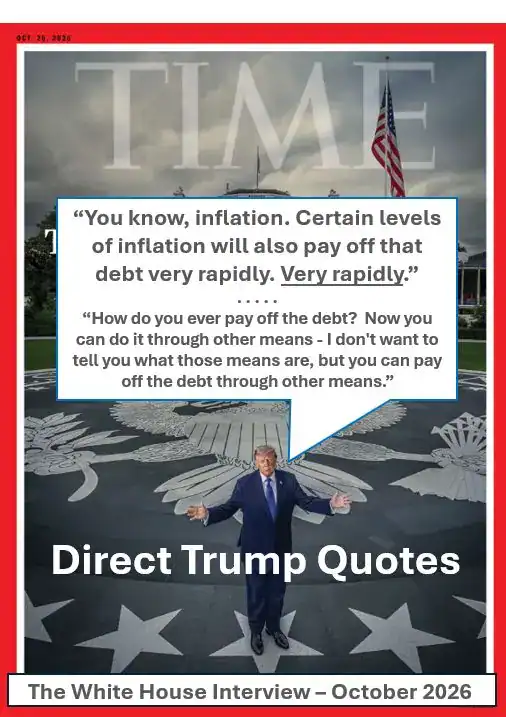
It’s an unusually direct acknowledgement of something we’ve discussed for years.
Inflation reduces the real value of debt.
A government can repay every dollar it owes. But if those dollars buy less when they’re eventually repaid, the real burden of the debt has fallen.
GoldFix’s Vince Lanci described Trump’s comments as effectively “saying the quiet part out loud” and linked them to financial repression.
Imagine inflation is running at 4%, while government debt pays 3%. The bondholder receives the promised interest and eventually gets their principal back. But their purchasing power is still going backwards.
Across trillions of dollars of debt, that gradually reduces its real value.
There’s a catch, though.
Bondholders get a say too.
If investors expect higher inflation, they can demand higher yields to compensate for it. That makes an already enormous government interest bill even more expensive.
The bond market’s initial reaction was significant. US Treasury yields moved higher following Trump’s comments, as The Kobeissi Letter noted.
Inflating away the debt may sound simple. Doing it without sending borrowing costs higher is another matter.
Chart of the Week: America’s Debt Has Grown Far Faster Than Its Gold
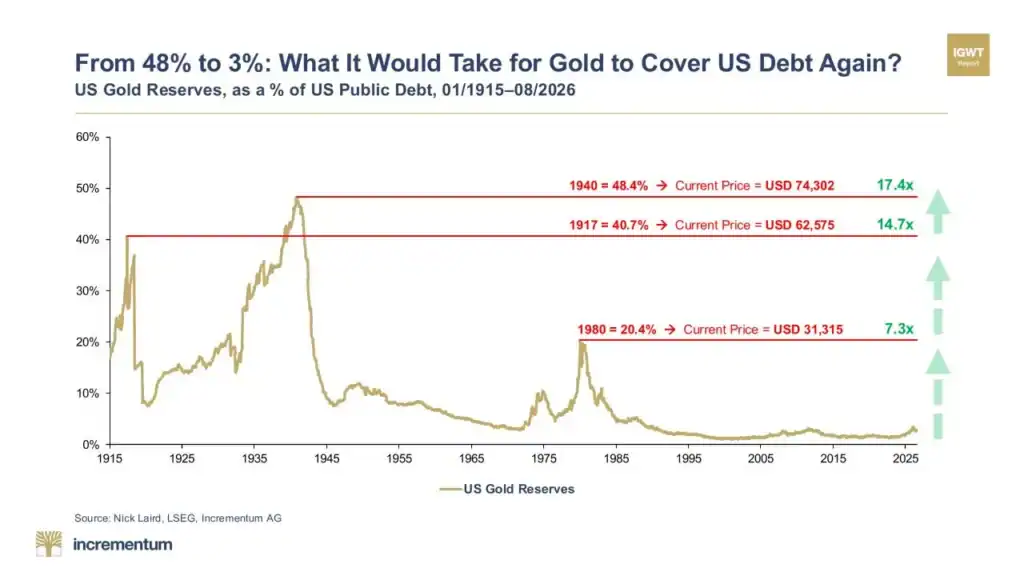
This week’s chart from the In Gold We Trust Report shows how dramatically the relationship between US debt and gold has changed.
In 1940, America’s gold reserves were worth the equivalent of 48.4% of US public debt.
By 1980, that figure was 20.4%.
Today it’s around 3%.
Importantly, America hasn’t sold off most of its gold in the meantime. Its official gold holdings have barely changed for decades.
What has changed is how much debt has accumulated around them.
The In Gold We Trust Report calculates that returning to the 1980 gold-to-debt ratio would require gold at around US$31,300 an ounce at today’s debt levels.
They’re not predicting gold will reach that price. The calculation simply shows how far US debt has grown relative to America’s gold reserves.
Central Banks Are Buying Gold for Some of the Same Reasons
Central banks appear increasingly conscious of these risks.
Speaking at the LBMA conference, Bundesbank president Joachim Nagel noted that gold’s share of global central bank reserves has risen sharply in recent years.
Foreign securities and bank deposits depend on somebody else honouring an obligation. They can also potentially be frozen or restricted.
Physical gold held directly is different.
There is no issuer behind an ounce of gold and no promise that needs to be honoured.
That’s why we prefer to think of gold as wealth insurance first and an investment second.
Central banks aren’t necessarily buying gold because they expect its price to be higher next week, next month or even next year. They’re holding it because of what it is.
If You Want to Own Physical Gold, What Should You Actually Buy?
Deciding you want some physical precious metals is only the first decision.
What should you actually buy?
Chris Weber provided an interesting example in his latest report. He noted that British investors can buy UK legal-tender gold coins such as Britannias and Sovereigns that receive favourable capital gains tax treatment.
A recent post from the Royal Mint also highlighted that Britannia bullion coins are exempt from UK Capital Gains Tax.
That’s a valuable benefit for someone living in Britain. It also shows why there isn’t one bullion product that’s best for everyone.
We’ve seen this ourselves with people moving from the UK to New Zealand. A bullion product that made sense to own in Britain may not be the best choice once you’re living here.
For New Zealand buyers, considerations include premiums, GST treatment, international recognition, resale, storage and how much flexibility you want when the time comes to sell.
Interestingly, despite the advantages available to British buyers, Weber says his UK contacts estimate that the average Brit owns virtually no gold. That echoes what we found last week when we looked at how much gold people actually own.
So, if you’ve decided physical precious metals deserve a place in your wealth-protection plan, the next question is a practical one:
Gold or silver? Coins or bars? Locally produced bullion or internationally recognised products?
That’s exactly what we look at in this week’s featured article.

Glenn's dedication to educating individuals on wealth protection through precious metals has helped over 2400 clients from New Zealand, Australia, USA and Europe to safeguard their financial futures. Passionate about financial independence and lifestyle freedom, Glenn’s mission is to empower others with the knowledge and tools to thrive in today’s volatile economic environment. When he's not advising on precious metals, Glenn enjoys spending time with his family and pursuing outdoor adventures.
Education: University of Auckland Bachelor of Science
Linkedin: https://www.linkedin.com/in/glenn-thomas-0984a4310/
- Gold and Silver Purity Explained: What NZ Bullion Buyers Need to Know - November 2, 2026
- NZ Housing Wealth Down 6% Since 2022 – Gold Up 138% - October 28, 2026
- Why New Zealand Gold Buyers Should Focus on the NZD Gold Price - October 27, 2026
