
Silver
Why Buy Silver? A Guide to Owning Silver in New Zealand

Sep
Silver occupies an unusual place in the precious metals market.
Like gold, physical silver is a tangible asset you can own outright. It has no issuer and, when held directly, no counterparty risk.
But silver is also widely used in solar panels, electronics, vehicles and other technologies. Its price can therefore be influenced by both investment and industrial demand.
Silver’s lower price per ounce can also make physical precious metals accessible for smaller purchases. But there are trade-offs. Silver is generally more volatile than gold and takes up more space for the same dollar value.
So, why buy silver?
At Gold Survival Guide, we see silver as serving two potential roles: wealth insurance and opportunity. Understanding both — along with the risks — can help you decide whether physical silver belongs in your wealth strategy.
Quick Answer: Why Buy Silver?
People buy silver for a combination of wealth protection and potential investment upside.
Physical silver provides direct ownership of a scarce, tangible asset. It also has substantial industrial demand and a lower price per ounce than gold.
However, silver is more volatile than gold and bulkier to store.
At Gold Survival Guide, we therefore view silver as both insurance and opportunity — rather than simply a bet on a higher silver price.
Table of Contents
- Quick Answer: Why Buy Silver?
- What Gives Silver Its Value?
- Is Silver Still Undervalued?
- Why Industrial Demand Matters for Silver
- Silver Supply and Demand: Why the Market Deficit Matters
- Silver vs Gold: Which Should You Own?
- What Are the Downsides of Owning Silver?
- Physical Silver or Paper Silver? Know What You Own
- How to Buy Silver in New Zealand
- How and Where Should You Store Silver?
- Common Mistakes to Avoid When Buying Silver
- FAQs About Buying Silver
- Final Thoughts: Why Own Silver?
- Ready to Take the Next Step?
Estimated reading time: 14 minutes
What Gives Silver Its Value?
Silver has been valued for thousands of years as money and a store of value. Today, its value comes from an unusual combination of monetary and industrial demand.
Physical silver can be owned outright, outside the banking system. It is also a useful industrial metal. Its high electrical and thermal conductivity makes it valuable in electronics, solar technology, vehicles and many other applications.
This gives silver two distinct sources of demand: people who want to own it as a precious metal and industries that need to consume it.
That also helps explain how we think about silver at Gold Survival Guide:
Gold is wealth insurance first. Silver can be both insurance and opportunity.
Silver can provide some of the wealth-protection characteristics people seek from precious metals. But its smaller market, industrial demand and greater volatility can also contribute to larger percentage price movements than gold.
That potential works both ways. Silver can rise faster during strong precious-metals markets, but it can also fall harder when sentiment or economic conditions change.
So owning silver isn’t simply about predicting a higher price. It’s about deciding whether that combination of wealth protection, opportunity and risk suits the role you need it to perform.
Is Silver Still Undervalued?
Silver has often been described as undervalued, particularly compared with gold. But after its sharp rise in 2025 and extraordinary price moves in 2026, that claim needs more context.
Silver rose 147% in US dollar terms during 2025. It then surged to a record high of around US$121.60 an ounce in January 2026 before falling sharply.
By late August 2026, silver was trading around US$66–67 an ounce — well below its January peak, but also well above the levels seen when we last updated this article.
So rather than simply declaring silver “cheap”, we think it is more useful to compare today’s price with gold and with silver’s own history.
Two ways to do that are the gold–silver ratio and an inflation-adjusted comparison with previous silver price peaks.
What Does the Gold–Silver Ratio Tell Us?
The gold–silver ratio (GSR) tells us how many ounces of silver it takes to buy one ounce of gold. A higher ratio means silver is cheaper relative to gold.
The ratio has varied enormously over time, so claims that it has one “correct” level should be treated with caution.
Research published by the Silver Institute in July 2026 examined monthly data from January 1970 to May 2026. It estimated a long-run equilibrium gold–silver ratio of 59.65:1 — roughly 60 ounces of silver for one ounce of gold.
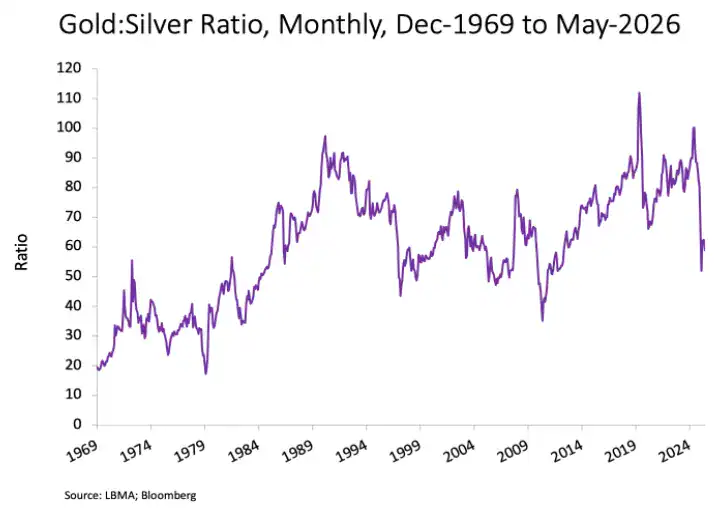
By 1 September 2026, the ratio was around 67:1. That’s well below the levels above 80 seen during parts of 2025 and early 2026, reflecting silver’s recent gains relative to gold.
At around 67:1, silver was still somewhat cheaper relative to gold than the long-run equilibrium identified in the Silver Institute study. But the gap had narrowed considerably.
The gold–silver ratio is a measure of relative value, not a silver price forecast.
A higher ratio doesn’t guarantee it will fall. And if it does fall, that could happen because silver rises, gold falls or both prices move.
That’s why we use the GSR as one measure of silver’s relative value, rather than evidence that silver must reach a particular price.
Learn more: Gold Silver Ratio: What Is It and How Do You Use It?
How Does Today’s Silver Price Compare After Inflation?
Another way to assess silver’s price is to compare it with previous peaks after allowing for inflation.
For decades, silver’s famous nominal high was around US$50 an ounce, reached in January 1980. Silver finally surpassed that record in 2025 and went much further in January 2026, briefly reaching around US$121.60.
But US$50 in 1980 bought considerably more than US$50 does today.
The Bloomberg chart below adjusts historical silver prices into constant 2020 US dollars. On this measure, even silver’s sharp rise into early 2026 remained well below the inflation-adjusted peak reached around 1980.
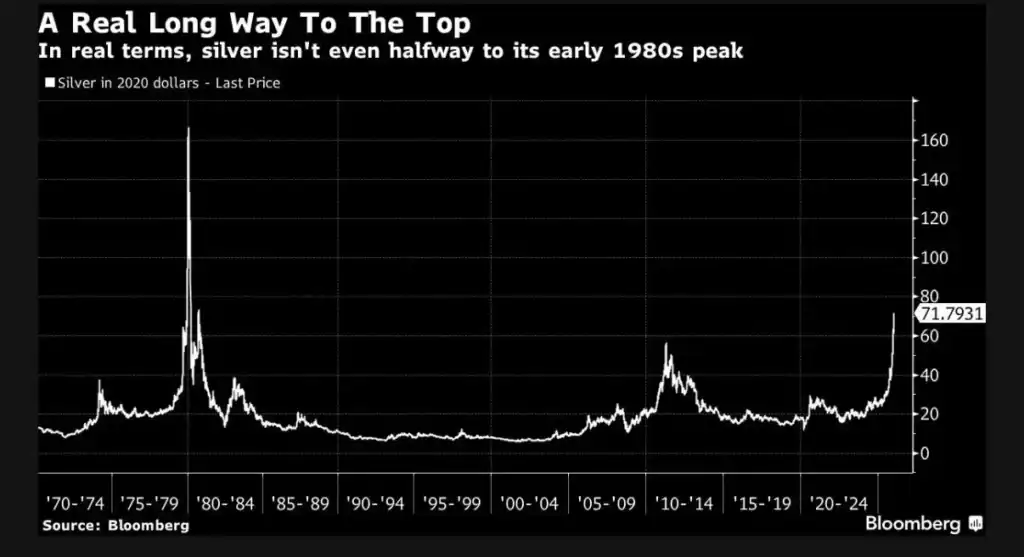
That previous inflation-adjusted high is not a price target.
The 1980 peak came during an extraordinary period of speculation involving the Hunt brothers. January 2026 also demonstrated silver’s volatility, with the price falling more than 25% in a single day after its rapid rise.
The comparison simply shows why using the old nominal US$50 high as a valuation benchmark can be misleading.
Why Industrial Demand Matters for Silver
Silver’s industrial uses distinguish it from gold.
Its high electrical and thermal conductivity makes it useful in electronics, solar cells, vehicles, electrical infrastructure and many other applications.
Industrial silver demand reached a record 679.0 million ounces in 2024, after four consecutive years of growth. But demand fell 3% to 657.4 million ounces in 2025, according to the World Silver Survey 2026.
One major reason was solar.
Silver use in photovoltaic applications more than doubled between 2020 and 2024. But higher silver costs encouraged manufacturers to use less silver in each cell and increase substitution. These savings outweighed growing demand from areas including AI infrastructure, vehicles and power-grid investment.
The World Silver Survey 2026 forecasts industrial demand of around 639.6 million ounces in 2026, another 3% decline.
Industrial demand can be both a strength and a weakness.
Growth in technology and electrical infrastructure can increase silver demand. But high prices also encourage manufacturers to use less of it, while weaker economic conditions can reduce industrial consumption.
That’s why rising industrial use shouldn’t automatically be treated as a forecast for higher silver prices.
Silver Supply and Demand: Why the Market Deficit Matters
Industrial demand is only one side of the market. We also need to consider supply.
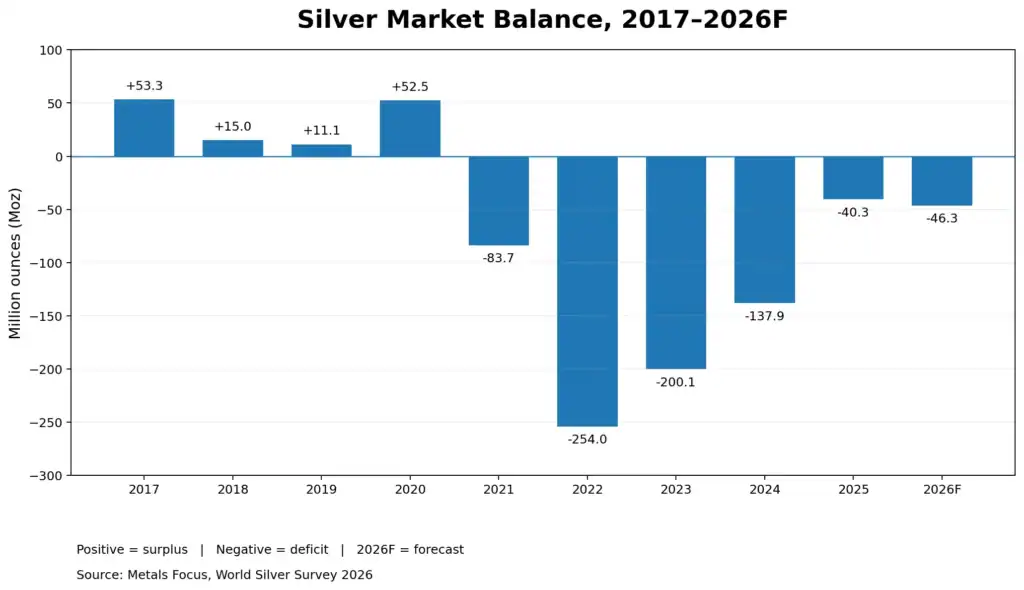
According to the World Silver Survey 2026, silver recorded its fifth consecutive annual market deficit in 2025, with a sixth forecast for 2026.
But the size of those deficits has varied considerably.
The market deficit was 137.9 million ounces in 2024 and 40.3 million ounces in 2025. Metals Focus forecasts a deficit of 46.3 million ounces for 2026.
A deficit does not mean the world has run out of silver. It means annual demand has exceeded annual supply, with the difference met from sources such as above-ground inventories.
What matters is the cumulative effect.
Including the 2026 forecast, the World Silver Survey 2026 puts the cumulative market deficit from 2021 to 2026 at 762.1 million ounces.
Supply also can’t necessarily respond quickly to higher prices. Much of the world’s silver is produced as a by-product of mining other metals, including lead, zinc, copper and gold.
Recycling can respond more quickly. It reached 197.6 million ounces in 2025, its highest level in 13 years.
So persistent deficits don’t guarantee higher silver prices. They show that annual demand has repeatedly exceeded annual supply, with above-ground stocks helping to bridge the gap.
Silver vs Gold: Which Should You Own?
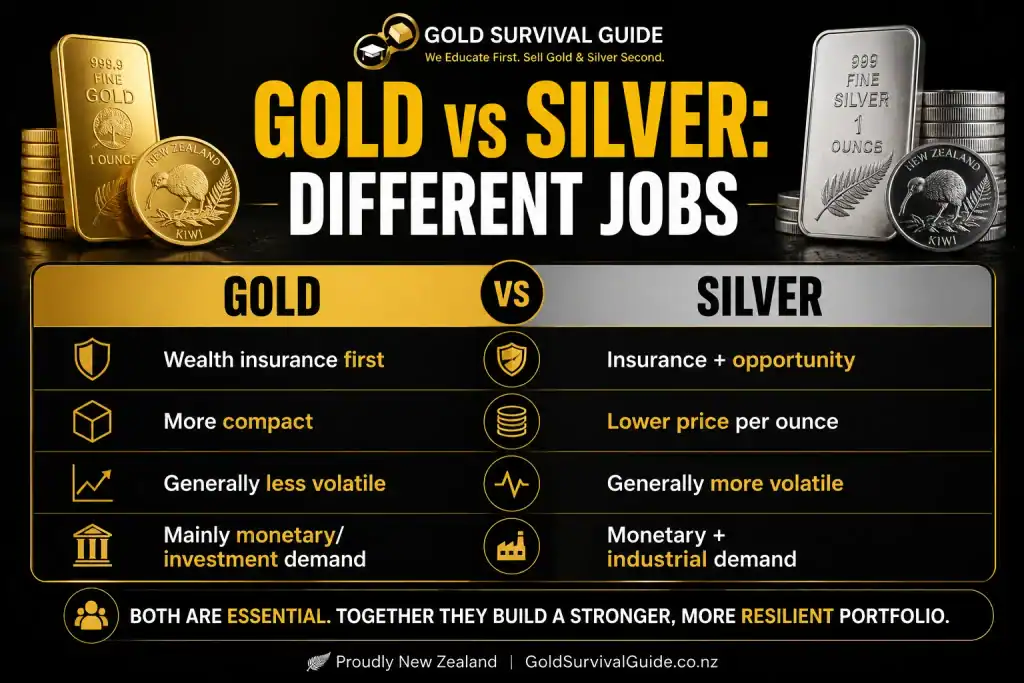
Gold and silver can perform different jobs in a wealth strategy.
Gold is generally less volatile and more compact, making it better suited to storing larger amounts of wealth. Silver has a much lower price per ounce and can produce larger percentage price movements.
Someone focused mainly on preserving substantial existing wealth may therefore favour gold. Someone prepared to accept greater volatility for greater potential upside may prefer more silver. Others choose to own both.
What We’re Seeing in New Zealand
We’ve noticed a clear shift towards silver-only purchases at Gold Survival Guide in recent months.
Historically, our transactions were more evenly spread between gold, silver and a mixture of both. More recently, silver-only purchases have made up the clear majority.
Affordability may be one factor. Gold has risen substantially in New Zealand dollar terms. Silver has risen too, but its much lower price per ounce still makes it more accessible for smaller physical precious-metals purchases.
For a fuller comparison, see Should I Buy Gold or Silver? 7 Factors to Consider
What Are the Downsides of Owning Silver?
Silver comes with several trade-offs compared with gold:
- Higher volatility: Silver can experience larger price swings in both directions.
- More storage space: The same dollar value of silver takes up considerably more room than gold.
- Premiums and spreads: Physical bullion costs more than spot, and there is normally a difference between dealer selling and buyback prices.
- Economic sensitivity: Silver’s industrial uses mean demand can also be affected by manufacturing conditions and the wider economy.
Silver’s volatility is often amplified by changing investor sentiment. Our silver market cycle analysis looks at how this has played out during previous peaks and the sharp correction in 2026.
These aren’t necessarily reasons not to own silver. They are factors to weigh against the role you want it to perform.
Physical Silver or Paper Silver? Know What You Own
Different ways of gaining exposure to silver give you ownership of different things.
Physical bullion: You own silver bars or coins directly. You are also responsible for arranging storage and eventually selling them.
Physically backed ETFs or funds: You generally own shares or units in a fund holding silver. Fees, custody arrangements and redemption rights depend on the particular product.
Silver mining shares: You own part of a mining business, not silver bullion. Returns therefore depend on factors such as costs, management and operational performance as well as the silver price.
None is automatically right or wrong. They simply serve different purposes.
If your objective is direct ownership of a tangible asset outside the financial system, physical bullion provides that. If you primarily want convenient price exposure and trading liquidity, a financial product may suit that purpose better.
What do you actually own, and does that match the reason you’re buying silver?
See Physical Gold vs Paper Gold – Which Should You Own? for a deeper explanation of this ownership principle.
How to Buy Silver in New Zealand
For most physical silver buyers, the first decision is coins or bars.
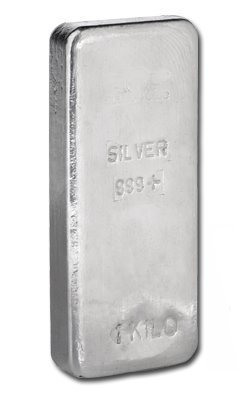
Bullion coins are typically produced by government mints and are widely recognised. Bars come in various sizes and can often provide a lower premium per ounce, particularly at larger sizes.
Neither is automatically better. Compare the premium, product size, recognisability and likely ease of resale.
Remember that physical silver normally sells above the spot price. This premium reflects costs involved in producing and supplying finished bullion.
See our guides to buying gold and silver coins or bars and choosing a silver bar for more detail.
What We’re Seeing in New Zealand
We’ve seen how quickly silver premiums and product availability can change when investment demand rises.
Popular government-mint coins can become harder to source and more expensive. At times, we’ve found products from Scottsdale Mint, including its bars and Lady Justice coins, offered better relative value when premiums on other products increased.
The takeaway isn’t that one mint is always cheapest. The best-value silver product can change with market conditions.
Think About Selling Before You Buy
Check whether your dealer offers a straightforward buyback process. Recognised bullion products and an established dealer can make selling much simpler when the time comes.
Our guide to buying and investing in gold and silver explains the wider purchasing process.
How and Where Should You Store Silver?
Physical silver can be stored at home or with a professional bullion storage provider.
Home storage gives you direct access but makes you responsible for security, discretion and insurance.
Professional storage can be useful for larger holdings or when you want bullion kept in another location. Don’t consider the storage fee alone. Check how ownership is recorded, how the metal is held, who provides the vaulting and insurance, and how you can withdraw or sell it.
Some people also choose to hold precious metals in more than one country for geographic diversification.
What We’re Seeing in New Zealand
Silver is bulkier than gold, but the practical importance depends on how much you own.
In our experience, for many buyers investing around NZ$100,000 or less, storage volume isn’t necessarily a major deciding factor. Rising silver prices also mean fewer bars are now required to hold the same dollar value than several years ago.
Storage space is a real disadvantage compared with gold, but its importance shouldn’t be exaggerated.
See our gold and silver storage guide for more detail.
Common Mistakes to Avoid When Buying Silver
Three mistakes are particularly worth avoiding:
Paying collectible premiums when you only want bullion. Collectible coins aren’t inherently bad, but don’t pay for rarity or design if your objective is simply to own silver.
Ignoring the total cost of buying and selling. Consider both the premium you pay and the likely dealer buyback price.
Buying because of a price prediction. Start with why you want to own silver and what role it should perform, rather than relying on someone else’s price target.
FAQs About Buying Silver
Silver can provide both wealth protection and potential investment upside, but it is more volatile than gold. Whether it suits you depends on your goals, timeframe and tolerance for price swings.
At Gold Survival Guide, we view physical silver as both insurance and opportunity, rather than simply a bet on a higher silver price.
Silver isn’t necessarily better than gold. Gold is generally less volatile and more compact, while silver has a lower price per ounce and can experience larger percentage price moves.
Which you choose should depend on the role you want precious metals to perform.
For a fuller comparison, see Should I Buy Gold or Silver? 7 Factors to Consider.
It depends on your objective.
Physical silver gives you direct ownership of the metal. A silver ETF generally gives you shares or units in a fund designed to provide exposure to silver.
If you want a tangible asset outside the financial system, physical bullion may better suit that purpose. If you want convenient price exposure and trading liquidity, an ETF may suit you better.
There is no single percentage that suits everyone.
The appropriate amount depends on your existing assets, financial goals, need for liquidity and tolerance for silver’s price swings.
Rather than starting with an arbitrary percentage, decide what role you want silver to perform within your wider wealth strategy.
Recognised silver bullion can generally be sold through established New Zealand bullion dealers.
The price you receive will depend on the product, market conditions and the dealer’s buyback policy. Choosing recognised bullion and a dealer with a clear buyback process can make selling simpler.
Final Thoughts: Why Own Silver?
Silver isn’t simply cheaper gold.
It combines some of the wealth-protection characteristics of precious metals with industrial demand and the potential for larger price movements. That creates opportunity, but also greater volatility.
At Gold Survival Guide, we therefore see silver as both insurance and opportunity.
The key is to understand why you’re buying it, what you actually own and how it fits alongside your other assets. Those questions are more important than trying to predict silver’s next price move.
Ready to Take the Next Step?
If you’ve decided physical silver has a place in your wealth strategy:
- View Gold & Silver Bullion
- Subscribe to our Daily Gold & Silver Price Alert
- View our current bullion deals
Editor’s Note: This article was first published on 1 October 2012 and fully rewritten on 28 October 2025. It was substantially reviewed and updated again in September 2026 to reflect current silver prices, supply and demand data, industrial demand trends and conditions in the New Zealand bullion market.

Glenn's dedication to educating individuals on wealth protection through precious metals has helped over 2400 clients from New Zealand, Australia, USA and Europe to safeguard their financial futures. Passionate about financial independence and lifestyle freedom, Glenn’s mission is to empower others with the knowledge and tools to thrive in today’s volatile economic environment. When he's not advising on precious metals, Glenn enjoys spending time with his family and pursuing outdoor adventures.
Education: University of Auckland Bachelor of Science
Linkedin: https://www.linkedin.com/in/glenn-thomas-0984a4310/
- What Type of Gold Bar Should I Buy? (Best Sizes, Brands & Bars Explained) - October 20, 2026
- Gold Prices Fall as ETF Investors and Established NZ Buyers Keep Buying - October 14, 2026
- What Are The Different Types of Gold Bars? - October 13, 2026

I think that you should address the issue of Kiwisaver. Is it better or should you just buy Gold/Silver. I am retired but my children are not.
I know that if you were in a kiwi saver type fund overseas our Govt takes 100% of the proceeds. Thus there is no reason whatsoever for anyone currently overseas and planning to come here, to invest in such schemes.
The issue is much more complex here. If you buy gold /silver every month will you end up better off than placing your hard earned in a kiwisaver fund bearing in mind taxes and loss of freedom of choice!
I would like to make a comment regarding Maurices message on Kiwisaver. As a Kiwisaver participant, I recently did some research on Kiwisaver funds, I am also an investor in Precious metals with diverse holdings in stocks and physical metals. I was keen to find a fund that had precious metals as part of a portfolio. The only provider with a % of commodities in a fund is AXA Kiwisaver Growth fund of which make up 5% of the fund with 11% of that in Gold futures and 3.8% made up in silver the rest is made up with various other commodities. With the future prices in silver and gold set to sky rocket, I believe this fund will outperform the rest. I don’t however have information on how secure these investments are. I hope this helps.
Hi Chris,
Thanks for sharing your thoughts. That’s the only fund we’d heard of that was remotely invested in precious metals too.
Of course being only 5% commodities and only a sliver in gold and silver, it will be as or even more important how the rest of the fund investments perform. And it is invested in futures by the sounds of it, so there will of course be counter-party risk involved.
We’re a long way from being Kiwisaver experts so not sure if we can offer too much else of value at this stage.
Thanks for your comments anyway Maurice and Chris.
Glenn.
I would like to put my kiwi saver into silver bullion as well…
@Heiko, We imagine a few people would like to do the same. Unfortunately there are no precious metals funds in Kiwisaver that we know of. Last we looked there was only one that invested in commodities and this had only a tiny sliver in gold. Maybe some other readers have come across other options but we haven’t to date.
Bought 15 ounces of gold in 03 & 04, at close to 400 US per. bought some silver also. Could have bought over twice that much, and wish I had. No big time here, but sold it the latter half of 2011 and made 358% profit. Just goes to show what the everyday person can do with a little patience. Once you’ve made money at it, you can smell it coming. The aroma is very strong these days. Even if you only have five or ten thousand, I would suggest that anybody buy as much as they can get their hands on.
Nice work in timing the purchase and the sale! Odds are that right now is not that dissimilar to 2003/04 in terms of time to buy.