Why Buy Gold? A New Zealand Guide to Protecting Your Wealth

Why buy gold in New Zealand – gold as wealth insurance first and investment second

Why buy gold when it pays no interest, produces no dividends and can fall in price?

It’s a fair question. But it also highlights one of the most common mistakes people make when thinking about gold: judging it in exactly the same way as shares, property or other productive assets.

At Gold Survival Guide, we think gold has a different job.

Gold is wealth insurance first and an investment second.

That doesn’t mean investment returns are irrelevant. Far from it. Gold has outperformed many conventional assets over some surprisingly long periods. But the main reason for owning physical gold is not to predict what its price will do next month or next year.

It is to own an asset that can help preserve purchasing power, diversify financial risk and protect part of your wealth when other parts of the financial system are under pressure.

In New Zealand that is an important distinction. We earn and spend in New Zealand dollars, while gold trades internationally in US dollars. Our local gold price therefore reflects both the international price of gold and the value of the Kiwi dollar.

In this guide, we’ll look at the main reasons people buy gold, what the New Zealand evidence tells us about its long-term performance, where gold can fit alongside shares, property and cash, and the risks and disadvantages you should understand before buying it.

Quick Answer: Why Buy Gold?

People buy gold primarily to protect and preserve wealth.

Physical gold is a tangible asset that can be owned outside the banking system. It has no issuer and, when owned outright, no counterparty promising to repay you.

Gold can help diversify a portfolio, preserve purchasing power over long periods and provide financial insurance against risks such as currency depreciation, inflation and financial-system stress.

For New Zealanders, gold can also provide diversification away from the NZ dollar. However, gold pays no income, its price can fluctuate significantly, and physical bullion needs to be stored securely.

The key is to think of gold as wealth insurance first and an investment second — not as a replacement for productive assets such as shares, businesses or property.

Gold Is Wealth Insurance First, Investment Second

One of the easiest ways to misunderstand gold is to compare it with assets that are designed to do a different job.

Shares represent ownership in productive businesses. Property can provide rental income. A successful business can generate profits and reinvest them to grow.

Gold does none of those things. It produces no income, pays no dividend and does not grow simply because you own it.

So why hold it?

Because creating wealth and preserving wealth are not the same thing.

Most people quite reasonably want productive assets to help grow their wealth over time. But once you have accumulated wealth, another question becomes important: how much of it do you want exposed to the same financial and monetary system?

Physical gold offers an alternative. When you own gold outright, it is not a promise from a bank, company or government to pay you in the future. It is an asset you already own.

That is why we prefer to think of gold as financial insurance.

You don’t normally buy insurance because you expect to make a profit from it every year. You own it because there are risks you would rather not leave completely uncovered.

Gold can play a similar role in a broader wealth strategy. It can provide diversification away from shares, property, cash and other financial assets, while reducing your reliance on counterparties and the monetary system itself.

But Insurance Doesn’t Mean Poor Investment Returns

Calling gold wealth insurance doesn’t mean its price performance is unimportant.

In fact, the historical record is more interesting than the common assumption that shares will always outperform gold over any sufficiently long period.

Our analysis of gold versus shares, bonds and the dollar over 25 years found that gold actually outperformed the broader sharemarket over the period we measured.

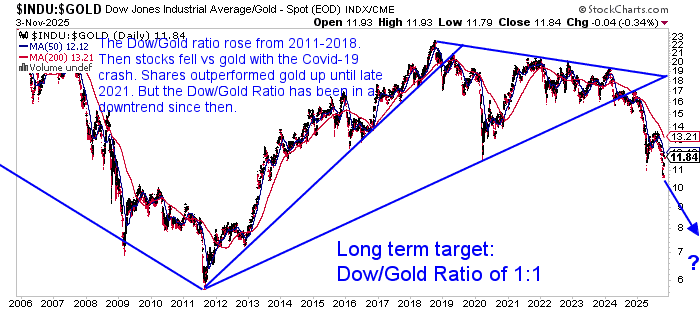
Zoom out further and the picture changes again. Our 100-year analysis of the Dow-to-Gold Ratio shows long cycles when shares outperform gold and other periods when gold gains considerably against shares.

The Dow-to-Gold Ratio shows long cycles where shares outperform gold, followed by periods where gold gains considerably against shares. Source: GoldChartsRUs.com

So the question isn’t simply:

Will gold outperform shares?

A more useful question is:

What job do I need this part of my wealth to do?

For wealth creation, productive assets have an important role. For diversification, purchasing-power protection and reducing exposure to financial-system risks, gold can perform a very different one.

Further reading: Why Gold Bullion Is Your Financial Insurance | Wealth Protection Guide

Different assets have different jobs: shares and property for wealth creation, cash for liquidity, and physical gold for wealth protection.

Why Do People Buy Gold?

People buy gold for many reasons, but most come back to one idea: gold behaves differently from the assets that make up most people’s wealth.

It has been used as money and a store of wealth for thousands of years. It is scarce, globally recognised and no government or central bank can create more of it at will.

For modern investors, those characteristics can make gold useful alongside shares, property and cash rather than necessarily as a replacement for them.

Here are some of the main reasons people continue to own it.

1. To Preserve Purchasing Power Over the Long Term

Gold is often described as an inflation hedge. But that description needs some qualification.

Gold does not reliably rise every time the Consumer Price Index (CPI) increases. Over shorter periods, its price can move independently of inflation and can sometimes fall even while living costs are rising.

The longer-term argument for gold is different.

Unlike fiat currencies, the supply of gold cannot be increased at the push of a button. Mining adds new gold each year, but only gradually. By contrast, the supply of dollars can expand considerably over time.

This is one reason gold has been used to preserve purchasing power over longer periods.

We’ve examined this specifically in New Zealand. In our analysis covering roughly 25 years to January 2024, New Zealand’s CPI index increased by around 83%, while the price of gold in New Zealand dollars increased by around 460%.

Chart comparing the NZ dollar gold price with New Zealand CPI inflation from 2000 to 2023, showing gold rising approximately 460% versus 83% for CPI inflation.
Gold priced in New Zealand dollars compared with the NZ Consumer Price Index, March 2000 to December 2023. Source: Gold Survival Guide analysis.

That doesn’t mean gold will always beat inflation over every future period. But it demonstrates why the relationship between gold and purchasing power is more useful when measured over decades rather than months.

Further reading: NZ Dollar Gold Price vs Inflation – Does Gold Really Protect Your Purchasing Power?

2. To Diversify Beyond Shares, Property and Cash

Many New Zealanders have a large proportion of their wealth concentrated in a relatively small number of places: their home, KiwiSaver, bank deposits and perhaps some shares or investment property.

Those assets can all be valuable. But they also respond differently to changes in interest rates, economic growth, credit conditions and financial markets.

Gold adds something different.

It has no earnings forecast, tenant, mortgage or business model. Its price can therefore behave very differently from conventional financial assets.

That doesn’t mean gold will always rise when shares or property fall. Correlations change, and there will be periods when several asset classes rise or fall together.

The purpose of diversification is not to find an asset that always moves in the opposite direction. It is to avoid having every part of your wealth dependent on the same conditions.

Our own New Zealand comparisons illustrate this particularly well. Over the period measured in our March 2024 analysis, New Zealand property prices rose around 391%, while gold priced in NZ dollars rose around 495%.

Again, the point isn’t that gold will always outperform property. It is that the two assets can move through very different cycles.

Further reading: Money Supply, Inflation, Property Prices and Gold – A New Zealand Comparison

3. To Own an Asset With No Issuer or Counterparty

Most financial assets involve somebody else.

A bank deposit is a liability of a bank. A bond depends on a borrower meeting its obligations. Shares represent ownership in a company whose value depends on the success of that business.

Physical gold owned outright is different.

There is no company behind a gold bar that needs to remain profitable. There is no borrower who needs to repay it and no central bank whose promise gives the metal its value.

This is what people mean when they say physical gold has no counterparty risk.

Of course, owning physical bullion creates other considerations. You need to know what you’re buying and arrange suitable storage and security. But the asset itself does not depend on somebody else’s promise to pay.

Further reading: Why Gold Bullion Is Your Financial Insurance | Wealth Protection Guide

4. To Protect Against Monetary and Currency Risk

Gold can also provide diversification away from the currency in which you normally save and spend.

Cash is useful. But its purchasing power ultimately depends on the monetary system behind it.

Governments can run deficits, central banks can alter interest rates, and the supply of currency can expand. Over long periods, those decisions can reduce what a unit of currency will buy.

Gold sits outside that process.

No central bank can decide to create another million tonnes of gold. Nor does gold depend on the policies of a single country.

That doesn’t mean the gold price only rises when a currency weakens. Many factors influence gold. But holding some wealth in gold can reduce the amount of your purchasing power tied entirely to one currency and one monetary system.

For New Zealanders, there is an additional layer because the international gold price is generally quoted in US dollars while we measure our wealth in New Zealand dollars.

Further reading: Why Buy Gold? No Fiat Currency Lasts Forever – Even the NZ Dollar

5. As Financial Insurance During Periods of Uncertainty

Gold has a long history of attracting demand during periods of financial and geopolitical uncertainty.

Banking crises, wars, political instability and concerns about the monetary system can all cause investors to reassess where and how they hold their wealth.

Gold won’t necessarily rise every time a crisis occurs. Its short-term response can vary considerably depending on factors such as the US dollar, interest rates and how markets initially react.

But physical gold can be owned outside the financial system, which is one reason some investors choose to hold it before a crisis occurs rather than trying to predict the next one.

Further reading: How Does War Affect Gold Prices?

6. Because Gold Is Globally Recognised and Liquid

One of gold’s advantages is that it is recognised almost everywhere.

Gold has been used as money and a store of wealth for thousands of years. Individual currencies and monetary systems have come and gone over that time, but gold has continued to be valued across countries and generations.

Today, gold trades around the world in deep international markets and is owned by private investors, institutions and central banks.

A widely recognised investment-grade gold coin or bar can generally be valued using an international reference price. That makes gold very different from assets whose value may depend heavily on a particular country, financial institution or local market.

Physical gold is also highly portable relative to its value.

7. Because Central Banks Still Own Gold

Perhaps one of the most interesting reasons to pay attention to gold is that the institutions responsible for today’s fiat currencies continue to own large quantities of it themselves.

Central banks hold gold as part of their official reserves because it can provide diversification, liquidity and an asset that is not the liability of another country.

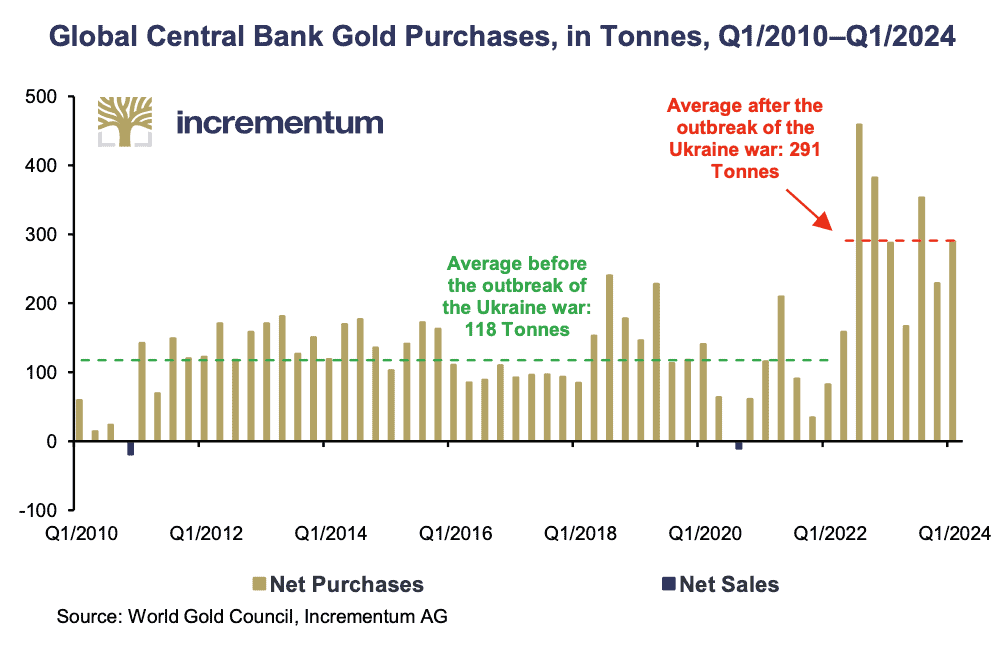
In recent years, central-bank gold buying has also returned to historically high levels.

Average annual global central bank gold purchases increased from 473 tonnes in 2010–2021 to 1,018 tonnes in 2022–2025.
Average annual central bank gold purchases more than doubled from 473 tonnes in 2010–2021 to 1,018 tonnes in 2022–2025. Source: In Gold We Trust Report / World Gold Council / Incrementum AG.

That doesn’t mean individual investors should simply copy central banks. Governments and households have very different objectives.

But it does challenge the idea that gold is merely an outdated relic from a monetary system that disappeared decades ago.

Gold no longer formally backs most currencies. Yet it remains an important reserve asset within the international monetary system.

Further reading: Central Banks Continue Building Their Gold Reserves

What Gold Can’t Do: The Risks and Trade-Offs

Gold has useful characteristics, but it also has limitations. Understanding them is just as important as understanding the reasons for owning it.

Gold Doesn’t Produce Income

Gold pays no interest or dividends. Unlike a business or rental property, it doesn’t generate cash flow simply because you own it.

That’s one reason gold can make more sense as wealth insurance than as a productive asset.

Gold Prices Can Fall

Gold can rise strongly, but it can also experience significant declines and spend years below previous highs.

Buying gold doesn’t guarantee a profit, particularly over shorter periods. This is another reason we prefer to focus on its role within a broader wealth strategy rather than trying to predict its next price move.

Physical Gold Needs Secure Storage

If you own physical bullion, you need somewhere suitable to keep it. Depending on which gold storage option you choose, that can involve additional costs.

The trade-off is that secure physical ownership is also what allows you to hold gold outside the banking and financial system.

There Are Costs to Buying and Selling

Physical gold is generally bought above the international spot price. When you sell, there will also usually be a difference between the spot price and the price a dealer is willing to pay.

These premiums and spreads vary depending on the product and market conditions.

Gold Shouldn’t Be Expected to Do Everything

Gold can help diversify and protect wealth, but it doesn’t need to replace shares, property, cash or other assets.

Each can perform a different role.

The more useful question is not whether gold is better than every other asset, but whether owning some gold improves the resilience of your overall wealth strategy.

Why Buying Gold Is Different for New Zealanders

Most international commentary about gold focuses on its price in US dollars. But if you live in New Zealand, the price that matters to you is gold in New Zealand dollars.

That’s because the local gold price is affected by two moving parts: the international US dollar gold price and the NZD/USD exchange rate.

This can produce some interesting results. Gold might be rising in US dollars while a strengthening Kiwi dollar reduces some of that gain for New Zealand investors. Conversely, a falling NZ dollar can push the local gold price higher even when the international gold price isn’t moving much.

Further reading: Why You Should Ignore the USD Gold Price When Buying Gold in New Zealand

If you’re considering when to buy, we’ve also looked specifically at how a strong New Zealand dollar can affect local gold and silver prices and whether currency movements can create better buying opportunities.

New Zealand Has No Official Gold Reserves

There’s another unusual difference closer to home.

Unlike many central banks around the world, the Reserve Bank of New Zealand does not hold gold as part of New Zealand’s official foreign reserves.

While many central banks use gold to diversify their reserves away from currencies and other countries’ liabilities, New Zealand’s official reserves provide no direct exposure to gold.

For individuals who want some of that diversification in their own wealth, physical gold is something they have to choose to own themselves.

Further reading: How Much Gold Does the Reserve Bank of New Zealand Have?

How Does Gold Compare With Cash, Shares and Property?

Gold, cash, shares and property can all play different roles in a wealth strategy. Here’s how some of their basic characteristics compare.

Physical GoldCash / Bank DepositsSharesProperty
Can produce incomeNoYesOftenOften
Tangible assetYesNo*NoYes
Issuer/counterparty riskNone when owned outrightYesYesNo issuer risk**
Generally easy to sellYesYesYesNo
PortableYesYesYes digitallyNo
Requires physical securityYesNoNoYes
Requires active managementNoNoSometimesOften

*Physical cash is tangible, but bank deposits are claims on a financial institution.

**Property has no issuer in the way a bank deposit or security does, but ownership can involve mortgages, insurers, tenants and other counterparties.

None of these characteristics makes one asset universally better than another. Cash provides liquidity, shares offer ownership in productive businesses, and property can provide utility and income. Physical gold offers something different: a tangible, globally traded asset that can be owned without relying on an issuer or financial institution.

Why Physical Gold Rather Than Paper Gold?

Not all gold ownership is the same.

Gold ETFs, funds and other forms of “paper gold” can provide exposure to movements in the gold price without requiring you to store bullion yourself. Depending on your objective, that can be convenient.

But price exposure and outright ownership are different things.

With physical bullion, you own the underlying gold itself. With paper gold, your exposure usually comes through a financial product or structure.

So the choice comes back to what you want gold to do. Paper gold may be convenient for trading or gaining price exposure. Physical bullion may be better suited to someone who wants direct ownership as part of a longer-term wealth protection strategy.

Physical ownership also brings practical considerations, including storage and security.

The right choice depends on why you want to own gold in the first place.

Further reading: Paper Gold vs Physical Gold – What Should You Buy?

Is Now a Good Time to Buy Gold?

Once you’ve decided gold has a place in your wealth strategy, the next question is often: should I buy gold now or wait?

There is no simple answer. Gold can rise or fall significantly over shorter periods, and consistently picking the best time to buy is difficult.

That’s why it can help to separate two decisions:

Why do I want to own gold?

and

When and how should I buy it?

If your aim is long-term wealth protection, trying to pick the exact bottom in the gold price may be less important than deciding how much gold you want to own and building that position over time.

That could mean buying in stages rather than all at once. It can also mean considering gold’s current valuation, the NZ dollar and what else you already own.

Further reading: When Should You Buy Gold or Silver? A Strategic Guide for Every Wealth Stage

How Much Gold Should You Own?

There is no single percentage of gold that is right for everyone.

How much you choose to own will depend on your financial position, what other assets you hold and what you want gold to do for you.

Someone buying gold mainly as financial insurance may think differently from someone using it to diversify a portfolio heavily weighted towards shares or property.

Rather than starting with an arbitrary percentage, it can be more useful to ask:

How much of my wealth do I want protected by the characteristics that gold provides?

From there, you can consider an allocation that fits alongside your other assets and wider financial plans.

Further reading: How Much Gold and Silver Should Be in Your Portfolio? [Full Guide]

So, Should You Buy Gold?

Gold isn’t the right asset for every purpose.

It won’t pay you an income. Its price can fall. And if you own physical bullion, you’ll need to think about storage and security.

But gold also offers something that shares, property and bank deposits don’t: the ability to own a globally recognised asset outright, with no issuer and no promise from somebody else to pay you.

That’s why the decision to buy gold shouldn’t rest solely on whether you think its price will rise next year.

A better place to start is with your own wealth.

What do you already own? What risks are you exposed to? And would holding some of your wealth in gold make your overall position more resilient?

For some people, the answer will be no. For others, gold can provide diversification, purchasing-power protection and financial insurance alongside productive assets.

At Gold Survival Guide, that’s how we’ve always preferred to think about gold:

Wealth insurance first. Investment second.

Why Buy Gold FAQs

Is gold a good investment?

Gold can be a useful investment, but we think its primary role is wealth protection rather than wealth creation.
Unlike shares, businesses or property, gold produces no income. Its value comes from different characteristics: scarcity, global recognition, liquidity and the ability to own it without relying on an issuer or counterparty.
Gold can also produce strong investment returns over some periods. But rather than asking whether gold will outperform other assets, it can be more useful to ask what role you want it to play in your overall wealth strategy.

Is it better to keep cash or gold?

Cash and gold perform different jobs, so it doesn’t have to be an either/or decision.
Cash is useful for everyday spending, emergencies and short-term financial needs. Bank deposits can also earn interest.
Gold produces no income, but can help diversify wealth away from banks and currencies and preserve purchasing power over longer periods.
For many people, the more useful question is therefore how much to hold in cash and how much, if any, to hold in gold.

Why do central banks buy gold?

Central banks hold gold as part of their reserves because it can provide diversification, liquidity and an asset that is not another country’s liability.
Unlike foreign currency reserves or government bonds, physical gold does not depend on another government or institution meeting its obligations.
Gold no longer formally backs most currencies, but it remains an important reserve asset. That helps explain why central banks around the world continue to own — and in recent years have bought — large quantities of it.

Is gold a good investment in New Zealand?

Gold can offer some characteristics that are particularly relevant to New Zealand investors.
Most New Zealanders already have considerable exposure to the NZ dollar through their income, savings, KiwiSaver and property. Gold can provide diversification away from both the local currency and conventional financial assets.
The NZ gold price is also influenced by the NZD/USD exchange rate, so its performance can differ considerably from gold priced in US dollars.
Whether gold is suitable for you ultimately depends on what you already own and what role you want gold to perform.

Editors Note: Initially published on 26 September 2012. Fully updated 11 August 2026.

JOIN OUR NEWSLETTER
I agree to have my personal information.
You’ll receive our weekly newsletter every Wednesday including: Latest education blog posts + Weekly New Zealand focused gold & silver commentary + NZ and US dollar gold and silver charting analysis
We hate spam. Your email address will not be sold or shared with anyone else.
Glenn Thomas

2 thoughts on “Why Buy Gold? A New Zealand Guide to Protecting Your Wealth

  1. Gerry says:

    Hi there, Good reasons, may they be oft repeated. Another one is that, at this point at least, there is no tax to pay when selling, or GST… it is possible to “hide” ones wealth in precious metals. Its not officially money right? There is no need to declare it in any way. I’m just another conspiracy nutter with dreams of Gold but no “real” digits in any bank computer; no need to bother with me…thats how I like it!

    Keep up the good work!
    Gerry.

  2. admin says:

    Hi Gerry,

    Thanks for taking the time to add another very relevant reason – especially for those who prefer to stay “off grid”.

    Cheers
    Glenn

Leave a Reply

Your email address will not be published. Required fields are marked *