

When to buy gold or silver is one of the most common questions we hear — and it’s not as simple as waiting for a dip in the price.
The answer depends on a number of factors: your financial goals, your stage in life, the state of the global economy, and what you’re really hoping to achieve with your purchase.
That’s because timing the market is far less important than having a strategy. If you’re like many of our clients, you’re not looking to “flip” gold or silver for a quick buck — you’re looking to protect your wealth, secure your future, and gain more control over your finances.
In this guide, we’ll help you figure out the right time for you to buy precious metals. Whether you’re just starting out or already have a stack of bullion to your name, you’ll find a smarter path forward — one that doesn’t rely on crystal balls or lucky guesses.
Table of contents
- Why Timing Isn’t Everything: The Myth of the Perfect Price
- Where Are You in Your Financial Life? A Stage-Based Approach
- Gold or Silver — Which Should You Buy First?
- How Global Events Influence the Right Time to Buy
- 3 Smart Strategies for Buying Gold and Silver (That Don’t Rely on Luck)
- When Should You Buy More Gold or Silver (Even If You Already Own Some)?
- Is There a Best Time of Year to Buy Gold and Silver?
- Where Should You Store Your Gold or Silver?
- The Best Time to Buy: Today
- Conclusion: Buy With a Plan, Not a Prediction
- Frequently Asked Questions: When to Buy Gold or Silver
Why Timing Isn’t Everything: The Myth of the Perfect Price
If you’ve ever held off buying gold or silver because you thought, “Maybe the price will drop next week,” you’re not alone.
But here’s what we’ve seen time and again: waiting for the “perfect” moment can often mean missing the opportunity altogether.
Gold and silver prices move based on a wide range of factors — many of which are unpredictable. Geopolitical events, currency shifts, central bank policy decisions, and even short-term investor sentiment can cause big swings. And often by the time a price dip is obvious, it’s already over.
That’s why the most experienced bullion buyers don’t aim to “time” the market. Instead, they focus on building a position steadily, according to a plan. This approach reduces stress, lowers risk, and — as we’ll show later — often leads to better results over the long term.
So instead of asking, “Is today the bottom?”, a better question might be:
“Is now the right time for me to begin or continue building my position?”
That’s what the rest of this guide will help you answer.
Short-Term Timing vs Long-Term Positioning
There’s a big difference between:
- trying to perfectly time short-term price moves, and
- strategically building a long-term position in precious metals.
This guide focuses primarily on long-term wealth protection timing rather than short-term trading.
Many people spend a lot of time waiting for the perfect entry point. The challenge is that certainty often appears after prices have already moved.
If you’d like to understand why trying to wait for the “perfect time” can sometimes become a trap, read:
The Best Time to Buy Gold Is Before You Need It
If you’re looking for short-term entry signals and current price analysis, see:
Should I Buy Gold Today or Wait?
Your Wealth Goals Determine When to Buy
Gold and silver serve different purposes depending on your goals. And your goals are the key to knowing when you should buy — and how much.
Let’s break down a few common reasons people choose to buy precious metals:
Wealth Preservation
For many, gold and silver are a form of financial insurance. They’re a store of value outside the banking system — immune to counterparty risk and government printing presses.
If your goal is to preserve wealth, especially in uncertain times, then the best time to buy is before you need it. This is the approach we recommend most often: treat precious metals as a long-term safeguard, not a short-term trade.
Intergenerational Wealth
Some of our clients are building wealth not just for themselves, but for their children or grandchildren. Gold is an ideal asset for this — tangible, recognisable, and trusted across generations.
If you’re planning to pass on wealth, then the key is accumulation over time. Buying regularly, without trying to time highs or lows, can quietly build a powerful legacy.
Next up, we’ll help you understand how your stage in life can also shape your buying strategy.
Where Are You in Your Financial Life? A Stage-Based Approach
Knowing where you are financially can help guide not only when to buy gold or silver, but also how to buy.
The needs of a first-time buyer are very different from someone approaching retirement, or someone managing an inheritance. That’s why your strategy should match your stage of life.
Here’s how to think about it:
Just Getting Started
If you’re new to precious metals — or even new to investing altogether — start simple.
At this stage, the goal is to establish a position, even if small. The key is consistency. Consider dollar-cost averaging: buying a set amount at regular intervals regardless of the price. This takes the guesswork out of timing and helps smooth out volatility over time.
Focus on:
- Affordability: Work within your budget
- Flexibility: Smaller denominations like 1oz coins or bars
- Education: Learn the fundamentals of buying, storing, and selling
🔗 Want to know if now is a good time to begin? See our short-term timing guide: Should I Buy Gold Today or Wait?
Building Wealth
You may already have some savings or investments and want to diversify into hard assets. This is often when people add precious metals as a hedge against inflation, financial instability, or excess market risk.
At this stage, many of our clients start allocating 5–20% of their overall net worth to physical gold and silver — depending on their risk profile and view of the world.
Key strategies:
- Buy on dips, but don’t delay for perfection
- Increase silver exposure for potential upside
- Consider secure storage for larger holdings
Pre-Retirement or Already Retired
For those nearing retirement, the priority often shifts to security and stability. You may want to lock in wealth you’ve built — and move some of it out of the system entirely.
Gold and silver offer:
- No counterparty risk
- Liquidity when needed
- A store of wealth you can pass on easily
Common strategies:
- Use proceeds from asset sales or income drawdowns to allocate into metals
- Consider offshore storage for additional security
- Review your holdings annually and rebalance if needed
In the next section, we’ll help you choose whether to focus on gold or silver first — and how to use the gold-silver ratio to guide your decision.
Gold or Silver — Which Should You Buy First?
Deciding whether to start with gold or silver depends on your goals, risk tolerance, and budget. But the good news is: you don’t need to pick just one. Most people end up holding both — the only question is where to begin.
Here’s a quick overview to get you thinking strategically:
- Gold is generally more stable and compact — ideal for long-term wealth preservation.
- Silver offers more upside potential (with more volatility) — great for building a position over time.
But this is just the tip of the iceberg. If you want help deciding which is best for your situation:
Read this in-depth guide:
Should I Buy Gold or Silver? 7 Factors to Consider
When you’re ready to move from decision to action, you’ll want to choose the right format — bars, coins, or a mix – based on your storage, liquidity, and budget needs:
Read our practical buyer’s guide:
Buy Gold or Silver Coins and Bars in NZ: What You Need to Know
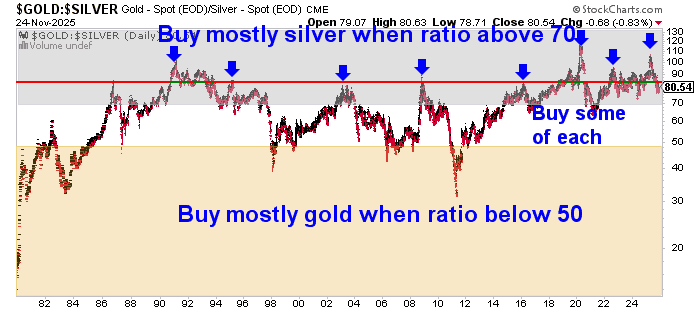
And if you’re looking for a data-driven edge in your decision, don’t forget to keep an eye on the Gold-Silver Ratio – it’s a simple indicator that can show when one metal is undervalued relative to the other.
When the ratio is above 70, silver is considered historically undervalued — and it’s often a good time to buy more silver than gold. When it’s below 50, gold becomes the better value.
Right now, at around 80, silver may offer more upside in relative terms.
For full insights: Gold-Silver Ratio: What Is It and Why It Matters
In the following section, we’ll look at how global events — like inflation, currency debasement, or geopolitical shocks — can influence your timing and mindset when buying gold and silver.
How Global Events Influence the Right Time to Buy
Gold and silver have long been seen as safe havens — assets that hold their value when the rest of the financial system wobbles. That’s why understanding what’s happening in the world around you can be a helpful signal for when to buy.
But global events shouldn’t cause panic or paralysis — instead, they should help shape a strategy that gives you more control in uncertain times.
Let’s look at some of the key events that can influence the right time to buy gold or silver — and how to respond wisely.
Inflation and Currency Debasement
One of the most common drivers of demand for precious metals is inflation — especially when it’s persistent and structural.
When central banks like the RBNZ or the US Federal Reserve print more money or hold interest rates too low for too long, it eats away at the value of fiat currencies. In this environment, gold and silver become attractive because they don’t lose purchasing power over time.
Strategy tip: You don’t need to wait for inflation to spike to buy gold or silver. In fact, once inflation becomes headline news, metals have often already begun their run.
Bank Failures and Financial Contagion
From Silicon Valley Bank in 2023 to Credit Suisse’s collapse, the past few years have shown just how fragile parts of the banking system still are.
When trust in banks is shaken, people often rush to physical assets — especially unencumbered assets they can hold or securely store. Gold and silver are one of the few options that don’t rely on counterparties or complex financial promises.
Events like these are reminders — not alarms. If your wealth protection strategy includes gold and silver, it’s best to be positioned before the headlines hit.
Geopolitical Tensions and War
Global conflict often triggers sharp movements in precious metal prices — especially gold. But just like with inflation, the biggest gains usually happen when the risks are rising, not after the first missile flies.
Think of war and geopolitical tension as part of a broader risk landscape — a backdrop against which gold can shine as a non-political, borderless, and universally accepted asset.
Want a deep dive? See how war affects gold and silver prices →
Sovereign Debt Crises
Whether it’s the US, Japan, Europe, or New Zealand, government debt levels are rising fast — and that has real consequences.
High debt reduces flexibility, increases default risk, and forces central banks to keep interest rates artificially low. The result? Long-term currency debasement — which is bullish for gold and silver.
Remember: Precious metals aren’t just a hedge against inflation — they’re a hedge against the system itself.
What Should You Do?
When global risks rise, your best move is usually not to react, but to ensure you’ve already taken action.
Ask yourself:
- “If something unexpected happens tomorrow, will I regret not having acted today?”
- “Have I positioned a portion of my wealth in real assets that don’t rely on governments, banks, or digital platforms?”
If the answer is no, it might be time to take the next step.
Next up, we’ll explore three smart buying strategies — so you can build your position without relying on luck or market timing.
3 Smart Strategies for Buying Gold and Silver (That Don’t Rely on Luck)
If you’ve ever felt unsure about the right time to buy gold or silver, you’re not alone. Even seasoned investors can get caught in the trap of waiting for “the perfect moment” — and missing multiple good ones along the way.
The good news? You don’t need to predict the market to build a solid position.
Here are three proven strategies our clients have used to build their gold and silver holdings with confidence — no crystal ball required.
1. Buy the Dips
This is a classic move: buy when prices pull back, especially during short-term corrections in a longer-term uptrend.
Gold and silver often rise in stair-step patterns — they climb, pause, pull back, and then climb again. Dips are natural, and they can be excellent entry points if you’re watching closely. (You can track live prices on our charts page).
Tip: Sign up for our free daily gold and silver price alerts to get notified of price movements and market commentary. It’s the easiest way to spot a dip without obsessing over charts.
Get Daily Price Alerts Here
What is Technical Analysis?
Technical analysis is simply using charts and indicators with a view to determining where the price of a financial asset (such as gold or silver) may be heading. But based solely upon what the price has done in the past.
Read more here: Gold and Silver Technical Analysis: The Ultimate Beginners Guide
Finally, here is a Q&A call where we give a run down on some simple ways to improve your timing when buying gold and silver.
2. Dollar-Cost Averaging (DCA)
This is a smart strategy if you’re worried about buying at the wrong time.
With dollar-cost averaging, you simply invest a fixed amount regularly — say, monthly or quarterly — regardless of what the price is doing. This smooths out your entry price over time, avoids emotional decision-making, and builds discipline into your wealth protection strategy.
Perfect for:
- Beginners just getting started
- Long-term planners
- Anyone wanting to avoid market FOMO
Even small, consistent purchases can quietly build a powerful position over 1–2 years — without needing a large lump sum.
3. Rebalancing and Opportunistic Top-Ups
Already own some gold or silver? Great. That doesn’t mean you’re done.
Many experienced buyers choose to rebalance their holdings periodically — especially after large moves in price or other investments (like property or shares).
Other times, it makes sense to “top up” during times of major global risk or uncertainty, even if prices are higher. Think of it as insurance you hope you’ll never need, but that you’re glad you have when things turn.
Example: If gold pulls back 10% from a recent high, that could be a smart time to add more — especially if fundamentals haven’t changed.
No matter which strategy fits you best, the key is to have a plan — and stick to it. That’s what separates the confident from the hesitant, and the protected from the exposed.
Next, we’ll talk about a lesser-known question:
“When should I buy more gold or silver — even if I already own some?”
When Should You Buy More Gold or Silver (Even If You Already Own Some)?
If you’ve already started your precious metals journey — congratulations. You’re ahead of most.
But like any long-term strategy, owning gold or silver isn’t a “set and forget” decision. The real question becomes:
When should I add more to my stack?
Here are a few key times when topping up your position might make sense:
1. After Big Price Pullbacks
One of the smartest times to add to your position is when the market temporarily turns against you — but the long-term fundamentals haven’t changed.
Example: If silver drops 15% in a short timeframe due to market noise — but the global debt load, inflation outlook, or geopolitical tensions remain — it may be a tactical time to buy more.
In fact, some of our most successful clients use price corrections as buying signals — not reasons to panic.
Our silver market cycle analysis looks at how investor sentiment has changed following silver’s sharp 2026 correction.
2. When Your Portfolio Gets Out of Balance
As your net worth grows or changes, your gold and silver allocation might get out of line with your goals.
Let’s say:
- You initially aimed for 10% of your wealth in metals
- Your property or equities portfolio grows faster
- Suddenly, metals are only 5% of your total assets
In that case, it may make sense to rebalance — topping up gold or silver to bring things back into alignment.
Rebalancing isn’t just about ratios — it’s about staying true to your strategy.
3. When Economic or Political Risk Spikes
Sometimes it’s not about the charts — it’s about what’s happening in the world.
If there’s a new bank failure, war, financial panic, or political shake-up, you might choose to strengthen your position in metals to increase your financial resilience.
Think of this like topping up your fire insurance when there’s smoke on the horizon — better to act before the flames arrive.
4. When Your Goals Shift
Maybe your income has grown, or you’re getting closer to retirement. Maybe you’ve inherited wealth or are planning to leave a legacy.
As your life changes, your approach to wealth protection should evolve too.
Adding more gold or silver at these turning points can help lock in your progress — and ensure your wealth is backed by real, tangible assets.
Next, we’ll look at a more seasonal question we get asked a lot:
Is there a best month or time of year to buy gold or silver?
Is There a Best Time of Year to Buy Gold and Silver?
You might be surprised to learn that gold and silver tend to move in seasonal patterns — with certain months offering better buying opportunities than others.
While no one can predict short-term moves with certainty, looking at historical trends can give you an edge when deciding when to enter or top up your position.
Let’s break it down.
Seasonal Buying Patterns
Historically, gold and silver have shown a tendency to pull back during certain months, creating potentially better entry points.
Gold in USD Terms:
Based on decades of data, the best-performing months for buying gold have often been:
- March
- April
- June
- November to December
These months often follow seasonal dips or slower trading periods, giving buyers a temporary discount before the next leg up.
But What About NZ Dollar Buyers?
If you’re buying in New Zealand — as most of our clients are — there’s another important factor to consider: the NZD/USD exchange rate.
A weaker Kiwi dollar can push local gold and silver prices higher, even if the international (USD) price is flat or falling. So relying on USD seasonality alone might not tell the full story.
While global gold seasonality is usually discussed in US dollar terms, New Zealand investors also need to consider currency movements.
Historically however, NZ dollar gold prices have still shown surprisingly consistent second-half strength.
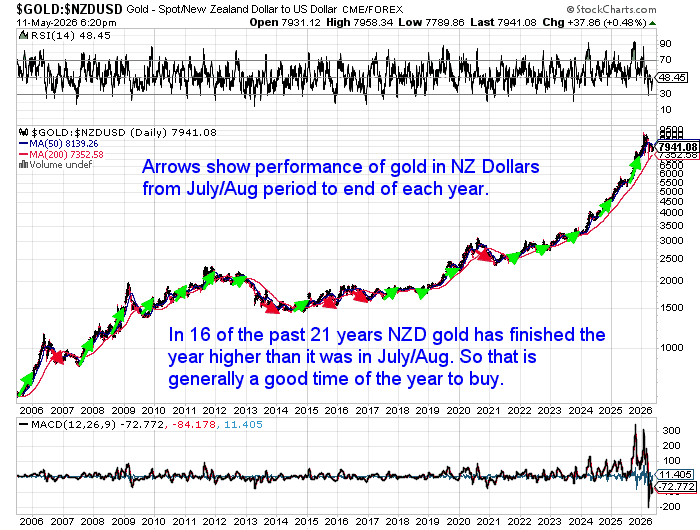
Seasonal trends can sometimes help improve buying decisions — especially for long-term investors gradually building a position.
But seasonality should only be viewed as one piece of the puzzle.
Inflation, interest rates, currency movements, and broader economic conditions usually matter far more over the long term.
For a deeper analysis of:
- NZ gold seasonality
- silver seasonality
- the holiday dip effect
- year-end buying trends
- and historical NZD price patterns
read our full guide:
Does Gold Seasonality Affect the NZ Dollar Gold Price?
Where Should You Store Your Gold or Silver?
Once you’ve decided when to buy gold or silver, the next step is deciding where to store it.
Most investors choose one of three options:
- Home storage for quick access and control
- Bank safety deposit boxes
- Professional bullion vault storage for higher security and insurance
For larger holdings, many investors prefer specialist bullion vaults because they offer:
- full insurance,
- high security,
- privacy,
- and easier long-term wealth protection.
Some also choose offshore storage as a form of geographic diversification.
→ Learn more in our full guide to gold and silver storage.
The Best Time to Buy: Today
Having said all of the above, perhaps the best answer to when to buy gold and silver is… today.
Or more accurately:
When you think you may need it — rather than when you actually do.
The best time to buy gold and silver is usually before a financial crisis, not during one.
Just like you don’t buy house insurance after the house catches fire, it’s often better to build your position while markets are calm and premiums are lower.
In the end, deciding to own gold and silver is usually more important than trying to perfectly time the purchase.
Conclusion: Buy With a Plan, Not a Prediction
There’s no one-size-fits-all answer to when you should buy gold or silver.
But here’s what we know for sure:
It’s almost never about finding the perfect price — it’s about having a plan that aligns with your goals, your values, and the world we’re living in.
Whether you’re:
- Just starting your wealth protection journey,
- Growing your holdings during uncertain times,
- Or rebalancing your portfolio to reflect today’s risks…
Gold and silver give you the power to take control.
They’re real, unencumbered, and sovereign assets — and they’re yours.
At the Gold Survival Guide, our mission is to make that journey easier, safer, and more strategic — with guidance, education, and secure storage to match.
Your Next Steps
- Still unsure whether now is the right time? Read this guide on short-term timing →
- Want to buy the dips? Sign up for our free daily price alerts
- Need secure storage? Explore our Storage Solutions
- Have questions? Ask us anything — we’re here to help.
Keep Reading
This article is part of our Wealth Protection Series:
- Why Buy Gold? 14 Reasons
- Why Buy Silver? 21 Reasons
- How Much Gold or Silver Should I Buy?
- Gold-Silver Ratio: What Is It and Why It Matters
Want to protect your wealth with confidence — without relying on guesswork or gut feelings?
This guide is your foundation.
Let us help you take the next step.
Or check out the gold and silver products available: Buy Gold or Buy Silver.
Editors Note: This article was originally published 6 December 2017. It was fully rewritten on 25 November 2025.
Frequently Asked Questions: When to Buy Gold or Silver
It depends on your goals. If you’re seeking stability and wealth preservation, gold is often the better starting point. If you’re comfortable with more volatility and want potential upside, silver may be a good fit. Many people end up owning both.
Compare gold vs silver →
There’s no perfect time — but if you’re worried about inflation, global uncertainty, or protecting your wealth, the best time may be before you need it. Many people wait for certainty or a perfect entry point, only to discover that opportunities often look clearer in hindsight.
Read: The Best Time to Buy Gold Is Before You Need It
Historically, March, June, and December have offered good entry points. But for NZ buyers, the NZD exchange rate also matters. Seasonal patterns can be helpful — but having a strategy matters more.
Gold seasonality explained →
Some buy a lump sum during pullbacks. Others dollar-cost average monthly or quarterly. The best approach is the one you can stick to — with calm, not FOMO.
This varies based on your goals, risk tolerance, and stage of life. Many use 5–20% as a starting range.
Full guide here →
You can store it at home (in a safe), at your bank (with limitations), or in a purpose-built vault like our Sovereign Store. We offer secure, insured storage in NZ and offshore.
Explore storage options →

Glenn's dedication to educating individuals on wealth protection through precious metals has helped over 2400 clients from New Zealand, Australia, USA and Europe to safeguard their financial futures. Passionate about financial independence and lifestyle freedom, Glenn’s mission is to empower others with the knowledge and tools to thrive in today’s volatile economic environment. When he's not advising on precious metals, Glenn enjoys spending time with his family and pursuing outdoor adventures.
Education: University of Auckland Bachelor of Science
Linkedin: https://www.linkedin.com/in/glenn-thomas-0984a4310/
- Where Are We in the Silver Market Cycle? - September 15, 2026
- Why the Netherlands Is Moving More of Its Gold Reserves to London - September 9, 2026
- What Is the Gold Silver Ratio? What Is It Telling Us Now? - September 8, 2026
