
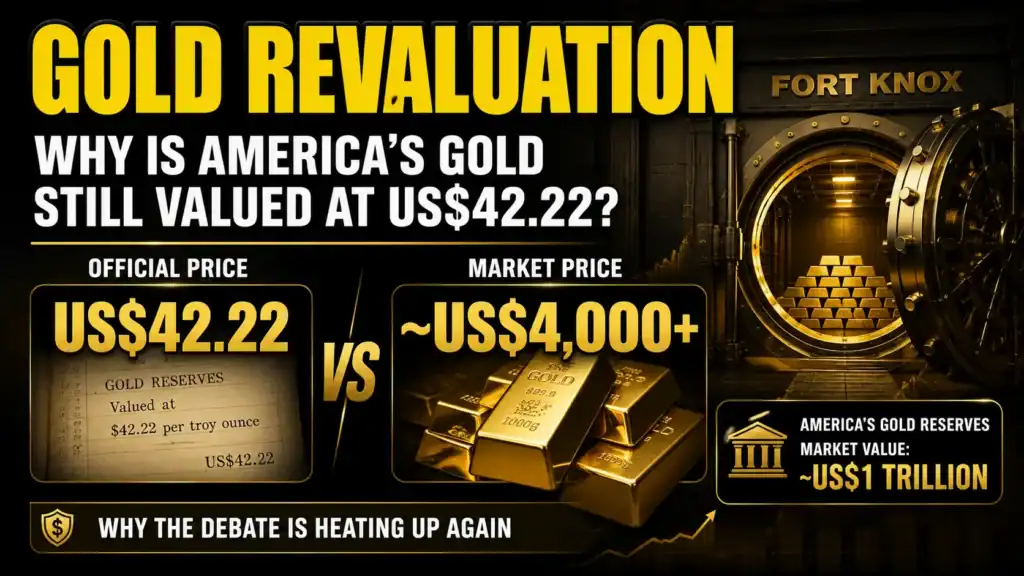
Gold Revaluation Is Back in the Headlines
For years, gold revaluation was largely confined to academic papers and specialist discussions among economists and precious metals investors.
Today, it’s back in the headlines.
Recent comments by US Treasury Secretary Scott Bessent confirming America’s gold reserves are “present and accounted for” have renewed attention on an unusual question:
Why does the United States still officially value its gold at just US$42.22 per ounce when it’s worth close to US$4,000 per ounce on the open market?
The answer lies in a little-understood concept known as gold revaluation.
Although there is currently no indication the US government intends to revalue its gold reserves, the debate has quietly returned to mainstream discussion.
Understanding why helps explain not only the role of gold in today’s financial system, but also why central banks continue accumulating it. Plus why economists periodically revisit the idea whenever sovereign debt and monetary reform become major issues.
Quick Answer: What Is Gold Revaluation?
Gold revaluation is when a government officially changes the accounting value of its gold reserves. It has happened before—most notably in the United States in 1934—and some economists believe it could be used again to strengthen sovereign balance sheets or restore confidence during periods of monetary stress.
There is currently no official proposal to revalue US gold reserves. However, renewed discussion around Fort Knox, the Treasury’s official gold valuation of just US$42.22 per ounce, and recent comments from Treasury Secretary Scott Bessent have brought the topic back into mainstream debate.
Understanding how gold revaluation works provides valuable insight into why governments still hold large gold reserves, despite no longer operating under a gold standard.
| Official gold price | Market gold price |
|---|---|
| US$42.22 | ~US$4,000 |
Table of contents
- Gold Revaluation Is Back in the Headlines
- Quick Answer: What Is Gold Revaluation?
- Why Is Gold Revaluation Being Discussed Again?
- What Is Gold Revaluation?
- Has Gold Ever Been Revalued Before? A Brief History
- Why Did the Federal Reserve Publish a Paper on Gold Revaluation?
- Why Economists Disagree About Gold Revaluation
- Could the US Revalue Its Gold Reserves Again?
- Why Do Some People Talk About Gold at US$10,000 Per Ounce?
- What Would Happen if the US Revalued Its Gold Reserves?
- What Does This Mean for Gold Investors?
- What Should Investors Watch?
- FAQs About Gold Revaluation
- Final Thoughts
Estimated reading time: 14 minutes
Why Is Gold Revaluation Being Discussed Again?
Only a few years ago, gold revaluation was rarely discussed outside academic papers and specialist circles.
Today, it is appearing in mainstream financial commentary once again.
Several developments have brought the topic back into focus.
Central banks have been buying gold at the fastest pace in decades, reinforcing its continued role as a strategic reserve asset.
At the same time, growing government debt levels have renewed discussion about ways countries could strengthen sovereign balance sheets without dramatically cutting spending or raising taxes.
More recently, attention has turned back to Fort Knox and the official value of America’s gold reserves. While Treasury Secretary Scott Bessent recently confirmed the United States’ gold is “present and accounted for,” his comments have also highlighted a little-known fact: those reserves are still officially carried on the Treasury’s books at just US$42.22 per ounce, even though their market value is many times higher.
Why Scott Bessent’s Comments Are So Significant
This isn’t just any Treasury Secretary.
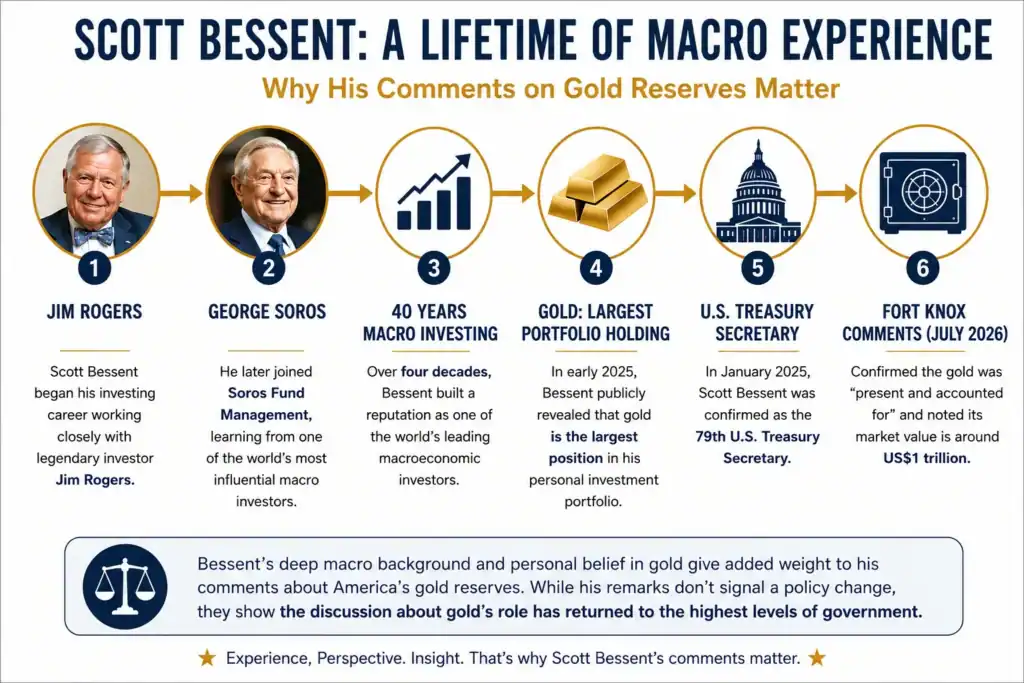
Scott Bessent spent decades as one of the world’s leading macro investors, working alongside Jim Rogers before later becoming Chief Investment Officer for George Soros. He has also publicly described gold as the largest holding in his own investment portfolio.
During the Fort Knox visit, Bessent didn’t simply confirm that America’s gold reserves were “present and accounted for.” He also referred to their value at today’s market prices – around US$1 trillion – rather than only their statutory book value of US$42.22 per ounce.
For decades, official U.S. gold has largely been discussed using its historical accounting value. Referring to its current market value naturally raises the question this article explores: should the official value ever be updated as well?
Related:
New US Treasury Secretary: Gold Holds the Centre of His Portfolio
For years, much of the public debate centred on whether the gold was really there. (See: What’s Really in Fort Knox?)
Increasingly, the question is becoming:
If the gold is there, why is it still valued using a price set more than fifty years ago?
Finally, the Federal Reserve itself added to the discussion when it published research examining historical examples of official gold revaluation. While the paper did not advocate revaluing US gold reserves today, it highlighted that governments have used gold revaluation before during periods of major monetary change.
Taken together, these developments have moved gold revaluation from an obscure historical topic back into a subject of active discussion among economists, investors and policymakers.
The question is no longer simply whether governments hold gold. Increasingly, it is what role that gold could play if confidence in today’s monetary system came under pressure.
What Is Gold Revaluation?
Gold revaluation is the process of officially changing the accounting value of a government’s gold reserves.
Unlike buying or selling gold, a revaluation doesn’t change how much gold a country owns. Instead, it changes the value assigned to those reserves on the government’s balance sheet.
Think of it like updating the value of a property on a company’s books. The building hasn’t changed, but its recorded value has.
The same principle can apply to gold.
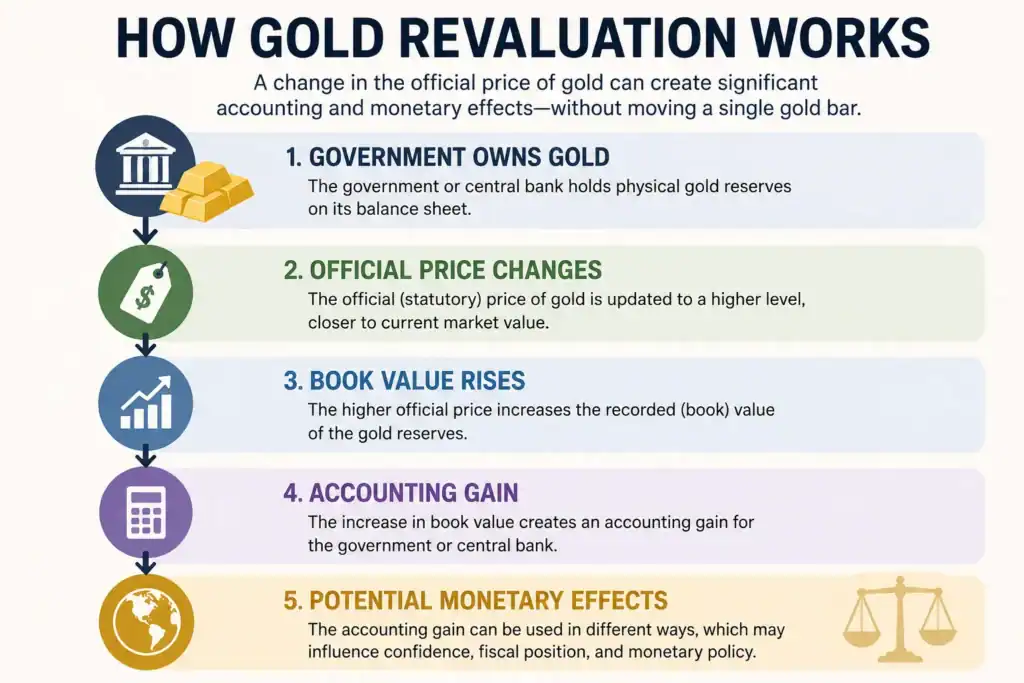
How Does Gold Revaluation Work?
A government doesn’t need to move a single gold bar.
Instead, it simply changes the official value assigned to its existing reserves.
Because central banks often hold thousands of tonnes of gold, even a relatively small change in the official price can dramatically increase the reported value of those reserves.
That increase creates an accounting gain, which may strengthen the government’s or central bank’s balance sheet. Depending on a country’s laws and monetary framework, some of that gain may also be transferred to the Treasury or used to support the financial system.
It’s important to understand that this is primarily an accounting change, not a physical transaction.
Why Is Gold Different?
Unlike most government assets, gold has served as money for thousands of years.
Although today’s currencies are no longer backed by gold, central banks continue to hold large gold reserves because gold remains one of the few reserve assets that carries no counterparty risk.
That is one reason economists occasionally revisit gold revaluation during periods of monetary stress.
Has Gold Ever Been Revalued Before? A Brief History
1933–1934: Roosevelt’s Revaluation
Amid the Great Depression, President Roosevelt suspended gold convertibility and later raised the price of gold from $20.67 to $35 per ounce. That devalued the dollar and increased the Treasury’s gold value, giving the government greater flexibility to spend during the Great Depression.
1971–1973: The End of Bretton Woods and the US$42.22 Gold Price
Although the US dollar was no longer convertible into gold after 1971, Congress set a new statutory gold price of US$42.22 per ounce in 1973.
Unlike the market price, this figure is used purely for accounting purposes when valuing the US government’s official gold reserves.
While gold now trades at many thousands of dollars per ounce, the statutory price has remained unchanged for more than fifty years.
| Year | What Happened | Why It Still Matters Today. |
|---|---|---|
| 1934 | Gold revalued from US$20.67 to US$35 | Increased the official value of government gold reserves |
| 1971 | Bretton Woods ends | Dollar no longer convertible into gold |
| 1973 | Statutory gold price set at US$42.22 | Still used for official accounting today |
| 2025 | Federal Reserve publishes research | Gold revaluation returns to academic discussion |
| 2026 | Bessent comments on Fort Knox | Public debate shifts back to the role and valuation of US gold reserves |
For decades, gold revaluation was largely viewed as a historical curiosity in the United States.
That is beginning to change.
Recent debate around Fort Knox, sovereign debt and the official value of America’s gold reserves has prompted economists and policymakers to revisit how previous gold revaluations worked. And whether they could ever become relevant again.
Why Did the Federal Reserve Publish a Paper on Gold Revaluation?
Gold revaluation had received relatively little attention in recent decades.
That changed in 2025 when the Federal Reserve published a research paper titled Official Reserve Revaluations: The International Experience.
The paper did not recommend that the United States revalue its gold reserves.
Instead, it examined several modern examples where governments used reserve revaluations to strengthen central bank balance sheets or address financial pressures.
Its publication was significant not because it proposed a new policy, but because it demonstrated that gold revaluation remained a subject worthy of serious economic research.
What Did the Fed Study?
Rather than focusing on historical US examples, the paper examined several modern cases where countries used reserve revaluations to improve public-sector balance sheets.
These included Curaçao and Sint Maarten, Germany, Italy, Lebanon and South Africa.
Although each country faced different circumstances, the common theme was that revaluation generated accounting gains that could support central banks or government finances.
Importantly, the paper also noted that revaluation did not solve underlying structural economic problems on its own.
Why Economists Disagree About Gold Revaluation
Gold revaluation has attracted renewed interest, but there is no consensus that it would be the right policy response. Economists generally agree on how gold revaluation works, but they disagree on whether it would produce lasting economic benefits. Much depends on the circumstances, the broader monetary framework and the objectives policymakers are trying to achieve.
Supporters argue that:
- It strengthens government or central bank balance sheets.
- It recognises the current market value of official gold reserves rather than an outdated statutory price.
- It could help restore confidence during periods of monetary stress.
- It has historical precedent.
Critics argue that:
- It creates accounting gains rather than real economic wealth.
- It doesn’t solve structural debt or fiscal problems.
- If handled poorly, it could unsettle confidence by signalling that the existing monetary system is under stress.
- Governments could become tempted to rely on financial engineering instead of reform.
The important point is that gold revaluation is neither a guaranteed solution nor an unrealistic idea. History shows it has been used before, but whether it is appropriate depends entirely on the economic circumstances and the objectives policymakers are trying to achieve.
Understanding both sides of the debate helps explain why gold revaluation continues to resurface whenever confidence in the monetary system comes under pressure.
Related: If/When the US Dollar Collapses, What Will Gold (and Silver) Be Priced In?
Could the US Revalue Its Gold Reserves Again?
History shows governments have revalued gold before, so it cannot be dismissed as impossible.
However, there is currently no official proposal for the United States to revalue its gold reserves, and Treasury Secretary Scott Bessent has not suggested such a policy.
What has changed is that gold revaluation has returned to mainstream discussion. Rising sovereign debt, record central bank gold buying, renewed attention on Fort Knox and the Federal Reserve’s research have all encouraged economists and market commentators to revisit an idea that had largely been forgotten.
Whether it ever happens will ultimately depend on future economic conditions rather than today’s headlines.
Why Do Some People Talk About Gold at US$10,000 Per Ounce?
One figure appears again and again whenever gold revaluation is discussed:
US$10,000 per ounce.
It isn’t an official target.
Nor has the US government proposed such a figure.
Instead, various analysts have attempted to estimate the gold price that might be required under different monetary scenarios, depending on how much of the money supply or government liabilities policymakers wished to support with official gold reserves.
Because each model uses different assumptions, estimates vary widely.
Some are considerably lower than US$10,000.
Others are significantly higher.
The important point is that these figures are theoretical exercises rather than predictions.
If governments ever chose to revalue gold, the official price would ultimately be a political and monetary policy decision—not a mathematical certainty.
Gold Revaluation at a Glance
| Question | Answer |
|---|---|
| Could gold be revalued again? | Yes. History shows it has happened before. |
| Is there an official proposal today? | No. |
| Has the Treasury announced a revaluation? | No. |
| Why are people discussing it? | Debt, Fort Knox, central bank gold buying and renewed policy debate. |
| Is US$10,000 an official target? | No. It’s one of many theoretical estimates. |
Ultimately, discussions about US$10,000 per ounce shouldn’t distract from the more important question. If governments ever chose to revalue gold, the official price would reflect the economic and monetary objectives they were trying to achieve at the time—not a predetermined number suggested by analysts today.
Related: See our Gold Backing to Debt Ratio (Historical Reset) model, which points to numbers as high as ~US$35,800/oz.
What Would Happen if the US Revalued Its Gold Reserves?
On paper, gold revaluation can look like a simple solution. In reality, its effects would extend far beyond the government’s balance sheet.
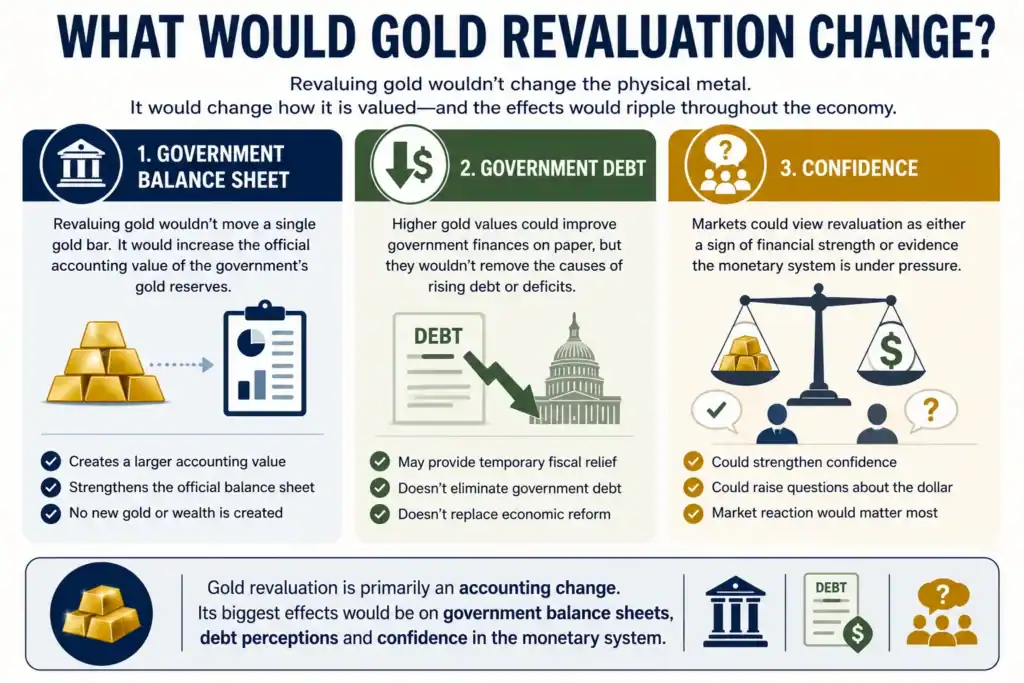
1) It Would Strengthen the Government’s Balance Sheet
A gold revaluation wouldn’t move a single gold bar. Instead, it would increase the official accounting value of the U.S. government’s gold reserves.
That could create a large accounting gain and strengthen the Treasury’s or Federal Reserve’s balance sheet. However, no new wealth would be created—the same amount of gold would simply be recorded at a higher value.
2) It Wouldn’t Solve America’s Debt Problem
Revaluing gold could improve government finances on paper, but it wouldn’t remove the underlying causes of rising debt or budget deficits.
History shows that countries have occasionally used gold revaluation to provide temporary fiscal relief or strengthen central bank balance sheets. However, as the Federal Reserve’s 2025 research notes, these measures have never been a substitute for broader economic and fiscal reform.
3) It Could Change Confidence in the Monetary System
Perhaps the biggest impact wouldn’t be financial—it would be psychological.
An official gold revaluation would inevitably raise questions about the value of the U.S. dollar and the direction of monetary policy. Some investors might see it as a sign of financial strength, while others could interpret it as evidence that the existing system was under pressure.
Because money ultimately depends on confidence, how markets responded could matter just as much as the accounting changes themselves.
What Does This Mean for Gold Investors?
Gold revaluation is an interesting monetary concept, but it isn’t something investors should try to predict.
There is currently no official proposal to revalue US gold reserves, and history shows that major monetary changes often unfold gradually rather than overnight.
The more practical lesson is that governments continue to hold thousands of tonnes of gold because they still regard it as an important reserve asset.
For long-term investors, that may be the most important takeaway of all.
What Should Investors Watch?
Whether or not the U.S. ever officially revalues gold, several long-term trends are worth monitoring closely.
- Central bank gold buying.
- Official comments from policymakers.
- Changes to the statutory gold price.
- Sovereign debt trends.
- Discussions about reserve assets. (See: How Much Gold Does New Zealand Have? Why The Reserve Bank Holds Zero Gold Reserves)
FAQs About Gold Revaluation
Yes. The U.S. has revalued gold twice. In 1934, President Roosevelt raised the price from $20.67 to $35 an ounce to support the New Deal. In 1973, after leaving the gold standard, Congress set the statutory price at $42.22, where it remains today.
The U.S. Treasury reports holdings of about 261.5 million troy ounces of U.S. gold reserves, mainly at Fort Knox (KY), West Point (NY), and Denver (CO). This is the largest official gold reserve in the world.
No. Revaluation is just changing the price of gold on government books. The gold standard, by contrast, linked every dollar directly to gold. Revaluation today would be an accounting move, not a new monetary system.
In theory, yes. The number comes from doing the math on U.S. debt and gold reserves. But in practice, such a sharp jump would be disruptive. More likely, revaluation would be gradual or used only as a last resort.
It could. If the Treasury spends the revaluation gains, it adds money into the system, much like quantitative easing. Unless the Fed offsets that, inflationary pressures could rise.
Final Thoughts
Gold revaluation is one of those ideas that sounds extraordinary until you discover it has happened before.
Whether it ever happens again remains uncertain.
What has changed is that the subject has moved from obscure academic papers back into mainstream discussion.
Recent comments from Treasury Secretary Scott Bessent, renewed attention on Fort Knox, record central bank gold buying and growing sovereign debt have all reminded investors that governments still view gold as an important monetary asset.
Nobody knows whether the United States will ever officially revalue its gold reserves.
But understanding why governments have done so in the past provides valuable insight into how the international monetary system continues to evolve.
For most investors, that’s a more useful lesson than trying to predict a specific future gold price.
Editors Note: This post was first published 26 September 2017. Fully rewritten on 18 August 2025 to analyse the new Fed report on gold revaluation.

Glenn's dedication to educating individuals on wealth protection through precious metals has helped over 2400 clients from New Zealand, Australia, USA and Europe to safeguard their financial futures. Passionate about financial independence and lifestyle freedom, Glenn’s mission is to empower others with the knowledge and tools to thrive in today’s volatile economic environment. When he's not advising on precious metals, Glenn enjoys spending time with his family and pursuing outdoor adventures.
Education: University of Auckland Bachelor of Science
Linkedin: https://www.linkedin.com/in/glenn-thomas-0984a4310/
- Where Are We in the Silver Market Cycle? - September 15, 2026
- Why the Netherlands Is Moving More of Its Gold Reserves to London - September 9, 2026
- What Is the Gold Silver Ratio? What Is It Telling Us Now? - September 8, 2026

$10,000 was based on 20 trillion debt but it is now over 22, so would not gold then be valued at $11, 000? Revaluing gold will only work with a balanced budget or you will soon get a gold drain.
In this example Rickards is using a gold to money supply ratio to determine the dollar amount gold could be revalued to. But yes as the money supply increases so would the number that gold would need to be revalued at.
Fascinating but does this mean that my accountant here in NZ should value my one oz at US$ 42 .22 per Oz?
Nice one! I guess you could try although that might lead to a very big gain if a revaluation happens!