
If the US dollar were to lose its role as the world’s dominant reserve currency, or suffer a severe loss of purchasing power, gold would almost certainly be priced much higher in US dollars. That does not necessarily mean gold becomes more valuable in real terms. Instead, it reflects the declining purchasing power of the currency used to measure it.
Throughout history, whenever confidence in paper currencies has fallen, investors, central banks and ordinary savers have tended to move towards scarce tangible assets. Gold has repeatedly served this role because it cannot be created by governments or central banks.
In this guide we’ll explain:
- what happens to gold if the US dollar collapses
- whether gold could become money again
- what history tells us
- what happens to silver
- why owning physical bullion is different from owning paper gold.
Quick Answer
If the US dollar collapses, gold will almost certainly rise in price when measured in US dollars.
However, that does not necessarily mean gold has become more valuable.
It usually means the dollar has become less valuable.
In severe monetary crises, gold has historically:
- preserved purchasing power
- attracted safe-haven demand
- outperformed depreciating paper currencies
- become more important as a store of wealth than as a speculative investment.
If confidence in the monetary system were lost completely, gold could even begin to be valued directly in terms of goods, services or stronger currencies rather than US dollars.
Table of contents
- Quick Answer
- What Do We Mean by a “Dollar Collapse”?
- Why a US Dollar Collapse Would Be Different
- Why Does Gold Usually Rise When Confidence in the Dollar Falls?
- If the US Dollar Lost Its Role, What Would Gold Be Priced In?
- Seven Possible Outcomes if the US Dollar Lost Its Reserve Currency Role
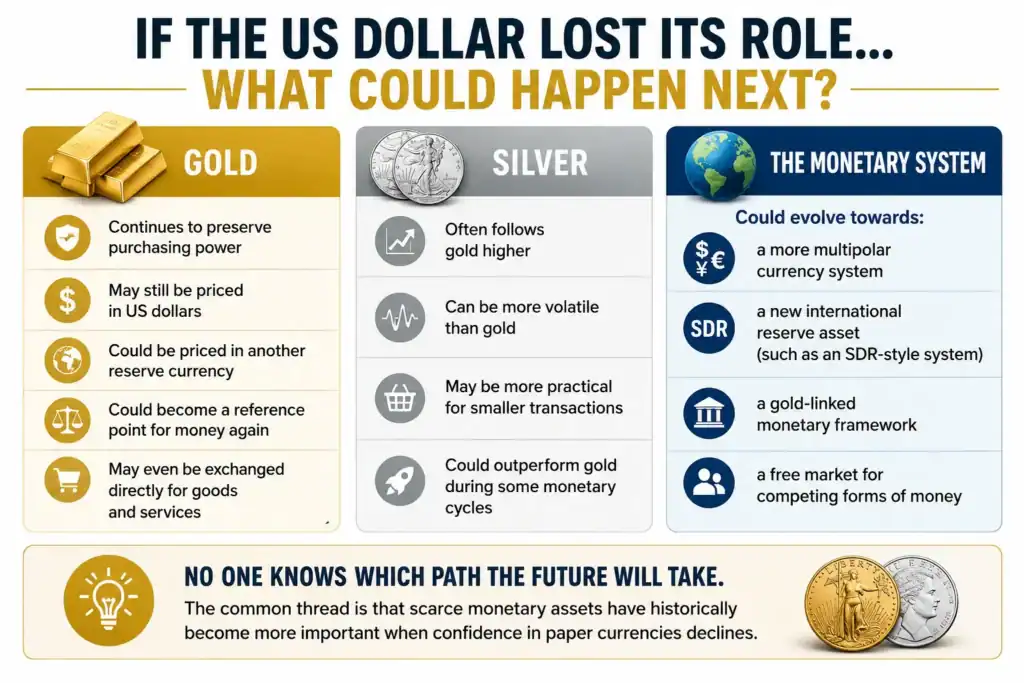
- 1. Gold Could Continue to Be Priced in US Dollars
- 2. Another Currency Could Gradually Share the Dollar’s Role
- 3. A New International Reserve Asset Could Emerge
- 4. Gold Could Again Become the Reference Point
- 5. Could Governments Simply Revalue Gold Instead?
- 6. Temporary Barter
- 7. Multiple Currencies – a Free Market for Money?
- What Happens to Silver if the US Dollar Collapses?
- What Do All These Scenarios Have in Common?
- Why This Debate Matters More Than Ever
- FAQs
What Do We Mean by a “Dollar Collapse”?
When people ask what would happen to gold if the US dollar collapsed, they are often referring to very different situations.
A “dollar collapse” could mean anything from a gradual decline in the dollar’s purchasing power through inflation, to the US dollar losing its role as the world’s reserve currency, or even a complete breakdown of confidence in the monetary system.
Each scenario would affect gold differently.
That’s why it’s helpful to separate them.
1. A Gradual Loss of Purchasing Power
A dollar collapse does not have to happen overnight.
It could take the form of a long decline in purchasing power, combined with a gradual reduction in the dollar’s role in global trade and central bank reserves.
Sanctions, geopolitical tensions and the freezing of foreign reserves have encouraged some countries to reduce their dependence on the US financial system. This has contributed to greater use of local currencies in trade, renewed interest in alternative settlement systems and continued central bank gold buying.
Rather than a sudden collapse, this type of change could unfold gradually over many years. During that time, gold may continue to rise in US dollar terms as the currency slowly loses purchasing power.

2. High Inflation or Hyperinflation
Another possibility is a period of very high inflation, or in an extreme case, hyperinflation.
This could occur if confidence in US government finances deteriorated to the point where investors became unwilling to keep lending to the government by buying US Treasury bonds. If borrowing became increasingly difficult, the Federal Reserve could come under pressure to create additional currency to finance government spending.
History shows that when governments rely heavily on currency creation to fund persistent deficits, the purchasing power of their currency can decline rapidly. Zimbabwe in the 2000s and Weimar Germany in the 1920s are two of the most well-known examples.
In this type of scenario, the currency may continue to circulate, but it takes progressively more dollars to buy the same goods and services. Gold often rises sharply in nominal price, not necessarily because it has become more valuable, but because the currency used to measure it has lost purchasing power.
3. A Financial or Banking Crisis
Some people use the term “dollar collapse” to describe a major financial or banking crisis rather than the failure of the currency itself.
In this scenario, the immediate problem is a loss of confidence in banks or financial markets. Credit becomes harder to obtain, lending slows and investors seek assets they believe will hold their value during periods of uncertainty.
The Global Financial Crisis of 2008 is a good example. While the US dollar did not collapse, confidence in the financial system was badly shaken. As the crisis unfolded, demand for safe-haven assets such as gold increased significantly.
Some economists, including the late Professor Antal Fekete, argued that a severe financial crisis could instead become hyper-deflationary, with credit destruction and falling asset prices outweighing inflation in the early stages. In that type of environment, cash may initially become more valuable before governments and central banks respond with measures designed to restore liquidity.
Whether a crisis begins with inflation or deflation, periods of severe financial stress have historically increased interest in holding tangible assets such as physical gold.
4. A Complete Monetary Reset
The most far-reaching interpretation of a “dollar collapse” is a complete restructuring of the international monetary system.
Rather than the US dollar simply losing purchasing power, this scenario assumes confidence in the current system breaks down and is eventually replaced by a different monetary framework.
Some monetary historians argue that because the US dollar sits at the centre of today’s global financial system, it may not be the first currency to fail. Instead, confidence could gradually weaken around the edges of the system before eventually affecting the dollar itself.
In other words, a dollar collapse may not begin in the United States. It could start with weaker currencies, spread through the international monetary system and only reach the dollar after confidence elsewhere has already deteriorated.
If that were to happen, gold could once again play a much larger role in the global financial system, whether as part of official reserves, a reference point for currencies, or simply as a trusted store of value during the transition.
Four Ways a US Dollar Collapse Could Affect Gold
| Scenario | What Happens? | What Could Happen to Gold? |
|---|---|---|
| Gradual loss of purchasing power | Dollar slowly loses buying power | Gold generally rises in dollar terms |
| High inflation or hyperinflation | Rapid currency debasement | Gold often preserves purchasing power |
| Financial or banking crisis | Confidence in banks and markets falls | Safe-haven demand increases |
| Complete monetary reset | Global monetary system changes | Gold could play a larger monetary role |
Why a US Dollar Collapse Would Be Different
Previous currency collapses have usually been local events.
When Zimbabwe’s currency failed, people could switch to US dollars.
When Argentina experienced repeated currency crises, citizens sought US dollars and other foreign assets.
The United States is different because the US dollar sits at the centre of the global monetary system.
If confidence in the reserve currency itself were seriously undermined, there would be no equivalent fiat currency waiting to replace it overnight.
Historically, one of the assets investors have turned to during periods of monetary uncertainty is physical gold.
Why Does Gold Usually Rise When Confidence in the Dollar Falls?
Gold is often described as a safe-haven asset, but that doesn’t mean it rises simply because markets become nervous.
Its role is more fundamental than that.
Unlike paper currencies, gold cannot be created by governments or central banks. Its supply grows only slowly through mining, while the supply of fiat currency can expand much more rapidly.
When confidence in a currency weakens, investors, savers and even central banks often seek assets that cannot be printed or debased. Throughout history, gold has repeatedly filled that role.
That is why gold frequently rises during periods of:
- persistent inflation
- banking and financial crises
- sovereign debt concerns
- geopolitical uncertainty
- declining confidence in paper currencies.
Importantly, gold does not always become more valuable in real terms.
Often it is the currency used to measure gold that is losing purchasing power.
This distinction explains why an ounce of gold may buy a similar amount of real goods over long periods of history, even though its dollar price can increase dramatically.
Understanding why gold rises helps explain the different outcomes that could occur if the US dollar were ever to lose its position at the centre of the global monetary system.
Gold’s price can rise even if gold hasn’t changed.
Gold may not have changed at all.
Instead, each dollar buys less than it used to.
Think of it like measuring the height of a mountain with a shrinking ruler.
The mountain hasn’t grown.
The ruler has shrunk.
If the US Dollar Lost Its Role, What Would Gold Be Priced In?
The short answer is – it depends.
There is no single roadmap for what would happen if the US dollar eventually lost its position at the centre of the international monetary system.
The following scenarios are not predictions. They simply illustrate several different ways the international monetary system could evolve if the US dollar eventually lost its dominant role.
Seven Possible Outcomes if the US Dollar Lost Its Reserve Currency Role
| Scenario | Relative likelihood |
|---|---|
| Dollar weakens but remains dominant | High (short term) |
| Multipolar reserve system | Medium |
| New reserve asset | Medium-Low |
| Government gold revaluation | Medium-Low |
| Gold becomes unit of account | Low |
| Temporary barter | Low |
| Free market for money | Speculative but possible |
1. Gold Could Continue to Be Priced in US Dollars
Ironically, even if people began talking about a “US dollar collapse”, gold could continue to be quoted in US dollars for many years.
Currencies do not usually lose their international role overnight. Even during periods of significant monetary stress, markets often continue to price commodities using the existing unit of account because it remains familiar and widely accepted.
In this scenario, the dollar would simply buy less than it does today. The quoted price of gold could rise substantially, while international markets, exchanges and bullion dealers continued to use US dollars for pricing.
This is similar to what happens during periods of high inflation. Gold’s dollar price rises, but the currency itself is still used to measure value.
For investors, this is probably the simplest scenario to understand. Gold does not need a new pricing system to protect purchasing power. It can continue performing its traditional role as a monetary asset while still being quoted in US dollars.
2. Another Currency Could Gradually Share the Dollar’s Role
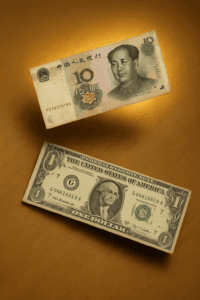
Another possibility is that the US dollar gradually loses its dominant position to another national currency.
The Chinese renminbi is often mentioned as the leading candidate because of China’s growing role in global trade. Others point to the euro, which is already widely used in international finance and central bank reserves.
However, replacing the world’s reserve currency is far more difficult than simply becoming the world’s largest economy.
A reserve currency benefits from powerful network effects. Governments, central banks, businesses and investors all prefer to use the currency that everyone else already accepts. International trade, financial markets and commodity pricing have developed around the US dollar over many decades, making the existing system difficult to replace.
There is also what economists call the Triffin Dilemma. A country supplying the world’s reserve currency must provide enough liquidity for international trade, often by running persistent trade deficits. While this helps support the global financial system, it can create long-term pressures within the issuing country’s own economy. (See: Why A Dollar Collapse Is Inevitable).
Any country hoping to replace the US dollar would eventually face many of the same challenges.
For these reasons, many economists believe the future is more likely to involve a gradual shift towards a more multipolar monetary system, where several major currencies play important international roles rather than one currency completely replacing another.
Even if this happened, gold would almost certainly continue to play an important role as a neutral reserve asset that is not issued by any government.
3. A New International Reserve Asset Could Emerge
Some economists believe the world could eventually move towards an international reserve asset that is not tied to any single country.
One example already exists. The International Monetary Fund (IMF) created the Special Drawing Right (SDR) in 1969 as an international reserve asset. Rather than being a currency itself, the SDR is based on a basket of major currencies including the US dollar, euro, Chinese renminbi, Japanese yen and British pound.
Today, SDRs are used primarily between governments and central banks. They are not used by the public for everyday transactions, but they demonstrate that international reserve assets can exist alongside national currencies.
Some analysts believe a future monetary system could expand on this idea. Instead of relying on a single national currency, international trade could increasingly be settled using a neutral reserve asset, a basket of currencies, or even a digital settlement system designed specifically for cross-border payments.
Central bank digital currencies (CBDCs) are sometimes mentioned in these discussions. While CBDCs are simply digital versions of national currencies, they could eventually form part of a broader international payments infrastructure if governments chose to coordinate their use.
Others have suggested that gold itself could once again play a supporting role by backing or helping to settle balances between countries. Gold’s unique advantage is that, unlike any national currency, it is not issued or controlled by a single government.
4. Gold Could Again Become the Reference Point
Today we think of gold as being priced in US dollars.
But for most of history, the relationship was effectively the other way around. Currencies were defined in terms of a fixed weight of gold or silver, and the value of money was measured against precious metals rather than the other way around.
Even after the Second World War, the Bretton Woods monetary system defined the US dollar as 1/35th of an ounce of gold for settlements between governments. It was only after the United States ended that convertibility in 1971 that gold began trading freely against the dollar.
If confidence in today’s fiat monetary system were ever seriously undermined, it is possible that gold could once again become an important reference point for pricing goods, services or even currencies themselves.
That does not necessarily mean you would buy a cup of coffee using a gold coin. Modern payment systems could still exist. However, the underlying unit used to measure value could once again be linked to a fixed weight of gold rather than an unrestricted fiat currency.
5. Could Governments Simply Revalue Gold Instead?
A complete collapse of the US dollar is not the only possible outcome.
Throughout history, governments have occasionally devalued or revalued their currencies rather than allowing the monetary system to fail completely. In some cases, these adjustments happened almost overnight.
Some analysts believe that if confidence in the international monetary system came under severe pressure, governments could choose to officially revalue gold instead of allowing a disorderly collapse.
Rather than gold gradually rising to reflect years of currency debasement, governments could simply recognise a much higher official gold price. This would increase the value of official gold reserves relative to the amount of currency in circulation and could help restore confidence in the monetary system.
Whether such a policy would ever be adopted remains uncertain. However, it illustrates that governments have more options than simply allowing currencies to collapse unchecked.
If you’d like to explore this idea in more detail (including potential revaluation levels), see our guide:
→ Gold Revaluation Explained: Why Governments Revalue Gold and What It Could Mean for Investors
6. Temporary Barter
During the early stages of a severe monetary crisis, barter often reappears as people lose confidence in the existing currency and before a widely accepted alternative emerges.
This is one reason some people argue that practical goods such as food, fuel or other everyday necessities would be more valuable than gold during the immediate disruption. (See: What Good is a Bar of Gold When the Shelves are Empty?)
History suggests, however, that barter is usually a temporary solution. As trade becomes more organised, people tend to adopt a common medium of exchange. In many historical monetary crises, gold and silver have gradually resumed that role because they are widely recognised, durable and easily divisible. (See: Societal Breakdown: Are Gold and Silver Coins Better Than Tradable Items Like Tools, Water and Wine?)
7. Multiple Currencies – a Free Market for Money?

One final possibility is that no government or international organisation ultimately decides what money should be. Instead, people and markets simply choose the forms of money they trust most.
History suggests this isn’t as unusual as it might sound. Before governments established national fiat currencies, gold and silver emerged over many centuries as widely accepted forms of money because they were scarce, durable, divisible and difficult to create.
Today, a free market for money might look different. Digital technologies and cryptocurrencies have introduced new ways to transfer value, while precious metals continue to offer qualities that many investors value as long-term stores of wealth. It is possible that a future monetary system could combine the strengths of both—for example, using technology for payments while relying on scarce tangible assets to preserve purchasing power.
Ultimately, a free market allows individuals to decide which forms of money they trust. Throughout history, gold and silver have repeatedly emerged as monetary assets because their value is not dependent on the promise of any government or central bank.
If you’d like to explore this idea further, see our article:
→ The Gold Standard & A Free Market for Money: What Do We Think About It?
You may also enjoy:
→ Gold vs Bitcoin/Cryptocurrencies – Which Should You Choose?
What Happens to Silver if the US Dollar Collapses?
Gold receives most of the attention during a monetary crisis, but silver has historically performed strongly as well. In fact, because the silver market is much smaller than the gold market, silver often experiences larger percentage price movements once monetary demand begins increasing.
Silver’s Volatility and Potential
Silver tends to move more sharply than gold—both up and down.
Because the silver market is much smaller than the gold market, even a modest increase in buying or selling can have a much larger effect on price.
Silver is also both a monetary and an industrial metal. During the early stages of a financial crisis, weaker industrial demand and investors raising cash can cause silver to fall further than gold.
As confidence returns and monetary demand strengthens, however, silver has historically recovered strongly and often outperformed gold during precious metals bull markets. This pattern was seen after both the 2008 Global Financial Crisis and during previous monetary cycles.
Why Silver Could Be Useful in a Currency Crisis
In a dollar collapse scenario, gold is often the metal chosen to preserve larger amounts of wealth.
Silver, however, has historically played an important supporting role because its lower value per ounce makes it more practical for everyday transactions. If precious metals were ever used more widely again, silver could once again complement gold in smaller purchases, barter and trade.
If you want to go deeper into how silver coins could be used specifically during a crisis, see our guide on silver coins in a currency collapse.
If the Dollar Collapses, What Will Silver Be Worth?
Just like gold, silver could continue to be priced in US dollars for many years, even if the dollar were gradually losing purchasing power or its dominant role in the global monetary system. Only if the monetary system itself changed more fundamentally might silver instead be quoted in another reserve currency, against gold, or directly in terms of goods and services.
Because silver has historically moved more sharply than gold during monetary cycles, its price could potentially rise by a larger percentage than gold’s. The exact outcome would depend on the type of crisis and the role industrial demand played at the time.
What Do All These Scenarios Have in Common?
Although these scenarios differ in important ways, they share one common feature.
None assume that gold suddenly becomes “magic.”
Instead, they all reflect the same underlying principle:
when confidence in paper money declines, scarce monetary assets tend to become relatively more valuable.
Whether that happens through inflation, banking stress, monetary reform or a gradual shift away from the US dollar, gold’s role as a store of wealth becomes increasingly important.
Why This Debate Matters More Than Ever
No one knows exactly how the international monetary system will evolve.
The US dollar could remain dominant for decades. It could gradually share its role with other currencies. Or the world could eventually move towards a very different monetary framework altogether.
The purpose of understanding these possibilities is not to predict the future with certainty. It is to appreciate that monetary systems change, and to consider how best to protect purchasing power if they do.
For investors, the more useful question may not be whether the US dollar collapses overnight. It may simply be how to prepare if its purchasing power continues to decline over time.
Throughout history, gold has repeatedly survived monetary transitions. That is why many investors view it as wealth insurance first and an investment second.
Further reading:
- What Would Happen to the NZ Dollar When the US Dollar Collapses?
- Silver coins in a currency collapse
- Best gold for trading in a currency collapse
- Barter vs Bullion: What Matters Most in a Societal Breakdown?
How do you think the next international monetary system will evolve?
Will gold once again become a central reference point, or will something entirely new emerge? We’d love to hear your thoughts in the comments below.
FAQs
If the US dollar were to lose value or its role as the world’s reserve currency, silver would likely benefit from increased demand for tangible assets. Because the silver market is much smaller than the gold market, its price tends to be more volatile. Silver may initially fall during a financial panic but has historically recovered strongly and often outperformed gold during precious metals bull markets.
In the short term, gold would likely continue to be quoted in US dollars, even if the dollar weakened, because global markets already use it as the primary pricing currency.
If the international monetary system changed more fundamentally, gold could instead be priced in another reserve currency, a new international reserve asset, or even directly in terms of weight, as it has under previous monetary systems.
Yes. Gold had value long before the US dollar existed and has historically remained valuable through currency crises, hyperinflation, and monetary resets.
If confidence in the dollar weakened severely, gold would likely continue to be valued either:
– in other currencies,
– directly against goods and services,
– or in relation to silver and other hard assets.
Throughout history, gold has retained value through currency crises, hyperinflation and monetary resets because it cannot be created by governments. That is one reason central banks continue to hold thousands of tonnes of gold today.
Silver can be more practical than gold for smaller transactions because its lower value per ounce makes it easier to use in everyday exchange. Gold, by contrast, is generally better suited to preserving larger amounts of wealth. For that reason, many investors choose to hold both.
Yes. In a severe monetary crisis or a future monetary reset, goods and services could once again be priced directly in ounces of gold or silver rather than paper currencies. Precious metals served as units of account for centuries before modern fiat money, and similar systems have re-emerged during periods of extreme monetary instability.
Yes. Rather than allowing a disorderly collapse of the monetary system, some economists argue that governments could officially revalue gold against paper currencies. A higher official gold price could strengthen central bank balance sheets and improve confidence in the financial system. While this is only one possible scenario, it has historical precedent and is explored in more detail in our guide to Gold Revaluation.
Editors Note: This article was first published 18 March 2014. Fully updated 14 July 2026.

Glenn's dedication to educating individuals on wealth protection through precious metals has helped over 2400 clients from New Zealand, Australia, USA and Europe to safeguard their financial futures. Passionate about financial independence and lifestyle freedom, Glenn’s mission is to empower others with the knowledge and tools to thrive in today’s volatile economic environment. When he's not advising on precious metals, Glenn enjoys spending time with his family and pursuing outdoor adventures.
Education: University of Auckland Bachelor of Science
Linkedin: https://www.linkedin.com/in/glenn-thomas-0984a4310/
- Physical Gold vs Paper Gold – Which Should You Own? - August 18, 2026
- Why Own Gold When It Pays No Interest or Dividends? - August 12, 2026
- Why Buy Gold? A New Zealand Guide to Protecting Your Wealth - August 11, 2026

It makes sense that China does not want the RMB to be the “Standard” to replace the USD. After all, they have so many bonds and many Chinese have invested money in the US and they don’t want the place to collapse. Maybe, China buying so much gold (and silver) bullion is to cover themselves if/when the IMF decides that all countries need to back their currency by eg 10% of their reserves. Cynical me asks… can a country just print some money, send it to Switzerland and buy some bullion with it?
We’re in a failing system where governments are ignoring common sense and the rules have gone out the window. Gold doesn’t fix this, but blockchain does. Data is the new oil, and rules fixed in data are the new gold standard.
Yes it’s likely blockchain will play a significant role in the future. But we wouldn’t write gold off completely yet. It’s been around for thousands of years. Maybe a combination of the two even?
The cabal will replace cash with digital money because they want control and power over people. It’s possible that the world most toxic vaccine might be the mark of the beast and you won’t be able to buy and sell if you don’t accept the mark of the beast in whatever form it comes in.