
Silver
Silver “Shortages”, Delays, and Rising Premiums: What’s Really Happening
Feb
This Week:
- Weekly Price Overview – 11 February 2026
- Silver “Shortages”, Delays, and What’s Really Going On
- There Is Metal — The Bottleneck Is Processing
- Why This Feels Like a “Shortage” to Many Buyers
- Why Premiums Can Rise Even When Spot Falls
- What We’re Seeing Locally
- So… Is There a Silver Shortage or Not?
- A Long-Term Shift, Not a One-Week Event
- What This Means for You as a Buyer
- Chart of the Week: Stocks vs Silver
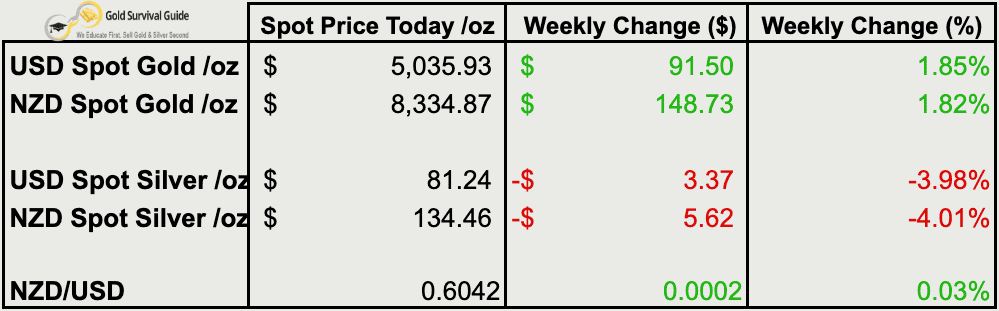
Weekly Price Overview – 11 February 2026
Gold firmed over the past week, while silver saw a sharper pullback after its earlier surge. Volatility remains elevated, particularly in silver, as markets digest recent gains. The NZ dollar ticked higher, but remains in a broader downtrend.
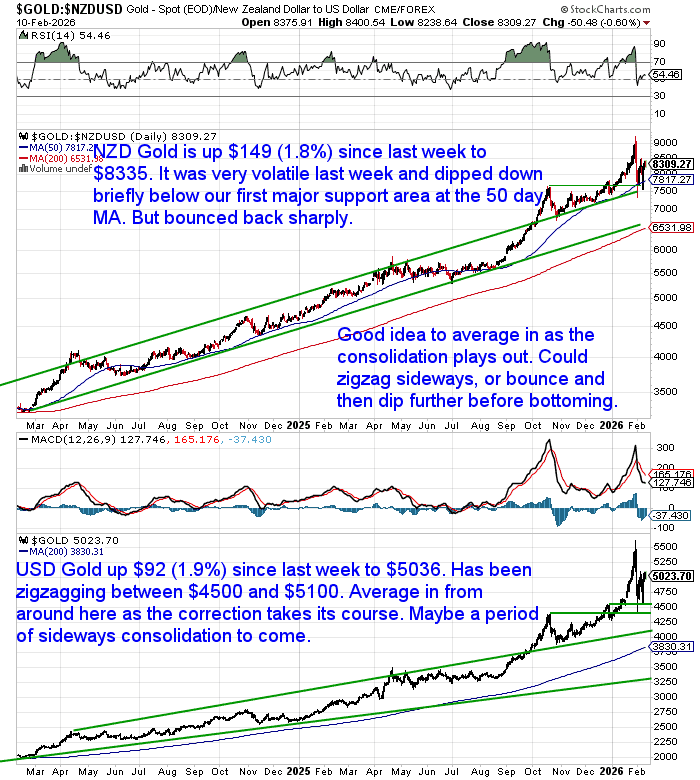
🟡 NZD gold rose $148.73 (+1.82%) to $8,334.87. Gold was volatile and briefly dipped below first major support at the 50-day moving average before bouncing strongly. Momentum remains positive, though some near-term consolidation would be normal after the recent move.
USD gold climbed $91.50 (+1.85%) to $5,035.93. The price continues to zigzag between roughly $4,500 and $5,100, suggesting consolidation within a broader uptrend. This type of price action often favours averaging in over trying to time short-term swings.
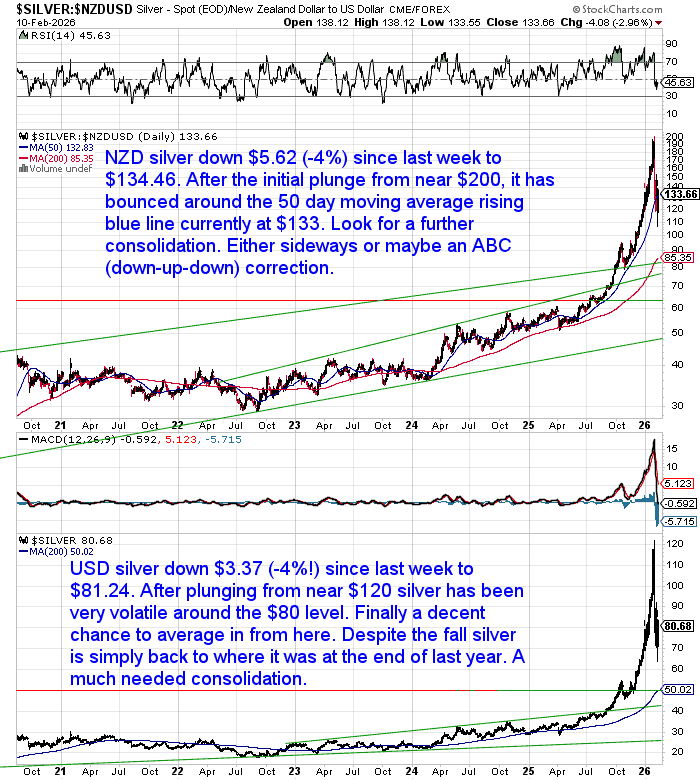
⚪ NZD silver fell $5.62 (-4.01%) to $134.46. After plunging from near $200, silver is attempting to stabilise around the rising 50-day moving average near $133. Further consolidation looks likely, either sideways or via an ABC-style correction.
USD silver dropped $3.37 (-3.98%) to $81.24. After the sharp decline from near $120, silver has been highly volatile around $80. This move has taken silver back to late-last-year levels and represents a much-needed consolidation after an extremely strong run.
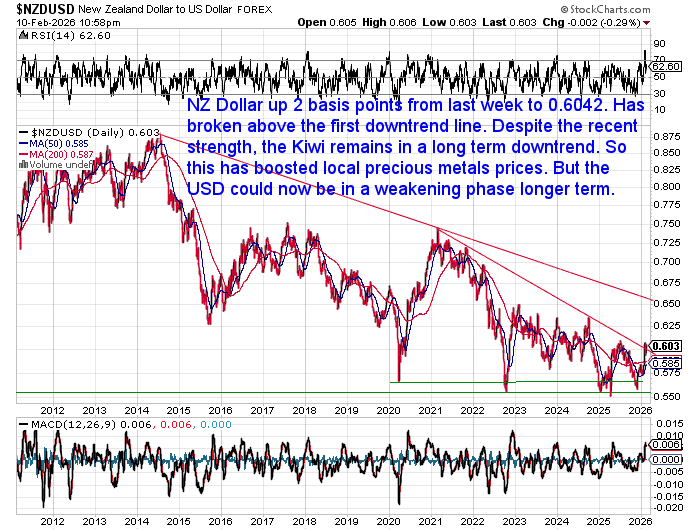
💱 NZD/USD edged up 2 basis points (+0.03%) to 0.6042. The Kiwi has broken above its first downtrend line but remains in a longer-term downtrend. Although the USD may be entering a broader weakening phase longer term.
📈 Takeaway: Precious metals appear to be consolidating after a powerful advance. Gold remains resilient and supported at key levels, while silver’s correction has been faster and more volatile. This looks like digestion within a broader bull market rather than a major reversal, and may continue to favour a steady averaging-in approach.
Silver “Shortages”, Delays, and What’s Really Going On
If you’ve been paying attention over the past couple of weeks, you’ve probably noticed the noise ramping up again.
Rumours of silver shortages.
Claims that orders won’t be filled.
Whispers that “there’s no metal left.”
Let’s slow this right down and separate fact from fear.
What’s actually happening in the physical metals market right now matters — and it’s not what many of the loudest voices online are suggesting.
There Is Metal — The Bottleneck Is Processing
One of our long-term suppliers is Scottsdale Mint, one of the largest private mints in the world. Their CEO, Josh Phair, recently addressed the situation directly.
His message was very clear:
- They have the metal
- Everything being sold is fully backed
- Demand is running 10–20x normal volumes
- The delays are due to refining, counting, minting, packaging, and fulfilment
- Not supply
Scottsdale is supplying governments, banks, wholesalers, and retail investors globally — all at the same time. Even at scale, that creates strain.
They’re running extra shifts.
They’re hiring aggressively.
They’re doing exactly what you’d expect a serious operator to do.
Importantly, Josh pointed out something that often gets lost in the noise:
They’ve delivered every single ounce they’ve ever sold for nearly two decades — including through COVID.
That track record matters.
Why This Feels Like a “Shortage” to Many Buyers
From the outside, longer wait times can feel like scarcity.
But what we’re seeing is throughput pressure, not empty vaults.
Here’s what’s happening behind the scenes:
- Huge inflows of buying from governments, institutions, and individuals
- Large volumes of metal coming back into the system that still need refining
- Refiners and mints running flat out
- Logistics and labour becoming the constraint, not raw material
When everything hits at once, dispatch times stretch out.
That’s very different from “there is no silver”.
Why Premiums Can Rise Even When Spot Falls
One thing that’s confusing some buyers right now is this:
Silver’s spot price has pulled back, yet physical silver hasn’t fallen as much — and in some cases, premiums have risen.
That’s not unusual.
When demand surges and processing capacity is stretched, the cost of raw silver to refiners and mints rises. Those higher input and production costs show up as higher premiums on sovereign mint coins and silver bars — even if the paper price is moving sideways or down.
We’ve seen this before.
During both the 2008–2009 financial crisis and COVID, silver premiums expanded sharply. At the peak, premiums on products like 1kg silver bars rose as much as 30%+ above spot.
So what we’re seeing now isn’t new, and it isn’t a sign of a broken market.
It’s simply the physical market doing what it always does under stress.
As we’ve mentioned before, this was a likely outcome once demand overwhelmed minting and refining capacity.
What We’re Seeing Locally
Even here in New Zealand, the same message is being communicated by other dealers and suppliers.
The common themes are:
- No stock shortage
- No risk to supply for orders already placed
- Products are available
- Delays are purely in processing and fulfilment
Delivery timeframes are simply longer — from around 4 weeks to as much as 10–12 weeks for some silver coins.
That aligns exactly with what the mints are saying globally.
So… Is There a Silver Shortage or Not?
It depends on how you define the word.
There is no shortage of metal available to be sold by reputable mints and refiners.
There is an overwhelming surge in global demand.
That demand is being driven by:
- Governments and central banks
- Military and strategic stockpiling
- China and India increasing physical buying
- Growing distrust in fiat currencies
- Investors realising they’re under-allocated
When too many buyers want the same asset at once, two things happen:
- Prices rise
- Systems slow down
That’s exactly what we’re seeing.
A Long-Term Shift, Not a One-Week Event
One of the more important points Josh made in a longer interview recently is this:
This isn’t a short-term trade or a temporary panic.
What’s happening in precious metals is part of a multi-year shift.
Silver, in particular, is being pulled from multiple directions at once:
- Monetary demand
- Industrial demand
- Strategic demand
And unlike currencies, silver can’t be printed.
That doesn’t mean prices go straight up in a line.
It does mean delays, volatility, and pressure are likely to remain part of the landscape.
What This Means for You as a Buyer
A few practical takeaways:
- Expect longer processing times during periods of extreme demand
- Work with suppliers who are fully hedged and transparent
- Be wary of panic-driven narratives
- Focus on positioning, not perfection
Physical metals have always required patience at key moments. That’s the price of opting out of a just-in-time paper system.
Chart of the Week: Stocks vs Silver
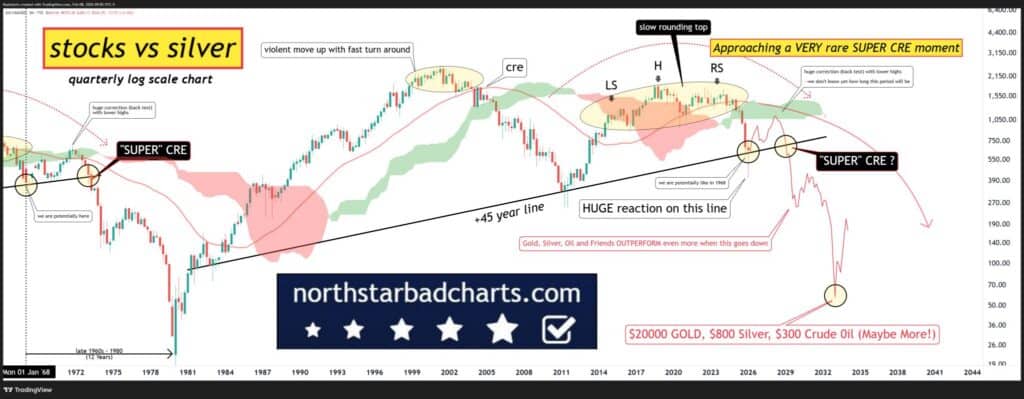
This week’s chart comes from Patrick Karim of North Star BadCharts and is a useful reminder of how capital rotates — often slowly at first, then all at once.
The chart compares stocks versus silver on a long-term, logarithmic basis and highlights what Patrick calls a Capital Rotation Event (CRE).
The key takeaway is simple:
- Silver can underperform stocks for a period during a corrective phase
- That underperformance has historically occurred before major relative outperformance
- These transitions don’t happen overnight — but when they turn, they tend to turn decisively
Patrick outlines potential long-term “roadmaps” that include very high nominal price targets for gold and silver ($20,000 and $800 respectively).. We’ve explored similar valuation frameworks before — not as predictions, but as reference points for what’s mathematically possible in a large monetary reset:
As always, charts like this aren’t about timing tops or bottoms.
They’re about context — and understanding where we may be in a much bigger cycle of capital moving out of financial assets and into real ones.
The current pullback and consolidation is likely a good long term entry point to start and add to your real assets.

Glenn's dedication to educating individuals on wealth protection through precious metals has helped over 2400 clients from New Zealand, Australia, USA and Europe to safeguard their financial futures. Passionate about financial independence and lifestyle freedom, Glenn’s mission is to empower others with the knowledge and tools to thrive in today’s volatile economic environment. When he's not advising on precious metals, Glenn enjoys spending time with his family and pursuing outdoor adventures.
Education: University of Auckland Bachelor of Science
Linkedin: https://www.linkedin.com/in/glenn-thomas-0984a4310/
- Gold Prices Fall as ETF Investors and Established NZ Buyers Keep Buying - October 14, 2026
- What Are The Different Types of Gold Bars? - October 13, 2026
- Should I Buy Gold Now or Wait? (2026 NZ Update) - October 12, 2026
