

Table of contents
Estimated reading time: 6 minutes
Weekly Price Overview – 8 April 2026
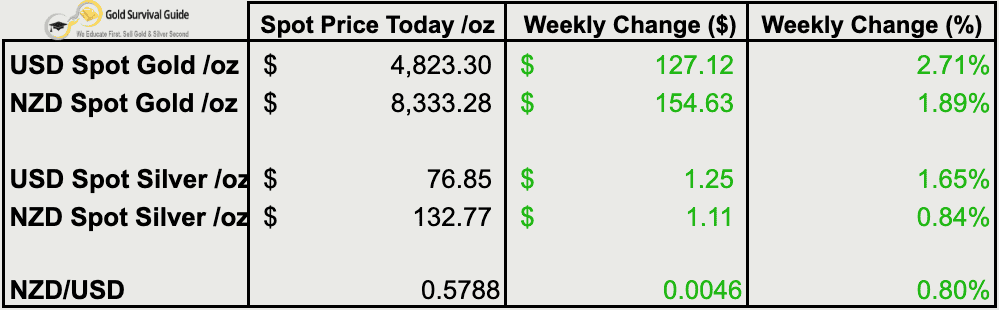
Precious metals moved higher this week, building on the recent rebound. Price has held above key support, suggesting the correction may have run its course. A weaker NZD continues to support local prices, though the broader picture still points to consolidation rather than a strong move higher.
🟡 NZD gold rose $154.63 (+1.89%) to $8,333.28.
Price has bounced from oversold levels and is now back above the 50-day moving average. It remains well above the rising 200-day MA (near $7,049), keeping the long-term uptrend intact. Momentum has improved, though consolidation would be normal. Any pullback toward the 200-day MA would likely be a solid long-term entry area.
USD gold gained $127.12 (+2.71%) to $4,823.30.
Price continues higher after rebounding from the 200-day MA (around $4,133). The trend remains up, with higher lows forming. While momentum has improved, a retest of the 200-day MA would still be consistent with a normal bull market move.
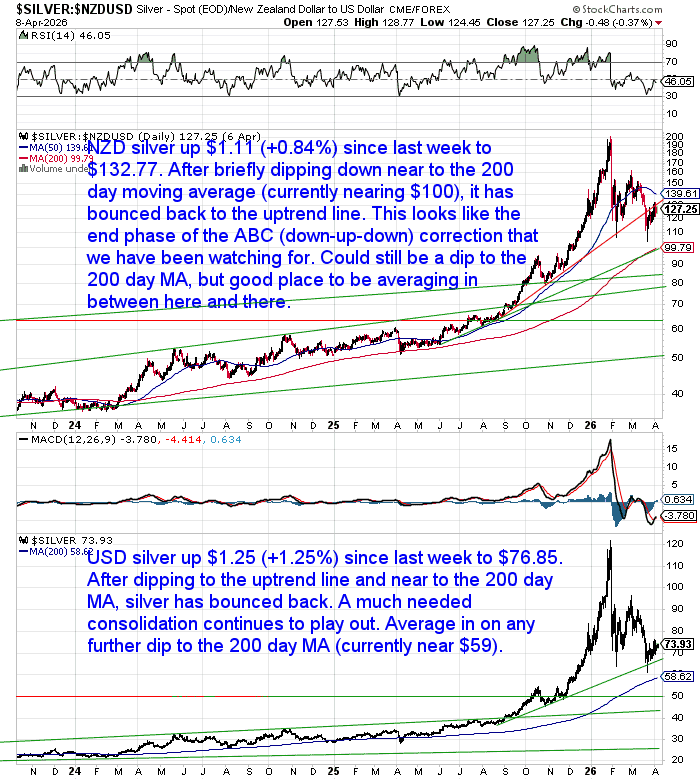
⚪ NZD silver rose $1.11 (+0.84%) to $132.77.
After dipping near the 200-day MA (around $100), silver has bounced back toward its uptrend line. The broader pattern still resembles a late-stage correction. Volatility is likely to continue, with dips toward the 200-day MA offering potential averaging opportunities.
USD silver gained $1.25 (+1.65%) to $76.85.
Price has rebounded from the uptrend line and the 200-day MA (near $59). Consolidation continues following the earlier rally. The broader trend remains higher, with pullbacks likely to stay within that structure.
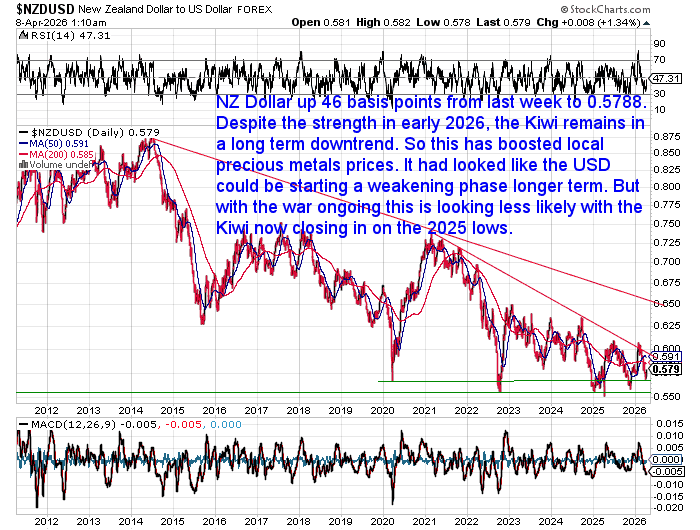
💱 NZD/USD rose 46 basis points (+0.80%) to 0.5788.
The Kiwi remains in a long-term downtrend despite recent strength. This has continued to support higher NZD gold and silver prices. Earlier USD weakness has faded, with the pair drifting back toward recent lows.

The US Dollar System Is Starting to Show Cracks
This week, a number of separate pieces are pointing in the same direction.
What we’re seeing is pressure building in the global financial system – particularly around the role of the US dollar.
1. The Petrodollar System Is Being Tested
Andre Chelhot laid this out clearly in his LinkedIn post on the petrodollar system and expanded further in his MacroAnchor Substack article What If.
For decades, the system has worked on a simple loop:
- Oil is priced in US dollars
- Countries earn dollars to buy energy
- Those dollars are recycled into US Treasuries
- The US provides security in return
That structure relies on three pillars:
- Security
- Dollar pricing of energy
- Recycling into US assets
We are now seeing signs that this arrangement is being tested.
One example:
- Oil rising at the same time as the US dollar
More importantly, the security side of the arrangement is now being questioned.
And alongside this, we’re seeing behaviour that doesn’t fit the old system.
Philippe Curchod shared a report showing foreign central banks dumping $82 billion of US Treasuries in a single month.
Countries that once recycled dollars back into US debt are now doing the opposite – selling to defend their own currencies.
That directly challenges one of the core pillars of the petrodollar system.
2. The Dollar Is Being Pulled in Two Directions
The In Gold We Trust Report explained this well in their recent piece: The dollar has two jobs.
The US dollar has two roles:
- It functions as money inside the United States
- It acts as the world’s reserve currency
These roles have always been in tension — this is the Triffin dilemma.
To supply the world with dollars, the US must run deficits.
But over time, those same deficits weaken confidence in the currency.
What’s changing is that the effects are becoming more visible:
- At home: rising debt, deficits, and refinancing pressure
- Globally: reduced demand for US debt
That refinancing pressure is significant.
The US needs to roll over roughly $10 trillion in debt in the near term — at a time when foreign buyers are stepping back.
At the same time, countries are prioritising their own stability.
For example, Charles-Henry Monchau highlighted that:
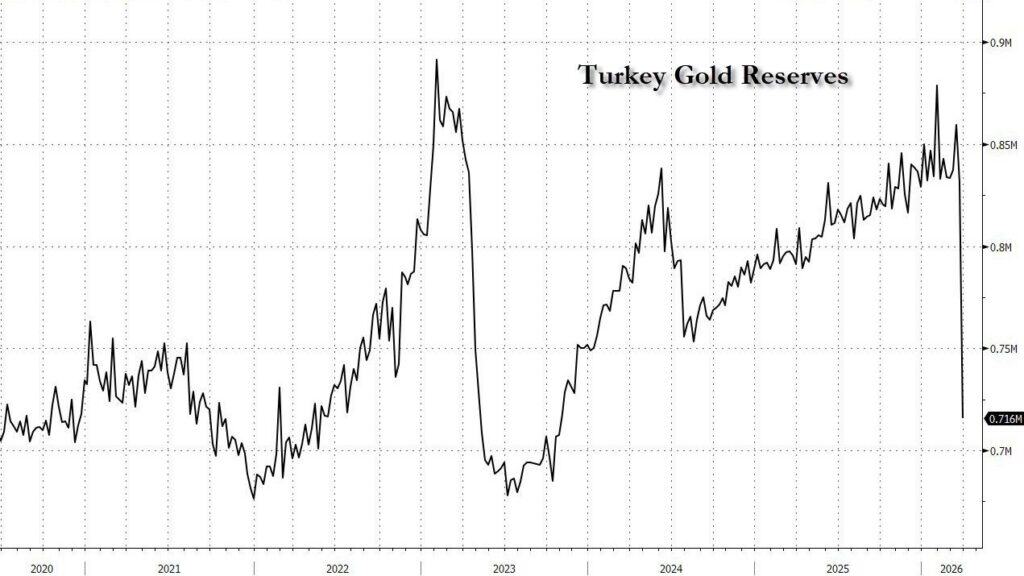
- Along with US treasuries, Turkey has also sold large amounts of gold reserves in a short period
- Not for strategic reasons – but out of necessity to defend its currency
That’s an important point. In times of stress, countries are choosing domestic stability over supporting the global system.
3. This Is Part of a Bigger Shift
Ray Dalio expands on this in his article: The Big Thing: We Are in a World War
His view is that what we are seeing is not just economic stress or isolated conflicts.
It’s part of a broader shift in the global order.
His key observation:
The United States appears strong, but is also highly overextended.
And we’re now seeing actions that reflect this shift in behaviour between nations.
One example is the Banque de France which recently:
- Sold gold held in the US
- Then repurchased it in Europe
That’s not about reducing exposure to gold. It’s about where that gold is held.
It reflects a world where:
- Trust between countries is lower
- Countries place more importance on holding assets within their own control
What Matters From Here
You don’t need to predict exactly how this plays out.
But it is worth recognising what’s changing.
- The system that supported global demand for US dollars is being tested
- The built-in tension in that system is becoming more visible
- And countries are starting to act more in their own interest, rather than supporting the broader structure
This is not about a single event. It’s a shift that is already underway.
And that leads to a simple question:
How much of your wealth depends on this system continuing as it has?
Because the risk isn’t just a sudden event.
It’s also being exposed to a structure that is gradually becoming less stable.
This is why many investors hold a portion of their wealth outside the financial system altogether.

Glenn's dedication to educating individuals on wealth protection through precious metals has helped over 2400 clients from New Zealand, Australia, USA and Europe to safeguard their financial futures. Passionate about financial independence and lifestyle freedom, Glenn’s mission is to empower others with the knowledge and tools to thrive in today’s volatile economic environment. When he's not advising on precious metals, Glenn enjoys spending time with his family and pursuing outdoor adventures.
Education: University of Auckland Bachelor of Science
Linkedin: https://www.linkedin.com/in/glenn-thomas-0984a4310/
