

Introduction: Why This Review Matters More Than Ever
Every January, we take stock of the year just gone – not just to analyse gold and silver price charts, but to understand the broader economic and monetary forces that shaped those moves. Because for us – and for many of our clients – gold and silver aren’t just commodities. They’re cornerstones of a personal wealth protection plan.
In 2025, the world economy continued to shift under our feet. Central banks, including our own Reserve Bank of New Zealand, wrestled with the covid hangover: Stubborn inflation and rising debt loads. Meanwhile, global forces like the BRICS alliance’s push for alternative currencies, record central bank gold purchases, and growing distrust in fiat systems all pointed to one clear theme: monetary instability is the new normal.
Amidst all this, gold and silver once again proved their value – not just as investments, but as financial insurance. Understanding how they performed in 2025, and what that performance tells us about 2026 and beyond, is crucial for anyone wanting to safeguard their purchasing power, protect their savings, and build a truly sovereign financial future.
Table of contents
- Introduction: Why This Review Matters More Than Ever
- Gold Outperformed All Major Asset Classes in 2025
- Gold Price Performance in 2025: A Year of Surging Demand and Soaring Returns
- Silver in 2025: The Comeback Kid Has Arrived
- How Did Our 2025 Predictions Stack Up?
- 1.Silver will outperform gold for the year.
- 2. Silver will take out its all-time nominal high by year end — at least in NZ dollars. Maybe even USD.
- 3. Long-term interest rates and inflation will be higher than they began the year.
- 4. Major stock market indexes will be down for the year.
- Bonus: The US Dollar
- Our Predictions for 2026
- Frequently Asked Questions (FAQs)
Estimated reading time: 11 minutes
Gold Outperformed All Major Asset Classes in 2025
Gold was a clear winner in 2025 in terms of major asset classes. A return (in USD) of 63.7% was almost double its nearest competitor. The below table also shows gold was second only to bitcoin (17.7% vs 18.8%) over a 5 year time horizon too.
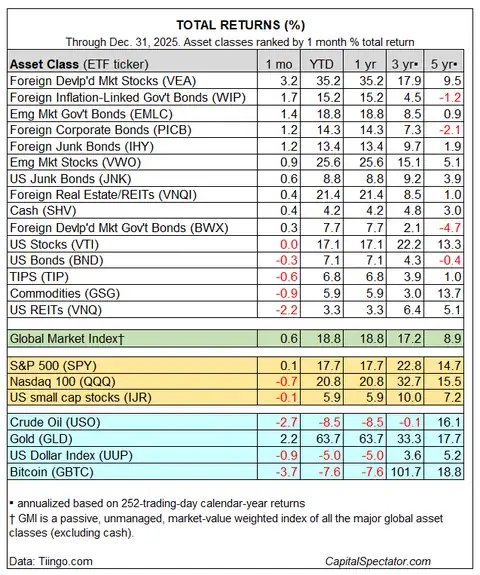
Major takeaway from this list of asset class performances?
That you are better off “not investing”. That is gold just sits there as many of its opponents like to say. But it outperformed the risk of owning stocks, bonds or realestate, which are still the most common investments to own.
The other point that is key for New Zealand residents is that these are mostly US based investments including the performance of gold. Of course we in New Zealand should track the gold and silver price in NZ dollars, not the commonly quoted US dollar price. So that’s what we always do this time of the year.
Gold Price Performance in 2025: A Year of Surging Demand and Soaring Returns
Gold delivered a powerhouse performance in 2025, climbing an astonishing +61.9% in NZD terms, according to full-year figures from your local price data. This closely matched the global USD return of +63.7%, making it one of the strongest years in recent memory for precious metals — and a clear signal that investors are turning to gold as a safe haven in an increasingly unstable world.
Chart: Gold in NZD — Full-Year 2025
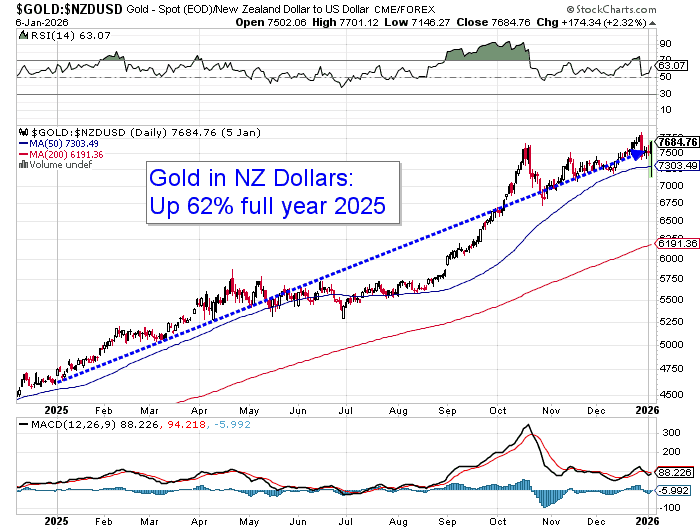
Table: NZD Gold Performance in 2025 and Since 2000
| Date | Price (NZD/oz) | % Change |
|---|---|---|
| 1 Jan 2025 | $4,640.81 | – |
| 31 Dec 2025 | $7,512.36 | +61.88% |
| 1 Jan 2000 | $551.00 | – |
| 2000–2025 | – | +1,263.4% |
Quarterly Price Trends (NZD)
- Q1 2025: Steady climb from $4,600 to ~$5,400 as global tensions rose and gold drained from London vaults
- Q2 2025: Sideways consolidation with brief pullbacks
- Q3 2025: Breakout rally triggered by BRICS currency developments and signs of Fed policy easing
- Q4 2025: Continued gains as investors anticipated rate cuts and sought safe havens
What Possibly Drove Gold’s Stellar Performance?
- Record central bank buying: 2025 saw continued sovereign gold purchases, led by China and other BRICS members. But also US allied nations too.
- Interest rate expectations: Market sentiment shifted from tightening to easing, favouring non-yielding stores of value like gold.
- Currency debasement: An increase in awareness of devaluing fiat currencies, boosting local gold prices further
- Geopolitical risk and global debt concerns: From US fiscal uncertainty to conflict zones, investors hedged systemic risks with tangible assets
Looking Back: Gold’s Performance Since 2000
Now let’s zoom out and take a longer-term view of gold’s performance — right back to the start of the millennium and the early days of this enduring bull market in precious metals.
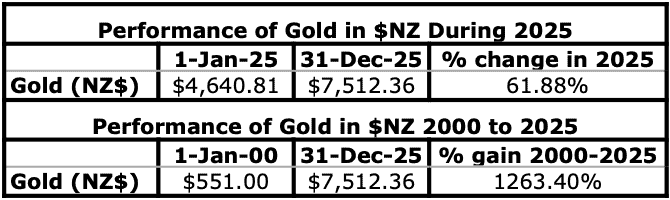
Since 1 January 2000, gold priced in New Zealand dollars has risen a staggering +1,263%. That’s not a typo — the price has more than 13X’d in just 25 years. And the massive gain in 2025 has supercharged that tally. Just a year ago, the 2000–2024 return sat at under 800%.
This surge is a powerful reminder of gold’s core purpose: to protect purchasing power over the long run, regardless of the monetary or political climate.
Silver in 2025: The Comeback Kid Has Arrived
After years of lagging behind its more glamorous cousin, silver came roaring back in 2025, posting its biggest annual gain in decades.
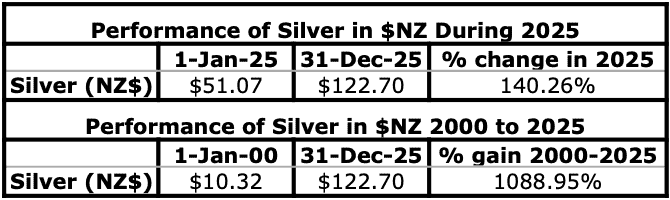
Silver soared an incredible +148.3% in USD terms — outperforming even gold’s stellar year — and climbed a massive +140.3% in NZD, rising from $51.07 to $122.70 over the 12 months.
Chart: Silver in NZD — Full-Year 2025
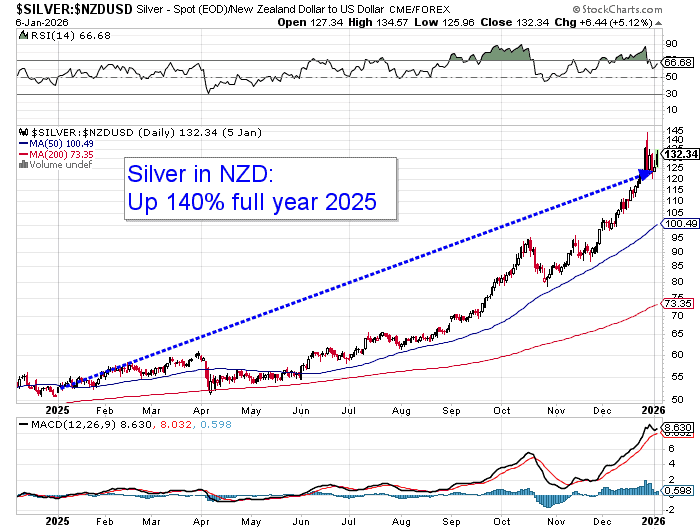
Table: Silver’s NZD Performance
| Date | Price (NZD/oz) | % Change |
|---|---|---|
| 1 Jan 2025 | $51.07 | – |
| 31 Dec 2025 | $122.70 | +140.26% |
| 1 Jan 2000 | $10.32 | – |
| 2000–2025 | – | +1,088.95% |
That long-term return — over 1,000% — puts silver firmly in the wealth-preserving asset class for Kiwi investors. And this year’s surge marks a major shift in silver’s market momentum.
Gold-to-Silver Ratio: A Dramatic Drop
The gold-to-silver ratio started 2025 at 90 — meaning it took 90 ounces of silver to buy 1 ounce of gold. But by year-end, that ratio had dropped sharply to 61, a 32% decline.
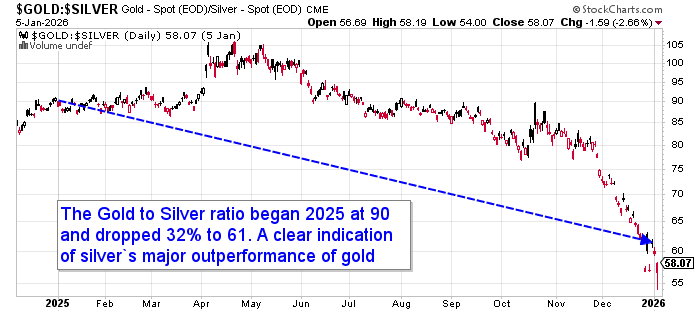
This ratio compression signals a shift in investor sentiment: more market participants are recognising silver’s undervaluation and dual-role appeal.
The Silver Story: Monetary Metal Meets Industrial Demand
The mainstream are reporting silver’s rise as speculative. But we’d say it reflects structural changes
2025 saw record demand from the solar energy sector, electric vehicles, and battery technology. As governments pushed ahead with net-zero initiatives, industrial silver demand hit all-time highs. This came just as mine supply remained tight and geopolitical risks increased. So it was the 5th year of a supply deficit.
Add to that silver’s longstanding role as a monetary hedge, and it created the perfect conditions for a breakout year.
What to Watch in 2026
- Can silver keep outpacing gold? After this year’s outperformance, will the trend continue — or is a pullback due?
- Will the gold/silver ratio return to historic norms? A drop below 60 could signal more upside.
- Will industrial demand continue to accelerate? Green energy, electrification, and global reindustrialisation trends will all play a role.
- Is price starting to finally reflect physical demand? Rather than being driven by paper and futures markets.
Final Thoughts: Silver Finds Its Footing
2025 may go down as the year silver finally reasserted itself.
After more than a decade in gold’s shadow, silver proved it still has the capacity for violent upside — especially when inflation, monetary uncertainty, and industrial demand collide.
If this year’s breakout was just the beginning, silver may still be the most undervalued hard asset in the world.
How Did Our 2025 Predictions Stack Up?
At the start of 2025, we made a few calls. Some hit the mark. Some… not so much. Here’s how our forecasts played out:
1.Silver will outperform gold for the year.
✅ Nailed it.
Silver surged +140% in NZD terms, handily outpacing gold’s impressive +62% rise. The gold-to-silver ratio dropped from 90 to 61, confirming silver’s dominant performance.
2. Silver will take out its all-time nominal high by year end — at least in NZ dollars. Maybe even USD.
✅✅ Correct — in both NZD and USD.
Silver didn’t just outperform gold — it rewrote the record books.
In NZD, silver surged from $51.07 to $122.70, a new all-time high.
In USD, it closed 2025 at US$70.60, smashing through the previous nominal highs of US$50 set in 1980 and again in 2011.
This was the breakout silver bulls have waited years — if not decades — to see. It was the year silver finally delivered on its potential, in both monetary and industrial terms.
3. Long-term interest rates and inflation will be higher than they began the year.
Partially correct — inflation rose, but interest rates held steady.
This prediction was focused on New Zealand, and we got half the story right.
- Inflation: ✅ Correct
Consumer price inflation steadily rose across 2025:- Dec 2024: 2.2%
- March 2025: 2.5%
- June 2025: 2.7%
- September 2025: 3.0%
That’s a clear upward trend — and it brought inflation to the top of the RBNZ’s 1–3% target range by year end.
- Interest Rates: ❌ Not quite
The NZ 10-year government bond yield started 2025 around 4.6%, and finished the year in roughly the same range — fluctuating slightly but with no clear breakout higher.
Long-term rates remained elevated, but didn’t rise further as we had expected.
Inflation pressure turned out to be stickier than many forecast — but markets didn’t push long-term rates much higher in response. So we’ll take a half-mark here.
4. Major stock market indexes will be down for the year.
❌ Didn’t happen.
Despite lots of volatility and warnings from macro indicators, equity markets rallied.
- S&P 500: +17.7%
- Nasdaq 100: +52.2%
- NZX 50 +3.3%: modest gains
Once again, the “everything bubble” found new legs. For now.
Bonus: The US Dollar
✅ Correct (from a Kiwi’s perspective)
We said at the time: “With the Kiwi dollar hitting new lows it’s tempting to also again say that the US dollar will be weaker by year end. But we might have to cut our losses on that prediction for now.”
Turns out we should have trusted our instincts.
The NZD/USD exchange rate rose from 0.5655 at the start of 2025 to 0.5754 by year end — a modest but clear strengthening of the Kiwi dollar against the greenback.
While the move wasn’t huge, it was a reversal from 2024’s downtrend — and it meant imported goods got slightly cheaper for New Zealanders holding NZD. We’ll chalk this up as a quiet win.
Overall Grade
Overall we got either 2.5 out of 4. Or 3.5 out of 5 if we allow us the Kiwi dollar call – which we probably shouldn’t since we didn’t really commit. So overall we’d still give ourselves a pass.
Our Predictions for 2026
So, what might the year ahead hold?
We’re not reinventing the wheel — in fact, we’re sticking with much of the same script. Why? Because the big-picture trends haven’t changed: inflation is still lingering, debt is still rising, and trust in fiat systems continues to erode.
With that in mind, here are our top 5 predictions for 2026:
1. Silver will once again outperform gold.
After silver’s breakout in 2025, we believe the momentum will continue — especially if gold remains strong and the gold-to-silver ratio keeps narrowing.
2. Silver will take out US$100 before year end.
Having smashed through US$50 in 2025, we expect silver to continue its run and reach a new psychological milestone — triple digits in US dollar terms.
3. Long-term interest rates and inflation will rise.
We’re doubling down on this call. Inflation may have cooled off at times, but structural pressures — energy, debt, wages — haven’t gone away.
We expect to see both NZ long-term bond yields and inflation figures finish 2026 higher than they started.
4. Major stock market indexes will end the year lower.
We’re least confident about this one — but valuations remain stretched, debt is mounting, and investor complacency is high.
A correction or even a broader repricing wouldn’t surprise us.
5. The Kiwi dollar will strengthen further against the USD.
After a modest rebound in 2025, we expect the NZD/USD rate to climb higher again in 2026, helped by relative USD weakness and ongoing global diversification away from the US dollar.
We’ll leave it at that for this year’s outlook.
Forecasting exact timing is always a challenge — which is why we often say that for most people, dollar-cost averaging into gold and silver is a more practical, stress-free approach.
If you do prefer a bit of timing, we suggest using a few simple technical indicators to help spot pullbacks and buy opportunities. You can learn more about that here.
And don’t forget to sign up for our daily price alerts to stay informed and ready to act when opportunities arise.
Frequently Asked Questions (FAQs)
If you’re investing for wealth protection rather than speculation, then any time is the right time. Dollar-cost averaging smooths out volatility and takes timing stress out of the equation.
No one can predict short-term prices perfectly, but the same macro drivers from 2025 — inflation, central bank demand, and currency risk — are still present. That suggests gold may remain strong.
Many expect the NZD to strengthen modestly in 2026, especially if global diversification away from the USD continues. This could slightly reduce local gold prices — but geopolitical or financial shocks could reverse that.
With the ratio dropping from 90 to 61 in 2025, it signals that silver outperformed gold significantly. If this trend continues, silver could still be the better value play in 2026.

Glenn's dedication to educating individuals on wealth protection through precious metals has helped over 2400 clients from New Zealand, Australia, USA and Europe to safeguard their financial futures. Passionate about financial independence and lifestyle freedom, Glenn’s mission is to empower others with the knowledge and tools to thrive in today’s volatile economic environment. When he's not advising on precious metals, Glenn enjoys spending time with his family and pursuing outdoor adventures.
Education: University of Auckland Bachelor of Science
Linkedin: https://www.linkedin.com/in/glenn-thomas-0984a4310/
- Rising Yields and Big Gold Targets: What Happens Next? - May 27, 2026
- Gold and Interest Rates: What Rising Rates Mean for Gold Prices - May 25, 2026
- Rising Bond Yields and Pressure on Precious Metals - May 20, 2026
