

This Week:
Estimated reading time: 6 minutes
Weekly Price Overview – 20 May 2026
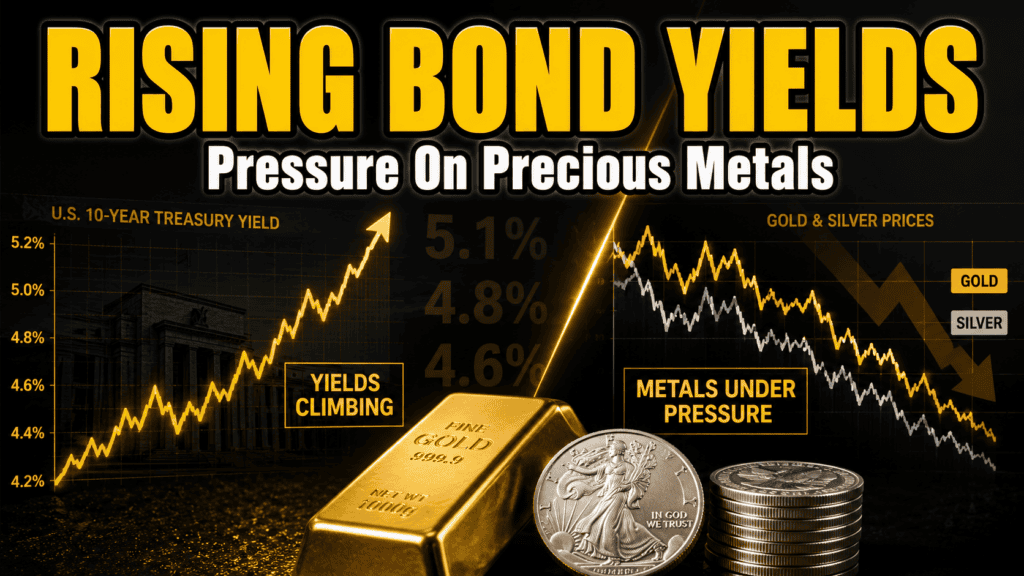
Precious metals pulled back this week as rising US Treasury yields and expectations for higher rates weighed on sentiment.
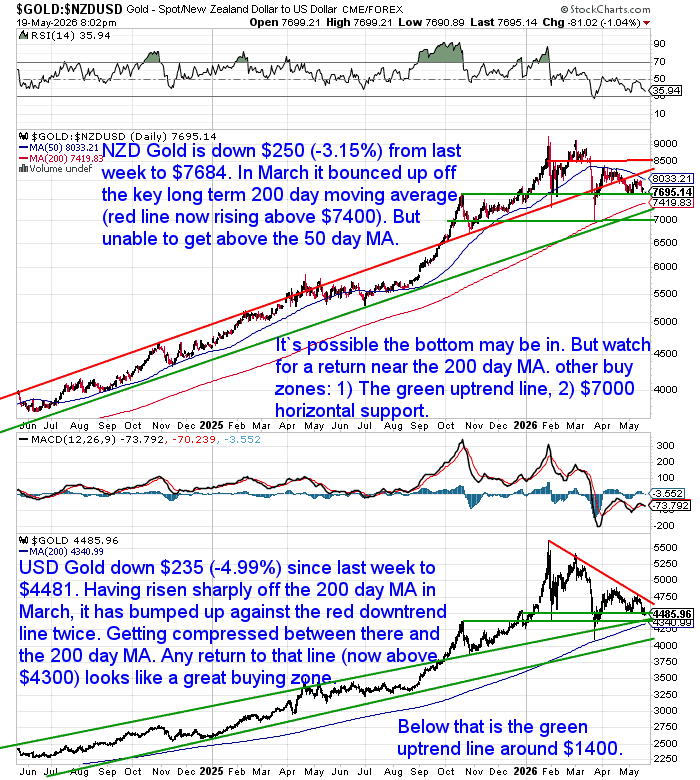
🟡 NZD gold fell $250 (-3.15%) to $7,684
NZD gold pulled back after failing to break above the 50-day MA. The rising 200-day MA near $7,400 continues to act as key support. If weakness continues, watch the 200-day MA, the uptrend line and the $7,000 level.
USD gold fell $235 (-4.99%) to $4,481
USD gold continued consolidating after its March rebound. Price remains compressed between the long-term uptrend and overhead resistance. The 200-day MA near $4,300 remains important support.
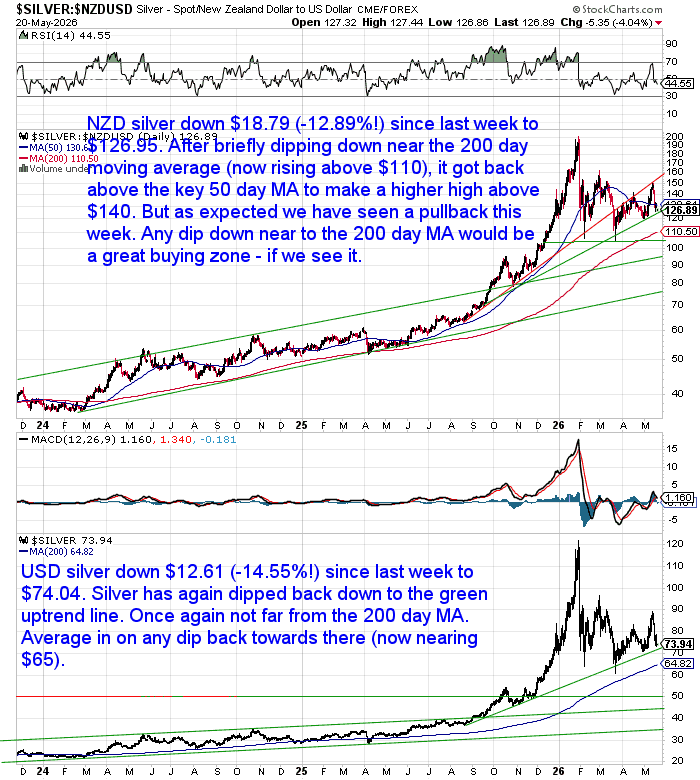
⚪ NZD silver fell $18.79 (-12.89%) to $126.95
NZD silver pulled back after briefly pushing above $140. It remains above the rising 200-day MA near $110, which continues to be a key long-term support area.
USD silver fell $12.61 (-14.55%) to $74.04
USD silver dropped back toward its long-term uptrend and the 200-day MA near $65. Any move toward that area would likely remain a strong accumulation zone.
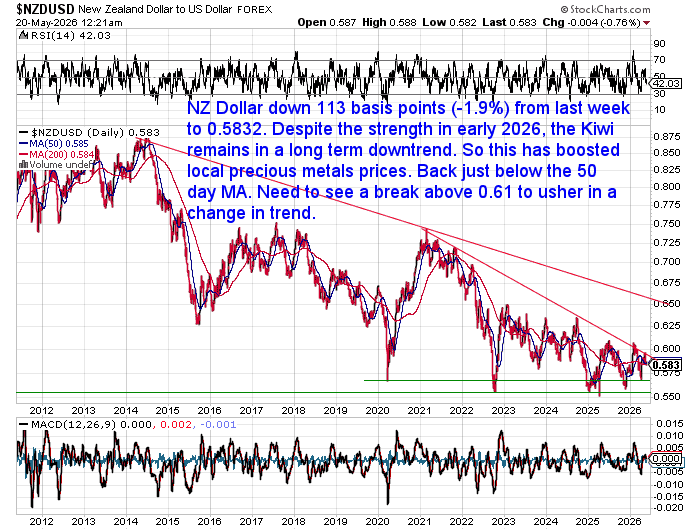
💱 NZD/USD fell 113 basis points (-1.90%) to 0.5832
The Kiwi dollar weakened again this week and remains in a broader downtrend. That continues supporting NZD precious metals prices. NZD/USD remains below the 50-day MA. A move above 0.61 would suggest a trend change.
Rising Rates, Rising Pressure: What Happens Next for Gold and Silver?
Interest Rates Are Moving Higher
The big market story this week was the sharp rise in US Treasury yields.
The 10-year Treasury yield has climbed to its highest level this year, while the 30-year Treasury yield recently touched levels not seen since 2007.
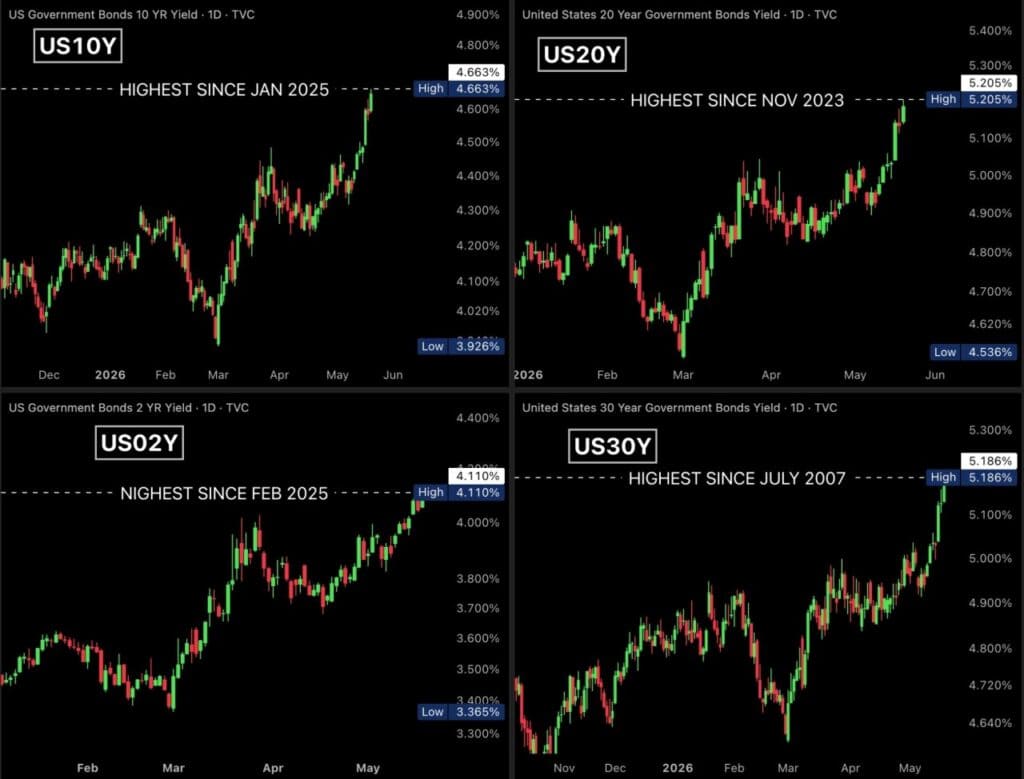
Source: Charles-Henry Monchau
Why does this matter?
Treasury yields influence borrowing costs across much of the global financial system. Mortgages, business lending, credit cards and government borrowing costs all tend to move from these benchmark rates.
They can also reflect confidence in the financial system.
Bond prices and yields move in opposite directions. Rising yields often signal investors want more compensation for lending money.
Rising yields can also signal growing concerns around inflation, debt and currency purchasing power.
With debt levels much higher today, even small rate increases can have a large impact.
So Why Isn’t Gold Moving Higher?
Many people are probably looking at the current environment and asking:
“Shouldn’t gold be doing well right now?”
Higher debt, inflation concerns and geopolitical risks would normally support precious metals.
But markets rarely move in a straight line.
This chart from Dana Samuelson highlights the strong inverse relationship between gold and US Treasury yields so far this year.

As yields rise, cash and bonds begin offering higher short-term returns. That can temporarily pull investment money away from precious metals.
This creates a short-term tug-of-war.
Long term, rising debt, economic instability and currency concerns can support gold and silver.
But in the shorter term, inflation fears can push interest rates and the US dollar higher. That can pressure prices even when the reasons for owning gold and silver remain unchanged.
Short-term market moves can distract from longer-term trends.
Want a deeper explanation of why rising interest rates do not always lead to lower gold prices? Read our guide on Gold and Interest Rates: What Rising Rates Mean for Gold Prices.
Waiting for the Perfect Time to Buy?
Gold and silver are still consolidating, leaving many investors asking the same question: Should I buy now… or wait for a bigger pullback?
The question sounds simple, but timing decisions are often driven more by emotion than logic.
This week’s featured article looks at the psychology of waiting for the “perfect” entry point and why certainty can come at a cost.
Read: When Is the Best Time to Buy Gold?

Are Bonds Still Providing Protection?
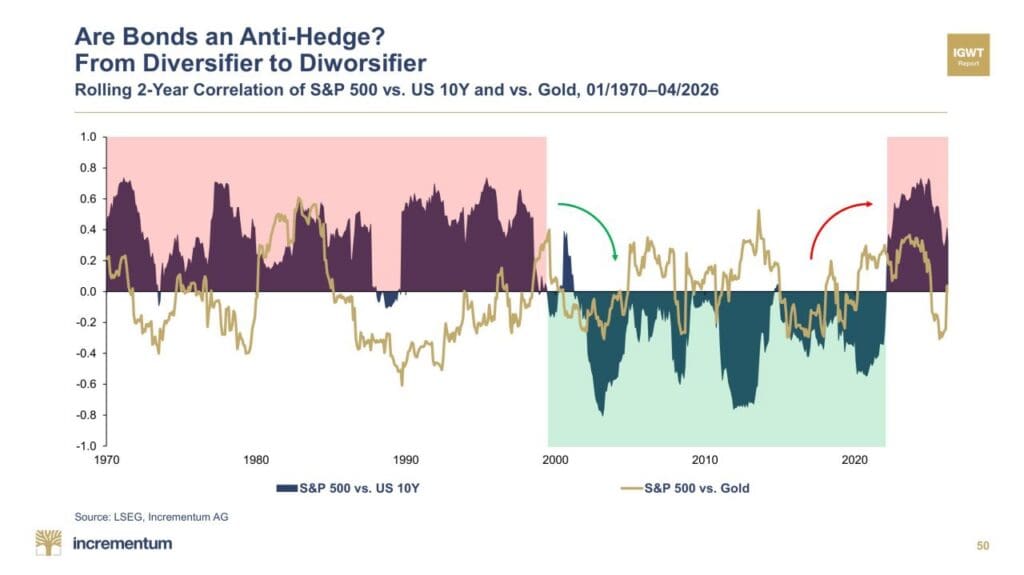
For decades, investors relied on government bonds as portfolio protection.
The traditional assumption was simple:
When stocks fell, bonds would usually rise.
Source: In Gold We Trust
That relationship now appears to be changing.
Since 2021, stocks and bonds have increasingly moved in the same direction rather than offsetting one another.
This does not mean bonds no longer have a place in portfolios.
But investors may no longer be able to assume they will provide the same protection.
Gold meanwhile has started behaving more like a diversifier again.
What Are Silver Producers Seeing?
One development caught our attention this week.
During Q1, First Majestic Silver chose to hold back approximately 676,000 ounces of silver and 2,700 ounces of gold rather than selling it immediately.
The inventory was worth around US$63 million.
That does not guarantee prices will move higher.
But producers rarely delay sales unless they believe market conditions may improve later.
Producers often see supply and demand trends before most investors.
It does not tell us what prices will do next week.
But it may offer clues about where experienced industry participants believe value may be emerging. If current market moves have left you wondering whether to buy, wait, or simply sit tight, feel free to get in touch.

Glenn's dedication to educating individuals on wealth protection through precious metals has helped over 2400 clients from New Zealand, Australia, USA and Europe to safeguard their financial futures. Passionate about financial independence and lifestyle freedom, Glenn’s mission is to empower others with the knowledge and tools to thrive in today’s volatile economic environment. When he's not advising on precious metals, Glenn enjoys spending time with his family and pursuing outdoor adventures.
Education: University of Auckland Bachelor of Science
Linkedin: https://www.linkedin.com/in/glenn-thomas-0984a4310/
- Physical Gold vs Paper Gold – Which Should You Own? - August 18, 2026
- Why Own Gold When It Pays No Interest or Dividends? - August 12, 2026
- Why Buy Gold? A New Zealand Guide to Protecting Your Wealth - August 11, 2026
