

Sep
The gold–silver ratio is one of the simplest ways to compare the relative value of gold and silver. But it can also be easily misunderstood.
In April 2025, the ratio climbed to around 107:1. In other words, one ounce of gold was worth roughly 107 ounces of silver. When we last updated this article, we noted that such an extreme reading could set the stage for silver to catch up with gold.
Silver did subsequently catch up — and far more dramatically than the ratio alone could have predicted.
Silver surged during the second half of 2025 and into January 2026. The gold–silver ratio briefly fell below 50:1 as a result. It has since climbed back to around 67:1 at the time of this September 2026 update.
So, what does the gold–silver ratio tell us now? And after such a dramatic move, is silver still undervalued compared with gold?
Let’s take a look.
Quick Answer: What Is the Gold–Silver Ratio?
The gold–silver ratio (GSR) tells you how many ounces of silver it takes to equal the spot-market value of one ounce of gold.
For example, if gold is US$4,500 an ounce and silver is US$75 an ounce, the gold–silver ratio is 60:1.
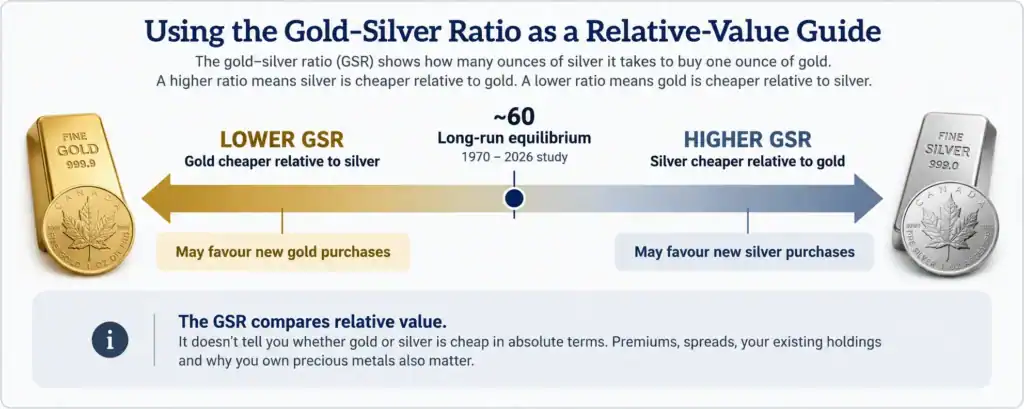
A high ratio means silver is relatively cheap compared with gold. A low ratio means silver has become relatively more expensive compared with gold.
However, the GSR measures relative value, not absolute value. A high ratio doesn’t automatically mean silver is cheap, nor does it tell you when silver will rise.
What Is the Gold–Silver Ratio Today?
The chart above updates automatically using the latest gold and silver spot prices.
At the time of this update in September 2026, the gold–silver ratio is around 67:1. That means one ounce of gold is worth about 67 ounces of silver at current spot prices.
The exact number changes throughout the trading day, so check the live chart above for the latest reading.
New Zealand investors sometimes search for a separate “NZ gold–silver ratio”. But the ratio itself is not currency-specific. If both gold and silver are priced in the same currency, converting them from US dollars to New Zealand dollars does not materially change the ratio.
What does differ in New Zealand is the cost of buying physical metal. Dealer premiums, buy-back spreads, product availability and storage costs mean you won’t necessarily be able to swap one ounce of physical gold for exactly 67 ounces of physical silver.
Want a longer-term view? See our live Gold–Silver Ratio charts, including the long-term weekly chart.
Table of contents
- Quick Answer: What Is the Gold–Silver Ratio?
- What Is the Gold–Silver Ratio Today?
- What Is the Historical Average Gold–Silver Ratio?
- Why Does the Gold–Silver Ratio Change?
- Case Study: What Happened After the Gold–Silver Ratio Hit 107 in 2025?
- What Does a High Gold–Silver Ratio Mean?
- What Does a Low Gold–Silver Ratio Mean?
- Does a High Gold–Silver Ratio Mean Silver Is Undervalued?
- What Could a Lower Gold–Silver Ratio Mean for the Silver Price?
- How We Use the Gold–Silver Ratio
- Spot GSR vs Physical GSR
- Should You Buy Gold or Silver Based on the Ratio?
- Final Thoughts: How Useful Is the Gold–Silver Ratio?
Estimated reading time: 14 minutes
What Is the Historical Average Gold–Silver Ratio?
There isn’t one single historical average for the gold–silver ratio.
You will often see ratios of 15:1 or 16:1 quoted as the historical norm. But these figures largely come from periods when gold and silver were both used as money and governments fixed, or heavily influenced, the exchange rate between them.
For example, the United States established a 15:1 ratio under the Coinage Act of 1792. France later adopted a ratio of 15.5:1 in 1803. These ratios tell us something about the monetary systems of the time, but they don’t necessarily tell us where gold and silver should trade today.
Since gold and silver began trading more freely, the ratio has generally been much higher.
A 2026 study produced by Precious Metals Insights for the Silver Institute examined monthly gold and silver prices from January 1970 to May 2026. It found evidence that the ratio tends to revert towards a long-run equilibrium of around 59.65:1.
That doesn’t mean 59.65 is the “correct” ratio, or that the GSR must always return to it. The ratio can remain well above or below its long-term trend for extended periods.
We’ve seen some striking examples:
| Period | Approx. Gold–Silver Ratio | Context |
|---|---|---|
| US Coinage Act, 1792 | 15:1 | Legally fixed bimetallic ratio |
| France, 1803 | 15.5:1 | Legally fixed bimetallic ratio |
| 1980 | 15:1 | Silver surged during the precious-metals boom |
| April 2011 | Around 30:1 | Silver again strongly outperformed gold |
| March 2020 | Above 120:1 | COVID-19 market panic |
| April 2025 | Around 107:1 | Gold strongly outperforming silver |
| January 2026 | Below 50:1 | Silver’s sharp catch-up rally |
| September 2026 | Around 67:1 | Ratio had moved back above its long-run equilibrium |
Those earlier ratios came from very different monetary systems. Comparing today’s freely traded gold and silver prices with a government-set ratio from 200 years ago isn’t an apples-to-apples comparison.
For today’s investor, the modern trading history is generally more useful. Even then, a long-term average is better treated as a reference point than a level the ratio is bound to return to.
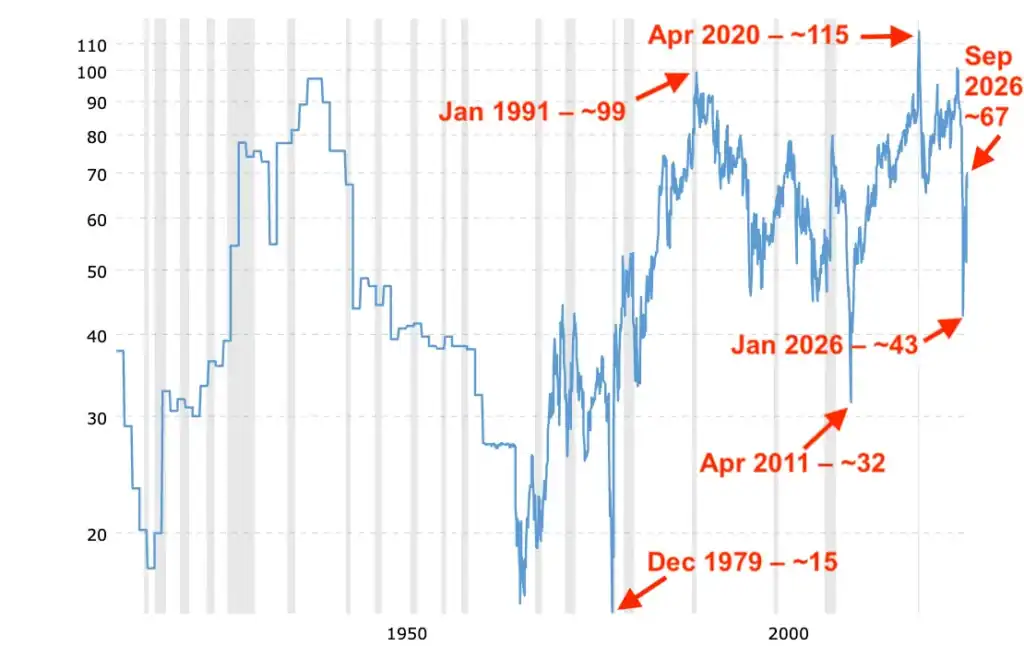
The sharp fall in the GSR in January 2026 looked dramatic compared with the previous few years. But over the longer term, the ratio has fallen much further. On this data series, it reached around 32 in April 2011 and around 15 in December 1979.
Those earlier lows don’t mean the ratio will return to 32 or 15. They do show that January 2026 wasn’t unprecedented — and that there is historical precedent for silver becoming considerably more valuable relative to gold.
Why Does the Gold–Silver Ratio Change?
Gold and silver share some of the same price drivers, but they don’t respond to them in exactly the same way.
Gold demand is heavily influenced by investment, central-bank buying and demand for a safe haven during periods of financial or geopolitical stress. Silver also attracts investment demand, but industrial use accounts for a much larger share of its overall demand.
That means economic conditions can affect the two metals differently.
During a financial panic, for example, investors may rush towards gold while weaker expectations for industrial activity weigh on silver. The GSR can rise sharply as a result.
At other times, strong industrial demand or growing investor interest in silver can cause silver to outperform gold and push the ratio lower.
The ratio moves because the forces driving gold and silver aren’t identical.
Case Study: What Happened After the Gold–Silver Ratio Hit 107 in 2025?
When we last fully updated this article in April 2025, the gold–silver ratio had climbed above 100 for the first time since the COVID-19 market panic of 2020.
Gold had been rising much faster than silver. By April, the ratio peaked at around 107:1.
At the time, we wrote that the widening gap could be setting up for a silver catch-up rally. That’s what followed, although the size and speed of the move were impossible to know in advance.
The ratio remained above 85:1 into late September 2025. Then silver began to rapidly outperform gold. By December, the ratio had fallen below 55:1. In January 2026, it briefly dropped below 50:1 as silver surged to a record high above US$120 an ounce.
That was a remarkable reversal. In less than a year, the market went from valuing one ounce of gold at more than 100 ounces of silver to fewer than 50.
Since then, silver has fallen sharply from its January peak and the ratio has climbed again. By early September 2026, it was back around 67:1.
That move coincided with an extraordinary shift in silver investor psychology, which we examine in our silver market cycle analysis.
What Did the Gold–Silver Ratio Get Right?
The April 2025 reading highlighted an extreme relative valuation.
Gold had raced ahead while silver lagged. A ratio above 100 showed just how wide that gap had become. Silver’s subsequent outperformance then closed much of it.
This is one reason we pay attention to the GSR. It can help identify periods when one metal has moved unusually far ahead of the other.
But there is an equally important lesson in what the ratio couldn’t tell us.
A reading of 107:1 couldn’t tell us:
- when silver would start catching up;
- how quickly the ratio would fall;
- how high silver or gold would rise in dollar terms;
- where the ratio would eventually bottom; or
- whether silver’s January 2026 peak was sustainable.
The GSR measures the relationship between two prices. It isn’t a price forecast.
An extreme ratio can highlight an unusual gap between gold and silver, but it can’t tell us when that gap will close — or whether gold, silver or both will move to close it.
What Does a High Gold–Silver Ratio Mean?
A high gold–silver ratio means gold is expensive relative to silver, or silver is cheap relative to gold.
For example, at 100:1 it takes 100 ounces of silver to equal the spot value of one ounce of gold. At 60:1, it takes only 60 ounces.
High ratios can occur when gold rises faster than silver, when silver falls faster than gold, or a combination of both. They have often appeared during periods of financial stress, when investors favour gold’s traditional safe-haven role.
For precious metals buyers, a high GSR can make silver look more attractive relative to gold.
What Does a Low Gold–Silver Ratio Mean?
A low gold–silver ratio means silver is expensive relative to gold, or gold is cheap relative to silver.
This can happen when silver rises faster than gold, as we saw during the second half of 2025 and into January 2026. It can also happen if silver holds up better while both metals are falling.
Some investors use a falling GSR as a reason to favour gold over silver or to rebalance part of their precious metals holdings.
A low GSR doesn’t automatically mean silver is overpriced. It simply tells us that silver has become more valuable relative to gold.
Does a High Gold–Silver Ratio Mean Silver Is Undervalued?
A high gold–silver ratio can indicate that silver is undervalued relative to gold. That’s not quite the same as saying silver is cheap.
Suppose the GSR rises from 60:1 to 100:1. That tells us silver has become much cheaper compared with gold. But it doesn’t tell us whether silver is cheap compared with its production costs, historical purchasing power, other assets, or its own previous prices.
Nor does a high ratio guarantee that silver will be the metal that moves next. The gap could narrow because silver rises, because gold falls, or because both prices move at different speeds.
April 2025 provides a good example of the first outcome. With the GSR around 107:1, silver looked unusually cheap relative to gold. Silver subsequently rose much faster than gold and the ratio fell sharply.
That doesn’t turn 100:1 — or any other number — into an automatic buy signal. It simply gives investors another way to judge the relative value on offer.
For a broader look at silver’s valuation, supply and demand, industrial uses and risks, see Why Buy Silver? A Guide to Owning Silver in New Zealand.
What Could a Lower Gold–Silver Ratio Mean for the Silver Price?
When we last updated this article in April 2025, we included a table showing what different gold prices and gold–silver ratios could mean for the silver price.
Some of the higher figures may have looked ambitious at the time. But on 28 January 2026, gold reached around US$5,429 while silver reached US$116.58, according to StockCharts. That works out to a GSR of about 46.6:1.
This doesn’t mean silver will revisit those prices, or that the ratio will return to its historical lows. But it does show how quickly the silver price can change when a rising gold price is combined with a falling GSR.
The table below shows the silver price implied by a range of gold prices and GSRs:
| Gold Price | GSR 80 | GSR 70 | GSR 60* | GSR 50 | GSR 40 | GSR 30 | GSR 20 |
|---|---|---|---|---|---|---|---|
| US$4,000 | $50 | $57 | $67 | $80 | $100 | $133 | $200 |
| US$4,500 | $56 | $64 | $75 | $90 | $113 | $150 | $225 |
| US$5,000 | $63 | $71 | $83 | $100 | $125 | $167 | $250 |
| US$5,500 | $69 | $79 | $92 | $110 | $138 | $183 | $275 |
| US$6,000 | $75 | $86 | $100 | $120 | $150 | $200 | $300 |
| US$7,000 | $88 | $100 | $117 | $140 | $175 | $233 | $350 |
*A GSR of 60 is close to the 59.65:1 long-run equilibrium identified in the 2026 Precious Metals Insights study.
For context, with gold at about US$4,442 today, a GSR of 50 would imply silver around US$89 if gold didn’t move. A GSR of 40 would imply about US$111, while a rise to 80 would imply around US$56. In practice, of course, the gold price is unlikely to stand still.
How We Use the Gold–Silver Ratio
We don’t think the GSR should decide whether someone owns gold or silver. We find it more useful as one part of the decision.
A simple way to approach it is:
1. Purpose
Start with why you want to own precious metals.
Gold is primarily a form of wealth insurance. It packs a large amount of value into a small space and tends to be less volatile than silver.
Silver can also provide wealth protection, but its lower price, industrial demand and greater volatility give it more potential upside — along with greater downside.
2. Relative value
Once you’ve decided what role precious metals will play in your holdings, the GSR can help compare the relative value of gold and silver.
An unusually high ratio may encourage someone who already owns gold to direct their next purchase towards silver. A low ratio could make gold comparatively more attractive.
3. Timing
This is where the GSR becomes less useful.
An extreme ratio can persist for months or even years. So rather than waiting for a particular number before buying anything, some investors use the ratio to influence what they buy, rather than whether they buy.
For example, someone regularly adding to both metals might tilt new purchases towards silver when the GSR is unusually high, without trying to pick the exact day the ratio will turn.
That approach also fits with dollar-cost averaging, where purchases are spread over time instead of relying on a single entry point. We cover this and other approaches in more detail in our guide to When to buy gold or silver.
One thing we’ve noticed from dealing with New Zealand bullion buyers is that attractive relative value doesn’t necessarily create immediate demand. Buyers often become more interested after prices have already risen strongly. At the moment, for example, buying activity is unusually quiet following silver’s sharp fall from its January 2026 high. That may tell us something about sentiment, although it doesn’t prove silver has reached a bottom.
Spot GSR vs Physical GSR
The gold–silver ratio is calculated using spot prices. But if you own physical bullion, you can’t expect to swap one ounce of gold for exactly the number of silver ounces shown by the GSR.
Physical coins and bars trade above spot when you buy them and usually below the retail price when you sell them. Premiums and buy-back spreads also differ between gold and silver, and can change with product availability and market demand.
Silver premiums, in particular, can move significantly during periods of strong physical demand.
So if the spot GSR is 70:1, the actual number of ounces of physical silver you could obtain by selling one ounce of physical gold may be quite different.
For anyone thinking about swapping between the metals, the prices you can actually buy and sell at matter more than the headline ratio.
Should You Buy Gold or Silver Based on the Ratio?
We wouldn’t choose between gold and silver based on the GSR alone.
Gold and silver can both protect wealth outside the banking system, but they don’t behave in exactly the same way. Gold is generally the more compact and less volatile form of wealth insurance. Silver offers similar ownership benefits, while its industrial demand and greater price volatility can provide more upside — and more downside.
So the first question isn’t what the gold–silver ratio is. It’s what you want the metal to do for you.
Once you’ve answered that, the GSR can help decide whether gold or silver offers better relative value at the time. It can influence the balance of a purchase without having to dictate the entire decision.
If you’re deciding which metal better suits your circumstances, see our Should I Buy Gold or Silver? 7 Factors to Consider.
Final Thoughts: How Useful Is the Gold–Silver Ratio?
The past 18 months provide a useful example of both the strengths and limitations of the gold–silver ratio.
When the GSR climbed to around 107:1 in April 2025, it showed that silver had fallen a long way behind gold. Silver subsequently caught up in spectacular fashion, driving the ratio below 50:1 by January 2026.
But the ratio couldn’t tell us when that move would begin, how far silver would rise, or where either metal would trade afterwards.
Today, the GSR remains useful for comparing the relative value of gold and silver. For physical bullion owners, it can help inform whether the next purchase might favour one metal over the other.
It just shouldn’t make that decision on its own.
Editors Note: This article was originally published on 18 September 2018 and fully updated on 8 September 2026.

Glenn's dedication to educating individuals on wealth protection through precious metals has helped over 2400 clients from New Zealand, Australia, USA and Europe to safeguard their financial futures. Passionate about financial independence and lifestyle freedom, Glenn’s mission is to empower others with the knowledge and tools to thrive in today’s volatile economic environment. When he's not advising on precious metals, Glenn enjoys spending time with his family and pursuing outdoor adventures.
Education: University of Auckland Bachelor of Science
Linkedin: https://www.linkedin.com/in/glenn-thomas-0984a4310/
- China’s Gold Buying Accelerates as Prices Fall - November 11, 2026
- NZ Housing to Gold Ratio Update – 2026 Edition - November 10, 2026
- Gold and Silver Price Correction: Are We Nearing a Bottom? - November 4, 2026

I agree that the ratio is too high but don’t know how to take advantage of this except by buying more silver than gold. Is selling gold futures and buying silver futures a safe way of achieving the same thing…how about margin calls, commission rates etc…I don’t know much about futures trading
Regards
Paul
I too believe that silver is lagging gold but sometime in the next couple of years there will be a catch up period. The maths is simple…if gold rises from is current $1250 USD to say $2000 USD with a current GSR of 83 (60% increase) then a drop in the GSR to say 60 would see the silver spot go from its current $15.15 USD to $33.33 USD (120% increase).
In my view, a 33% gold vs 66% silver investment ratio is a safe approach rather than putting all the eggs in the silver basket.
Can’t argue with that theory Stuart. Silver does seem to have plenty of upside from here. And yes indeed best not to have all eggs in one basket.
Thanks for commenting Paul. We prefer the method of buying more silver than gold too at times like this. From a trading perspective then yes buying futures or even Exchange Traded Funds (ETF’s) could be profitable on a more short term horizon. But yes you’d need to take commissions into account and only “play” with what you can afford to lose as silver can be volatile for sure!.