
Gold
Don’t Confuse Investing With Wealth Protection: What Is Gold Actually For?
Aug
Gold has an obvious weakness as an investment.
It doesn’t pay interest. It doesn’t produce a dividend. You can’t collect rent from it. And unlike a business, a bar of gold won’t become more productive over time.
Critics of gold often point to these facts as reasons not to own it.
And they’re right about one thing: gold is not a productive asset.
But perhaps we’re asking gold to do the wrong job.
Shares might be held to grow your wealth over time. Property can provide income, utility and potential capital growth. Cash gives you liquidity and helps meet short-term needs.
Physical gold can serve a different purpose: helping preserve wealth and purchasing power over the long term.
So rather than asking whether gold will outperform shares, property or anything else, start with a more useful question:
What job do you actually want your gold to do?
Table of contents
- Investing and Wealth Protection Are Not the Same Thing
- Why Gold Can Look Like a Bad Investment – If You Ask It to Do the Wrong Job
- The Three Jobs Your Wealth May Need to Perform
- The Question Isn’t “Which Asset Is Best?”
- What Gold’s Lack of Yield Actually Tells You
- Investment Return Isn’t the Only Measure of Financial Success
- A New Zealand Example: Know What You Actually Own
- Investing and Wealth Protection Can Work Together
- So What Is Gold Actually For?
- Frequently Asked Questions
Estimated reading time: 10 minutes
Investing and Wealth Protection Are Not the Same Thing
Investing and wealth protection are related, but they are not the same thing.
Investing is primarily about creating wealth. You put capital into an asset with the expectation that it will generate income, increase in value, or both.
Wealth protection starts from a different place. You already have wealth and want to reduce the risk of losing its value.
That means different parts of your wealth can have different jobs:
Create wealth → Maintain liquidity → Protect wealth
A long-term financial strategy can include all three. Problems arise when we judge an asset designed for one job by how well it performs another.
Why Gold Can Look Like a Bad Investment – If You Ask It to Do the Wrong Job
Gold doesn’t generate earnings. It pays no dividend or interest. It produces no rent.
These are genuine drawbacks if your objective is to generate income or compound your capital through a productive asset.
Warren Buffett has famously criticised gold on similar grounds. His preference is for productive assets such as businesses that can generate increasing amounts of wealth over time.
We don’t disagree with the basic logic.
In fact, we’d generally expect a successful business to outperform a lump of metal over a very long period. The business can reinvest profits, increase production and compound its earnings. Gold can’t.
But that comparison only tells us which asset is better at creating wealth. It doesn’t tell us whether both might have a place in a broader wealth strategy.
We’ve looked at Buffett’s views on gold – and his rather interesting history with silver – in more detail here:
Further Reading: Why Buffett is (Still) Wrong About Gold – But How He Loves Silver
The Three Jobs Your Wealth May Need to Perform
Here’s a simple way we think about it at Gold Survival Guide.
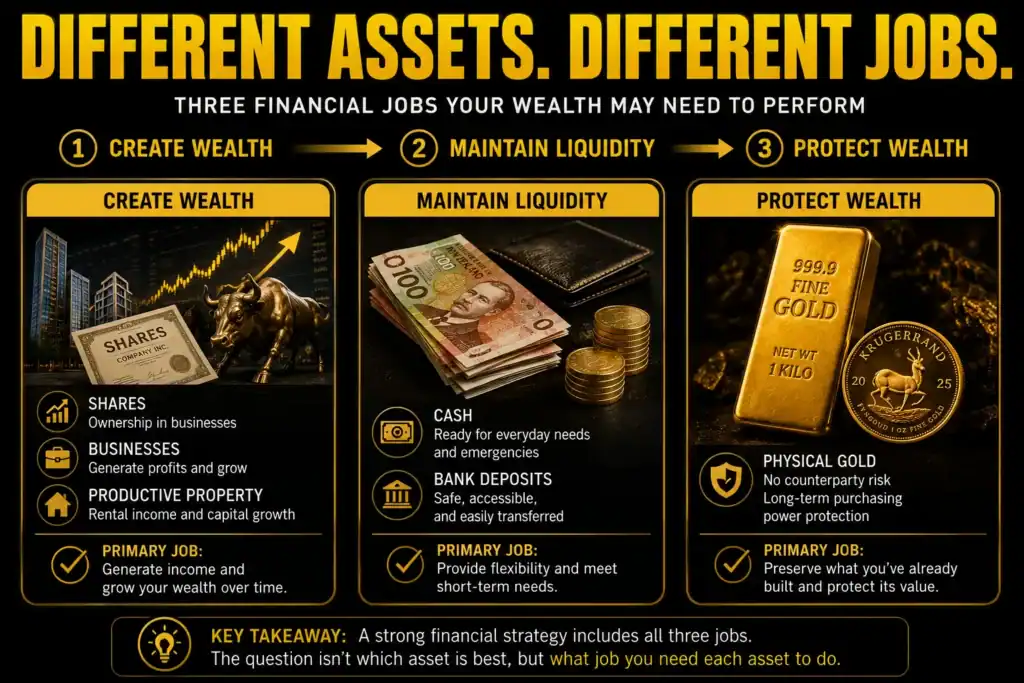
1. Create Wealth
Businesses, shares and productive property can generate income and potentially grow in value over time.
For most people building long-term wealth, productive assets are likely to play an important role.
2. Maintain Liquidity
Cash and bank deposits serve another purpose.
They give you currency that can be accessed quickly for everyday spending, emergencies or opportunities.
Holding too much cash for too long has its own risks. But that doesn’t make cash useless. Liquidity is its job.
3. Protect Wealth
Physical gold can perform a different role again.
Rather than expecting it to generate income, we primarily view gold as a way of preserving part of the wealth you have already accumulated.
That doesn’t mean gold can’t also produce strong investment-like returns. Over some periods, it has performed extremely well against shares, bonds, cash and other major assets. We looked at the numbers in our 25-year comparison below.
Further Reading: Gold vs Stocks, Bonds, Cash & More: A 25-Year Showdown
But for us, those potential returns come second to its role as long-term wealth protection.
We’ve covered the reasons for viewing physical gold this way – and the risks it may help protect against – in our dedicated guide:
Further Reading: Why Gold Bullion Is Your Financial Insurance | Wealth Protection Guide
The Question Isn’t “Which Asset Is Best?”
People often compare assets as though there must be a single winner.
Gold or shares? Property or cash? Which has produced the highest return?
But a better question is:
Which asset is best for the job I need it to perform?
A rental property can generate income, but it isn’t particularly liquid. Cash is highly liquid, but holding too much of it for too long can reduce your purchasing power. Shares can provide income and capital growth, but their value can fluctuate significantly.
Physical gold has its own strengths and weaknesses too.
A useful financial plan doesn’t need one winning asset. It needs the right mix of assets for the jobs you want them to do.
What Gold’s Lack of Yield Actually Tells You
One of the most common criticisms of gold is that it pays no interest or dividend.
That’s true. But it’s worth considering where investment income actually comes from.
A company can pay a dividend because it uses capital to operate a business and generate profits.
A bond pays interest because you’ve lent money to a government or company.
A bank deposit can pay interest because the bank uses deposits as part of its wider lending and funding activities.
Physical gold is different. There is no business, borrower or issuer behind it promising you an income stream.

So gold’s lack of yield isn’t a hidden flaw. It’s a characteristic of what you own.
If you need an asset to generate income, physical gold probably isn’t the right tool for that job. But income is only one reason to own an asset.
Investment Return Isn’t the Only Measure of Financial Success
Imagine two people with similar levels of wealth.
One has almost everything invested in assets chosen to maximise returns.
The other holds productive investments too, but also keeps some cash available and some wealth in assets that behave differently from the rest of the portfolio.
The first person might achieve the higher return.
But does that automatically mean they have the better financial strategy?
Not necessarily.
Return is important, especially when you’re building wealth. But so are liquidity, diversification, resilience and the ability to preserve what you’ve already accumulated.
A strategy that produces the highest return in good times may not be the one that best suits your needs when circumstances change.
A New Zealand Example: Know What You Actually Own
New Zealand has its own historical example of why it pays to understand exactly what you own.
Goldcorp sold “unallocated gold certificates”, with physical gold supposedly held in its vaults. But when the company collapsed in 1988, there wasn’t enough gold to meet the claims of all the certificate holders. The gold that was there was claimed by the company’s funder, BNZ.
Around 1,600 certificate holders fought through the courts, with the case eventually reaching the Privy Council. BNZ ultimately got the gold.
Source: Stuff – Lessons of the past
Other New Zealand Reminders to Understand What You Own
Goldcorp isn’t New Zealand’s only example of people losing money through arrangements connected with gold.
Bullion Buyer: Investors handed over money for a leveraged gold-options strategy. The company ultimately owed investors around $2.7 million, and a sentencing judge later described the scheme as “ponzi-like”. Sources: RNZ and Serious Fraud Office.
Prosper Through Trading: Businessman Steven Robertson was jailed in 2019 after taking money from investors who believed it would be used for share, gold and commodities trading. Instead, investor money was used for personal and business expenses. Source: Stuff
These weren’t the same type of arrangement as Goldcorp. But they reinforce the same basic question: before handing over money for anything described as a “gold investment”, understand exactly what you are buying, who controls the assets and what you actually own.
The lesson isn’t that every gold investment involving a third party is unsafe. It’s that exposure to gold and ownership of physical gold are not necessarily the same thing.
If direct ownership is one of the reasons you want gold in the first place, make sure the structure you choose actually provides it.
Further Reading: Physical Gold vs Paper Gold – Which Should You Own?
Investing and Wealth Protection Can Work Together
You don’t have to choose between being an investor and protecting wealth.
We certainly don’t think people should sell all their shares or property and put everything into gold. Someone can enthusiastically own productive businesses, property and shares while deciding that another portion of their wealth should perform a different job.
How much belongs in each category will vary. Someone still building wealth may have very different priorities from someone who has spent decades accumulating it.
Investing and wealth protection can work alongside each other rather than compete with each other.
So What Is Gold Actually For?
So, back to the question in the title.
What is gold actually for?
If you want income, gold isn’t designed to provide it.
If you want productive growth, businesses, shares and other productive assets are generally better suited to that job.
If you want to trade short-term moves in the gold price, physical bullion may not even be the most convenient or cost-effective option.
But if you want to hold part of the wealth you’ve already built in a tangible asset that you can own directly and keep for the long term, physical gold starts to make much more sense.
That’s why at Gold Survival Guide we tend to view gold as wealth insurance first and an investment second.
It can rise significantly in value. It can produce strong investment-like returns. But we don’t think you need to rely on either of those things to justify owning it.
Gold doesn’t need to replace your investments to earn a place alongside them.
Frequently Asked Questions
Gold can be both. Its price can rise and deliver strong investment-like returns, but physical gold doesn’t generate income or earnings like a productive asset. At Gold Survival Guide, we primarily view physical gold as a way to preserve wealth and purchasing power over the long term, with its investment potential coming second.
No. Gold doesn’t produce goods or services, generate earnings, or pay a dividend. That makes it fundamentally different from a business, shares or income-producing property. But not every asset needs to be productive. Physical gold can perform a different role as part of a broader wealth strategy.
Physical gold has no company, borrower or issuer behind it. A dividend comes from a business, while interest is generally paid because capital has been lent or deposited. Gold sitting in your possession has no contractual promise attached to it, so it doesn’t generate an income stream on its own.
Not necessarily. It depends on what you want the asset to do. Shares and productive property can generate income and help create wealth. Physical gold doesn’t provide income, but it can be held for long-term wealth protection and diversification. Rather than asking which asset is “best”, consider which is best suited to the job you need it to perform.
Yes. Investing and wealth protection don’t have to compete with each other. You can own productive assets such as shares, businesses or property to help grow your wealth, while holding some physical gold for a different purpose. Gold doesn’t need to replace your investments to earn a place alongside them.
Editors Note: This article was first published 14 February 2012. Fully updated 25 August 2026.

Glenn's dedication to educating individuals on wealth protection through precious metals has helped over 2400 clients from New Zealand, Australia, USA and Europe to safeguard their financial futures. Passionate about financial independence and lifestyle freedom, Glenn’s mission is to empower others with the knowledge and tools to thrive in today’s volatile economic environment. When he's not advising on precious metals, Glenn enjoys spending time with his family and pursuing outdoor adventures.
Education: University of Auckland Bachelor of Science
Linkedin: https://www.linkedin.com/in/glenn-thomas-0984a4310/
- NZ House Price to Silver Ratio (1968–2026): How Many Ounces to Buy a Home? - November 17, 2026
- China’s Gold Buying Accelerates as Prices Fall - November 11, 2026
- NZ Housing to Gold Ratio Update – 2026 Edition - November 10, 2026

Hello
I am interested in purchasing around $50,000 gold this year but need some advice where to store it. I could hide it in my house or in a security safe in my house or at some private security company but that could be risky too. Do you have any advice
Deane – Tauranga
Thanks for your comment Deane. We’ve sent you a personal message with thoughts on gold storage based on our experience.