
This Week:
Estimated reading time: 8 minutes
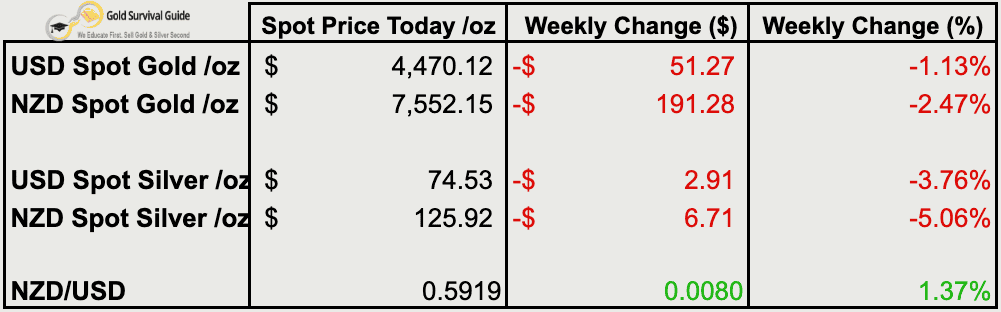
Weekly Price Overview – 3 June 2026
Precious metals pulled back this week as both gold and silver continued consolidating after their strong gains earlier this year. The NZ dollar strengthened slightly, adding further pressure to local precious metals prices.
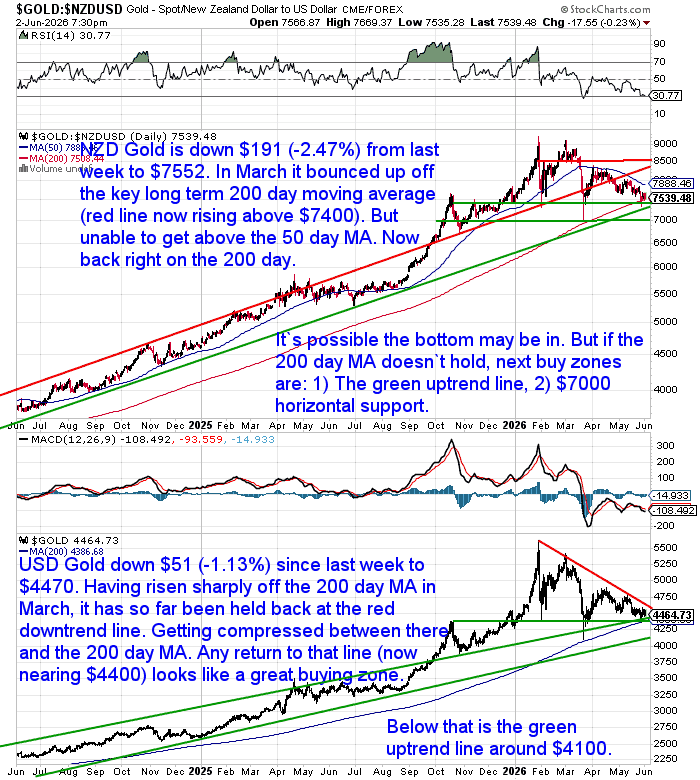
🟡 NZD gold fell $191 (-2.47%) to $7,552
NZD gold declined back to the rising 200-day MA near $7,400 after failing to break above the 50-day MA. The long-term uptrend remains intact for now, but a break below the 200-day MA would put the next major support zone near $7,000 into focus.
USD gold fell $51 (-1.13%) to $4,470
USD gold remains trapped between the 200-day MA and overhead resistance. The 200-day MA near $4,400 continues acting as key support, while the longer-term uptrend remains intact despite recent weakness.
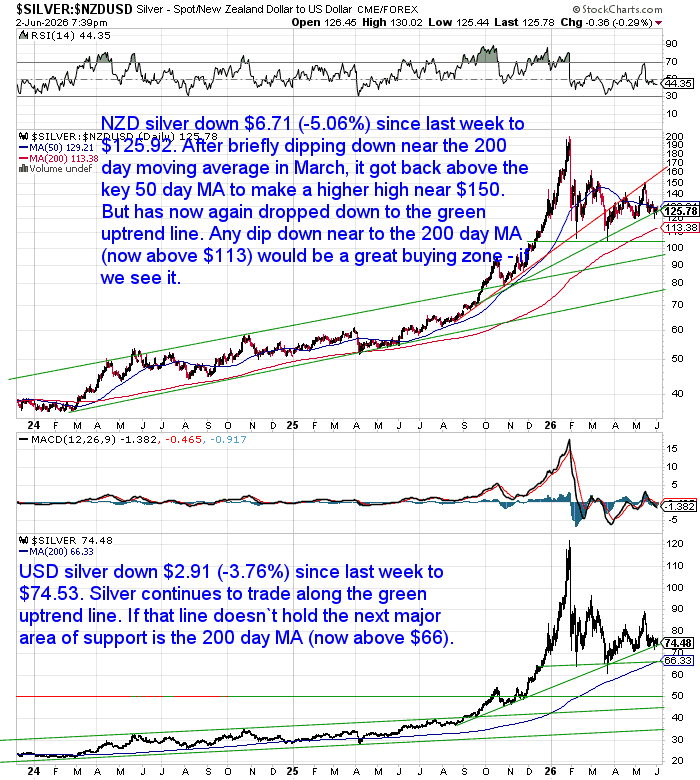
⚪ NZD silver fell $6.71 (-5.06%) to $125.92
NZD silver continued its pullback after failing near $150 earlier this year. The long-term uptrend line remains important support, while the rising 200-day MA near $113 remains a key buying zone.
USD silver fell $2.91 (-3.76%) to $74.53
USD silver remains above its long-term uptrend line despite recent weakness. If that support fails, the next major support level is the rising 200-day MA near $66.
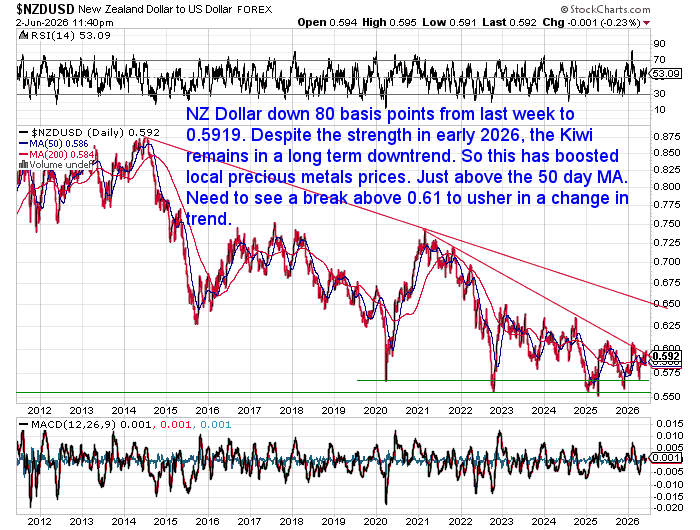
💱 NZD/USD rose 80 basis points (+1.37%) to 0.5919
The Kiwi dollar strengthened this week but remains within a broader long-term downtrend. That longer-term weakness continues supporting NZD precious metals prices. A break above 0.61 would be needed to signal a more meaningful trend change.
Most People Buy Gold for the Wrong Reason
Most people buy gold hoping the price will go up.
But what if that’s not the most important reason to own it?
In this week’s featured article, we explore a different way to think about physical gold – not as a speculation, but as a form of financial insurance. It’s a perspective that has shaped how individuals, institutions and even central banks approach gold for generations.
If you’ve ever wondered what role gold should really play in protecting your wealth, this is an article worth reading.
Read: Why Gold Bullion Is Your Financial Insurance | Wealth Protection Guide
Governments, Corporations and Central Banks Are Treating Gold Like Insurance
This week we listened to an excellent interview with Scottsdale Mint CEO Josh Phair, one of our key suppliers and someone we’ve followed closely for many years.
If you’d like to hear his observations firsthand, you can watch the full interview below:
Unlike many market commentators, Josh isn’t simply analysing charts from behind a screen.
Scottsdale Mint fabricates bullion for governments, institutions, wholesalers and investors around the world. That gives Josh a unique perspective on what is actually happening inside the physical precious metals market.
What stood out most was how closely the trends he discussed tie into this week’s featured article.
Gold is increasingly being viewed as financial insurance rather than simply another investment.
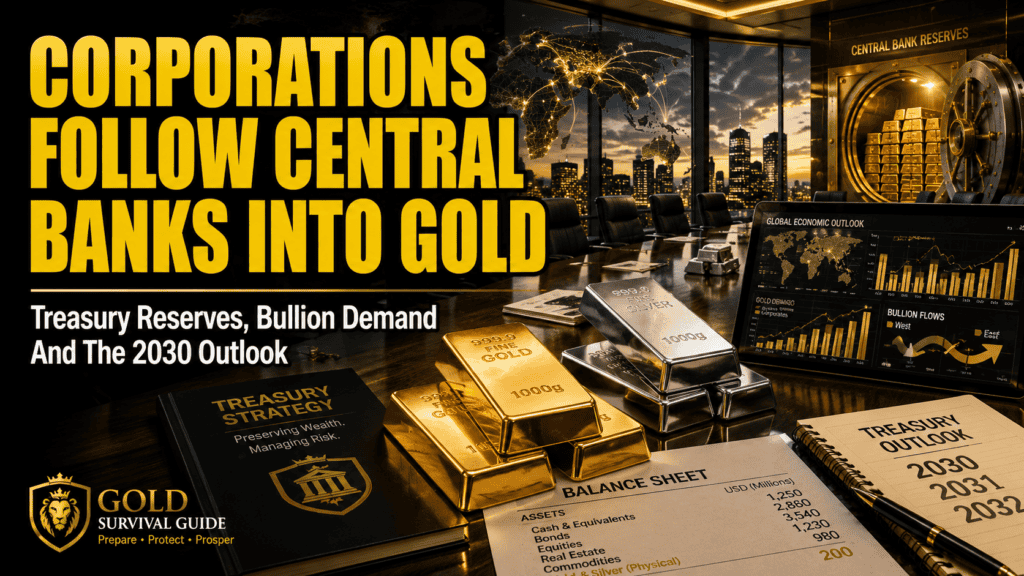
Corporations Are Starting To Follow Central Banks
For several years we’ve reported on record levels of central bank gold buying.
Back in 2023 we highlighted how central banks were purchasing gold at the fastest pace in decades. More recently, we looked at how that trend has continued despite ongoing economic uncertainty.
What caught our attention this week was Josh’s observation that corporations are increasingly exploring physical gold and silver as treasury assets.
According to Josh, more companies are considering adding allocated precious metals to their balance sheets.
We’re also beginning to see public examples emerge. Earlier this year, Hyperscale Data announced plans to add both physical gold and silver to its treasury strategy, targeting up to US$100 million in each alongside its Bitcoin holdings.
Whether that approach becomes common remains to be seen. However, it highlights the fact that some companies are actively exploring alternatives to holding all of their reserves in cash and traditional financial assets.
Rather than viewing gold as a speculation, they are beginning to ask some of the same questions central banks have been asking for years:
- How much exposure should we have to the banking system?
- How much cash should we hold?
- What assets might help preserve purchasing power over time?
In other words, they are beginning to think about gold as insurance.
If this trend continues, it could become one of the most important developments in precious metals over the next decade.
Physical Metal Continues Flowing East
Another interesting observation was that while retail demand has cooled in the United States, physical demand remains extremely strong across much of Asia, particularly for silver.
We would add that New Zealand has experienced something similar.
Demand locally remains well below the exceptional levels seen in January and February, when buying activity reached its highest levels in many years.
As demand has eased, premiums have started returning to more normal levels.
This highlights an important point.
Gold demand is rarely uniform around the world.
While many Western investors remain heavily exposed to shares, property and traditional financial assets, investors throughout Asia have historically placed a greater emphasis on owning physical precious metals.
The longer-term flow of bullion from West to East remains one of the most important trends in the global precious metals market.
Josh also pushed back on the popular “silver shortage” narrative.
His view was that the issue is less about silver disappearing and more about silver moving.
Demand remains strong in parts of Asia, while large volumes of metal continue flowing between regions as buyers compete for supply.
We think that’s a more useful way to understand the silver market.
Metal is moving.
It is not simply disappearing.
Governments Continue Accumulating Gold
Another theme from the interview was that governments appear increasingly interested in accumulating and controlling strategic assets.
The examples keep growing:
- Central banks continue buying gold.
- Wyoming has established a state gold reserve.
- Texas is issuing state-backed gold and silver coins.
- Some countries are directing more mine production into official reserves.
The trend is becoming difficult to ignore.
At the same time, some governments appear to be treating precious metals as more strategic while making access harder through taxes, duties or regulation.
The irony is that while many private investors still question whether they should own any gold at all, governments around the world continue increasing their exposure.
Daily price moves dominate the headlines.
Governments seem focused on something bigger.
They increasingly view precious metals as strategic assets in an increasingly uncertain world.
Why The 2030-2032 Timeline Is Worth Watching
One of the more interesting comments from the interview was Josh’s view that we may already be part way through a broader monetary transition that could unfold over the rest of this decade.
His view was not that a financial collapse is imminent.
In fact, quite the opposite.
He suggested that by around 2030-2032 we may look back and realise the financial system has changed significantly, even though those changes happened gradually over many years.
Personally, we find this far more plausible than the constant predictions that collapse is coming next month, next year or after the next election.
We’ve been hearing those forecasts for decades.
Major monetary shifts tend to unfold slowly and then appear obvious in hindsight.
Several trends point in the same direction:
- Central banks are buying gold.
- Government debt keeps rising.
- Supply chains are being restructured.
- Geopolitical tensions remain elevated.
- Interest in precious metals continues to grow.
Together, they suggest a long-term transition may already be underway.
Exactly where it ends is impossible to know.
But it is certainly worth paying attention to.
Gold As Financial Insurance
Ultimately, what stood out most from the interview was not a prediction about gold prices.
It was the growing list of institutions treating gold as insurance.
Central banks are doing it.
Governments are doing it.
Some corporations are beginning to do it.
Many wealthy families already do it.
Yet most investors still focus mainly on short-term price movements.
That is exactly why this week’s featured article encourages readers to think about gold differently.
Instead of asking:
“Will gold go up?”
A better question may be:
“What risks does gold help protect me from?”
Because insurance is not something you buy because you hope you need it.
It is something you own because some risks are simply too important to ignore.
Governments, central banks and increasingly corporations are all reassessing the role precious metals play in protecting wealth.
If you’d like to explore how physical gold and silver could fit into your own long-term strategy, get in touch with our team for a confidential discussion.

Glenn's dedication to educating individuals on wealth protection through precious metals has helped over 2400 clients from New Zealand, Australia, USA and Europe to safeguard their financial futures. Passionate about financial independence and lifestyle freedom, Glenn’s mission is to empower others with the knowledge and tools to thrive in today’s volatile economic environment. When he's not advising on precious metals, Glenn enjoys spending time with his family and pursuing outdoor adventures.
Education: University of Auckland Bachelor of Science
Linkedin: https://www.linkedin.com/in/glenn-thomas-0984a4310/
- Why Buy Gold? A New Zealand Guide to Protecting Your Wealth - August 11, 2026
- When the Crowd Loses Interest, Who Keeps Buying? - August 5, 2026
- If the US Dollar Was Linked to Gold Again, What Would It Mean for New Zealand? - August 3, 2026
