

GSG Weekly Market Wrap – 17 June 2026
This Week:
- GSG Weekly Market Wrap – 17 June 2026
- Weekly Price Overview – 17 June 2026
- New Zealand Holds No Gold Reserves — But Could It Simply Create The Money To Buy Some?
- Has Gold Finally Reached The Bottom?
- The 1973 Parallel Gains More Support
- Has The Bottom Already Been Reached?
- More Signs Of Extreme Pessimism
- The Bigger Story Nobody Is Talking About
- Why The Exact Bottom May Not Matter
Estimated reading time: 7 minutes
Weekly Price Overview – 17 June 2026
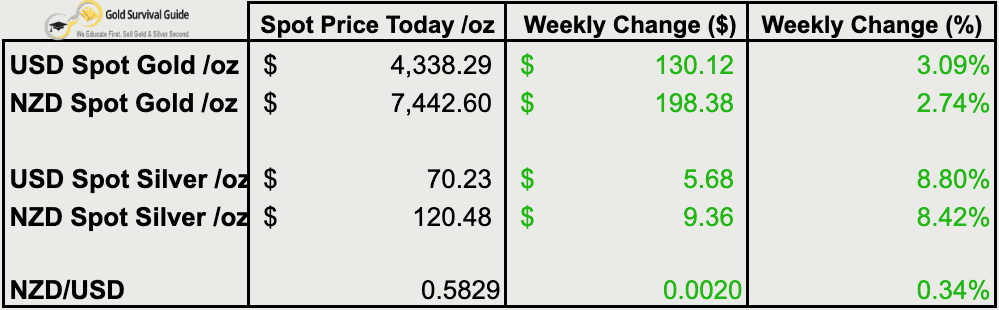
Precious metals rebounded strongly this week after briefly testing key support levels. Gold and silver both bounced from areas we highlighted last week, although it remains too early to confirm whether the final low is in. Sentiment remains extremely bearish, often seen near major turning points.
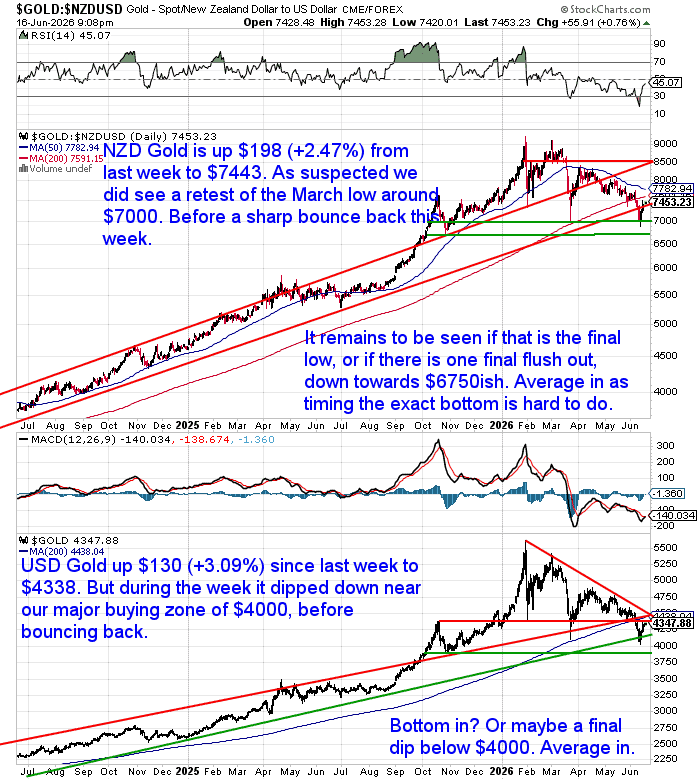
🟡 NZD gold rose $198 (+2.74%) to $7,443
NZD gold briefly retested the March low near $7,000 before rebounding sharply. The bounce is encouraging, but a final flush towards $6,750 remains possible. Averaging in remains preferable to picking the exact bottom.
🟡 USD gold rose $130 (+3.09%) to $4,338
USD gold dipped close to the major support zone around $4,000 before recovering strongly. The correction appears advanced, although one final move below $4,000 remains possible. The longer-term bull market remains intact.
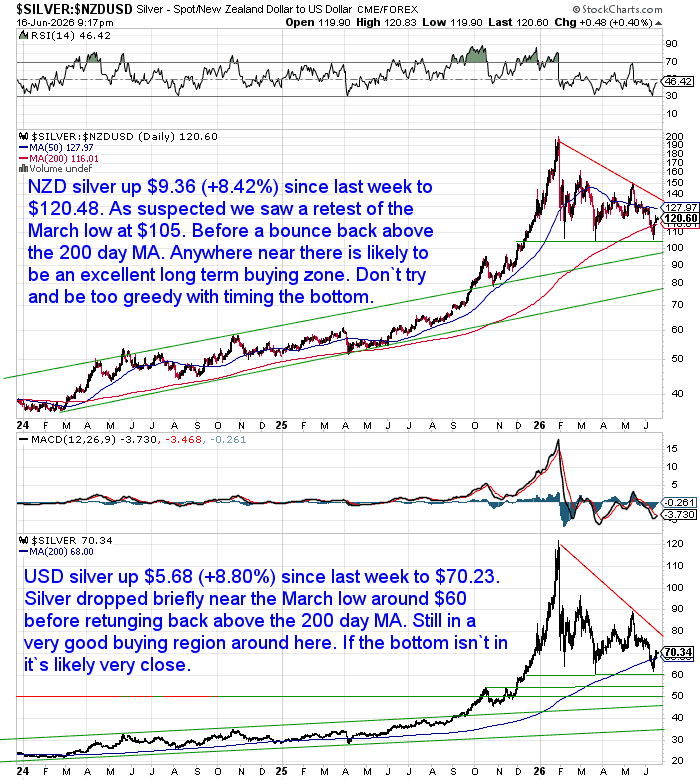
⚪ NZD silver rose $9.36 (+8.42%) to $120.48
NZD silver rebounded strongly after retesting the March low near $105. Prices have moved back above the 200-day MA and remain in an attractive long-term accumulation zone.
⚪ USD silver rose $5.68 (+8.80%) to $70.23
USD silver briefly dipped near $60 before bouncing back above its 200-day MA. While another test of support is possible, silver appears close to a major low.
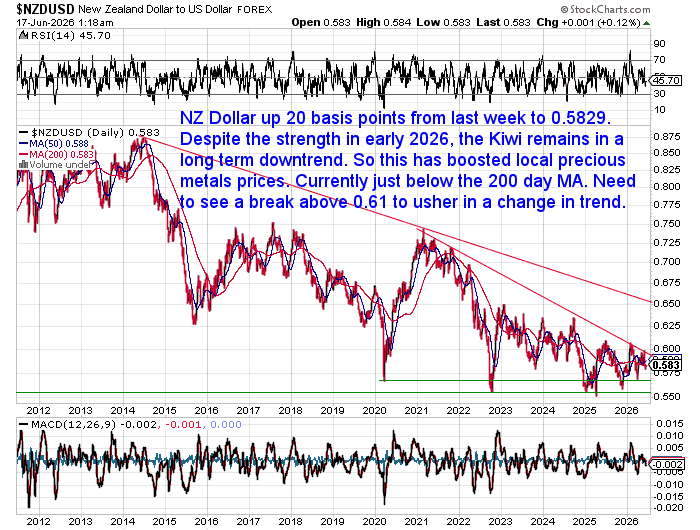
💱 NZD/USD rose 20 basis points (+0.34%) to 0.5829
The Kiwi dollar recovered modestly this week but remains within its long-term downtrend. A sustained move above 0.61 would signal a meaningful trend change. Until then, the weaker NZ dollar continues to support local precious metals prices.
New Zealand Holds No Gold Reserves — But Could It Simply Create The Money To Buy Some?
A reader recently asked us a great question:
“If the Reserve Bank can create money, why doesn’t it simply print some and buy gold?”
At first glance, it seems like an easy solution. After all, New Zealand currently holds zero official gold reserves, while central banks around the world have been buying gold at record levels.
But the answer reveals much about how modern monetary systems work, what gives a currency value, and why the Reserve Bank has rejected holding gold.
We explore why New Zealand sold its gold reserves, why central banks are buying gold again, and whether creating money to buy gold would actually work.
Read more: How Much Gold Does New Zealand Have? Why The Reserve Bank Holds Zero Gold Reserves

Has Gold Finally Reached The Bottom?
Last week we highlighted several signs that sentiment towards precious metals had turned sharply negative.
This week, we reckon that theme is harder to ignore.
When Mainstream Headlines Turn Bearish

The Financial Times recently ran the headline:
“Gold sinks to 6-month low as speculative investors exit.”
That sounds bearish.
But headlines often reflect what has already happened, rather than what comes next.
By the time investors are “heading for the exits”, much of the damage may already have been done.
That doesn’t guarantee a bottom is in place.
But it does fit a pattern often seen near important turning points.
The 1973 Parallel Gains More Support
Last week we shared Chris Weber’s observations about similarities between today’s correction and the silver market of 1973.
This week Weber highlighted analysis from Jordan Roy-Byrne of The Daily Gold, who identified remarkably similar patterns.
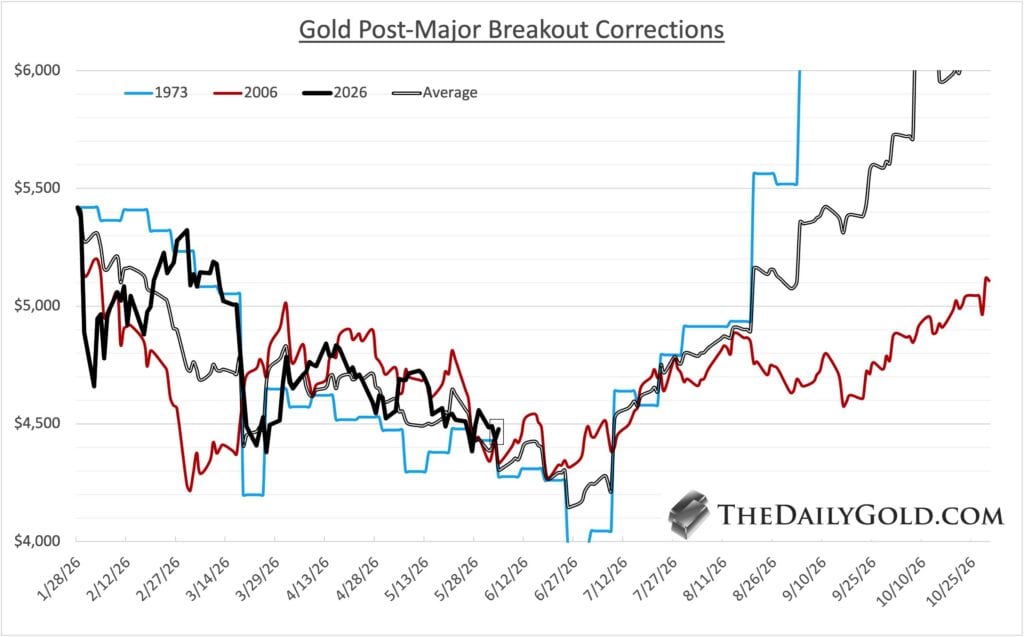
The chart compares gold’s first major correction following a breakout in:
- 1973
- 2006
- 2026
No two market cycles are identical.
But major bull markets often experience painful corrections before moving higher again.
This doesn’t mean 2026 must follow 1973 exactly.
The key takeaway is that large corrections after major breakouts are normal.
Has The Bottom Already Been Reached?
One of Jordan’s most useful observations was simple:
Nobody knows the exact day a market will bottom.
Gold may have already reached its low.
Or there may still be one final shakeout below recent lows.
Jordan outlined several possible bottoming patterns, including a scenario where prices briefly break lower before rapidly reversing higher.

If that happens, it could create exactly the kind of panic selling that often accompanies major lows.
Investors should avoid becoming obsessed with identifying the exact bottom.
Getting close to a major low is usually more important than getting it perfect.
More Signs Of Extreme Pessimism
Several indicators continue to suggest sentiment remains extremely weak:
- Silver sentiment recently reached “Extreme Fear”
- Precious metals website traffic has fallen sharply
- Gold has suffered one of its deepest corrections since the bull market began
- Gold mining shares have experienced widespread selling
Historically, these conditions appear much closer to bottoms than tops.
Again, that does not guarantee prices cannot fall further.
But it suggests much of the speculative excess has already been removed.
The Bigger Story Nobody Is Talking About
Perhaps the most interesting observation from Jordan’s presentation was investor positioning.
This chart showed that gold ETF allocations remain near historically low levels.

Separate family office data showed:
- 72% of family offices hold no gold at all
- Those that do hold gold allocate less than 1% on average
If gold were experiencing the speculative mania often associated with major tops, those figures would look very different.
Despite years of strong performance, most investors remain underexposed to precious metals.
Why The Exact Bottom May Not Matter
Markets rarely ring a bell at major lows.
By the time the all-clear arrives, much of the opportunity has usually passed.
Whether gold bottoms at US$4,200, US$4,000 or slightly below is unlikely to matter if the longer-term bull market remains intact.
What matters more is recognising when fear, pessimism and investor apathy become widespread.
Many of those conditions appear to be present today.
That does not guarantee prices will rise tomorrow.
But it suggests current levels may prove attractive long-term buying opportunities for gold and silver.

Glenn's dedication to educating individuals on wealth protection through precious metals has helped over 2400 clients from New Zealand, Australia, USA and Europe to safeguard their financial futures. Passionate about financial independence and lifestyle freedom, Glenn’s mission is to empower others with the knowledge and tools to thrive in today’s volatile economic environment. When he's not advising on precious metals, Glenn enjoys spending time with his family and pursuing outdoor adventures.
Education: University of Auckland Bachelor of Science
Linkedin: https://www.linkedin.com/in/glenn-thomas-0984a4310/
- Why Buy Gold? A New Zealand Guide to Protecting Your Wealth - August 11, 2026
- When the Crowd Loses Interest, Who Keeps Buying? - August 5, 2026
- If the US Dollar Was Linked to Gold Again, What Would It Mean for New Zealand? - August 3, 2026
