

Central banks exist to protect a nation’s financial stability. One way they do that is by holding reserve assets that can help them respond to economic uncertainty.
Those reserves may include foreign currencies, government bonds and, in many countries, gold.
Individual investors face uncertainty too. While we can’t issue currency or manage national reserves, we can apply some of the same principles. We can diversify. We can think long term. And we can hold assets that may help protect purchasing power over time.
This is the idea behind becoming your own central bank.
It doesn’t mean trying to predict the next financial crisis or monetary reset. It means recognising that uncertainty is a normal part of investing and building resilience rather than relying on forecasts.
In this article we’ll look at why central banks hold reserve assets, what investors can learn from their approach, and how the idea of becoming your own central bank can provide a useful framework for protecting long-term wealth.
Table of Contents
What Do Central Banks Actually Do?
Central banks have many responsibilities. They issue currency, help maintain financial stability, manage monetary policy and hold reserve assets that can be used during periods of economic stress.
While individuals can’t perform those roles, there is one important lesson we can take from the way central banks manage uncertainty.
Rather than trying to predict every economic event, central banks build reserves. They hold assets that can help them respond to changing economic conditions and provide flexibility when unexpected challenges arise.
Those reserves often include foreign currencies, government bonds and, in many countries, gold.
The goal is not to guess what will happen next. It is to be prepared for a range of possible outcomes.
Individual investors can apply the same principle.
We can’t create money or influence interest rates, but we can build our own financial reserves, diversify our assets and think beyond today’s headlines. In that sense, becoming your own central bank is simply about adopting the mindset of preparing for uncertainty rather than trying to predict it.
Become Your Own Central Bank
Think like a central bank:
- Build financial reserves
- Diversify your assets
- Own some physical gold
- Prepare for uncertainty
- Think long term
Why Do Central Banks Hold Gold?
One of the ways many central banks prepare for uncertainty is by holding a portion of their reserves in physical gold.
Unlike foreign currencies, government bonds or bank deposits, gold carries no counterparty risk. It is not dependent on another government, central bank or financial institution honouring its obligations.
Gold also has a long history as a monetary asset. Although no major currency is formally backed by gold today, central banks collectively continue to hold tens of thousands of tonnes of it as part of their official reserves. In fact, after decades of selling gold during the 1990s and early 2000s, central banks have been net buyers since the Global Financial Crisis, with purchases accelerating significantly in recent years.
This doesn’t mean gold is the only reserve asset that matters. Most central banks hold a mix of foreign currencies, government bonds and gold. The mix varies from country to country depending on its circumstances.
The important lesson for investors is not that every central bank holds the same amount of gold. It is that many of them choose to diversify rather than rely entirely on a single type of reserve asset.
If you’d like to explore these topics further, we’ve also examined why central banks continue buying gold and why New Zealand remains one of the few developed countries with no official gold reserves.
Why Your Own Reserves Matter More
Central banks hold reserve assets on behalf of their countries, not on behalf of individual citizens.
Even if a country holds substantial gold reserves, those reserves do not belong to households or investors. Their purpose is to support the nation’s financial position, not to preserve the purchasing power of every individual.
Turkey demonstrates this distinction. Although the country’s central bank holds official gold reserves, that did not prevent the Turkish lira from losing significant value over time. During that period, many Turkish citizens who owned physical gold were better able to preserve their purchasing power while the national currency weakened.
The lesson is simple: central bank gold reserves belong to the nation, not to you.
Your own financial resilience depends on the reserves you hold yourself. This is the principle behind becoming your own central bank.
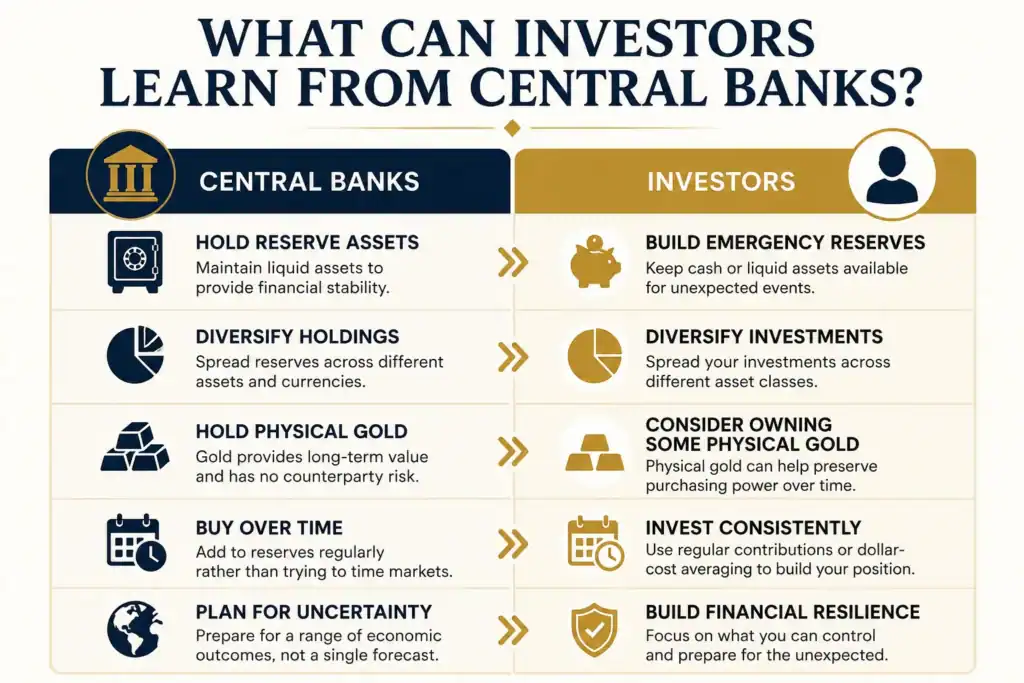
Five Ways To Become Your Own Central Bank
You don’t need to manage a nation’s currency to adopt some of the same principles used by central banks.
While individuals have very different objectives, the underlying ideas are surprisingly similar: build reserves, diversify your assets and become more financially resilient.
Here are five practical ways investors can apply that mindset.
- Hold Some Physical Gold
Most central banks continue to hold physical gold as part of their reserves. Every investor’s circumstances are different, but owning some physical gold can play a similar role by helping diversify your assets and preserve purchasing power over the long term.
- Build Your Position Gradually
Many central banks add to their gold reserves over time rather than trying to buy everything at once. Regular purchases can help smooth out price fluctuations and reduce the pressure of trying to perfectly time the market.
- Maintain Emergency Reserves
Central banks hold liquid reserves so they can respond to unexpected events. Individuals can apply the same principle by maintaining an emergency fund and keeping enough readily accessible cash to manage short-term disruptions.
- Diversify Where You Hold Assets
Central banks diversify across different reserve assets and jurisdictions. Depending on your circumstances, some investors also choose to diversify where they hold their wealth, whether through different financial institutions or by storing a portion of their precious metals offshore.
- Think Long Term
Central banks typically manage reserves over decades rather than weeks. Individual investors can often benefit from the same mindset by focusing on long-term resilience instead of reacting to every market headline.
What Becoming Your Own Central Bank Doesn’t Mean
Becoming your own central bank doesn’t mean trying to predict the next financial crisis, currency reset or market crash.
It doesn’t mean putting all of your wealth into gold, or assuming that one asset will outperform every other investment.
And it doesn’t mean abandoning cash, shares, property or other productive assets.
Instead, it is a framework for building financial resilience.
Central banks don’t hold reserve assets because they know exactly what the future holds. They hold them because they recognise that uncertainty exists.
Individual investors can apply the same principle.
By building financial reserves, diversifying your assets and thinking long term, you can be better prepared for a range of possible outcomes rather than relying on a single forecast proving correct.
Key Takeaway
Central banks don’t prepare for one future. They prepare for many possible futures. Individual investors can do the same.
Conclusion
Central banks don’t hold reserve assets because they know what comes next. They hold them because uncertainty is an unavoidable part of managing a nation’s finances.
Individual investors face the same reality.
Becoming your own central bank isn’t about predicting the next crisis or finding the perfect investment. It’s about building financial resilience by holding appropriate reserves, diversifying your assets and thinking long term.
The goal isn’t to predict the future. It’s to be prepared for it.
Ready To Build Your Own Financial Reserves?
If you decide that owning some physical gold or silver is an appropriate part of your long-term financial reserves, explore our range of investment-grade bullion.
You may also wish to read:
- How Much Gold Does New Zealand Have? Why The Reserve Bank Holds Zero Gold Reserves
- What Could A Global Currency Reset Mean For New Zealand?
- Could New Zealand Build Gold Reserves Using Mining Royalties?
Editors note: This post was first published 6 June 2018. Fully updated 28 June 2026.

Glenn's dedication to educating individuals on wealth protection through precious metals has helped over 2400 clients from New Zealand, Australia, USA and Europe to safeguard their financial futures. Passionate about financial independence and lifestyle freedom, Glenn’s mission is to empower others with the knowledge and tools to thrive in today’s volatile economic environment. When he's not advising on precious metals, Glenn enjoys spending time with his family and pursuing outdoor adventures.
Education: University of Auckland Bachelor of Science
Linkedin: https://www.linkedin.com/in/glenn-thomas-0984a4310/
- Fort Knox Gold Audit: Has America’s Gold Ever Been Properly Audited? - July 27, 2026
- Watch What Central Banks Do, Not Just What Governments Say - July 22, 2026
- Gold Revaluation: Why the Debate Is Heating Up Again - July 20, 2026

This is one for your most interesting article yet. Our Reserve bank has no gold reserves and the amount held by personal investors is seemingly unknown. In the case of our latest trade deal with India it seems that their reserve bank holds around 113 billion US dollars in gold. Truly amazing except for the fact that the total gold holding for India households seems to have been estimated at over seven trillion dollars!! They may not have to ask their banks for a mortgage!
I am suggesting that in some cases the folk of India have a mind of their own as to what really matters for them. I suggest that gold should ideally be part of a broader cultural interaction for any society.
Thanks for that compliment Maurice. And that’s a thoughtful observation. India is a fascinating example because gold isn’t just held by the Reserve Bank of India—it’s also deeply embedded in household savings and cultural traditions. Estimates of privately owned gold are enormous, and that highlights an important distinction we touched on in the article: official gold reserves and privately owned gold serve different purposes.
One of the lessons I think investors can take from countries like India is that financial resilience doesn’t sit entirely with governments or central banks. Individuals can also choose to hold assets that they believe will help preserve purchasing power over the long term. That’s really the thinking behind the “Become Your Own Central Bank” framework.