
In a world of rising debt, persistent inflation, and growing financial uncertainty, many investors are once again turning to gold and silver as long-term stores of value.
But once you decide to own precious metals, the next question becomes:
How much should you actually hold?
Or put another way:
What percentage of gold and silver should be in my portfolio?
This comprehensive guide will help you find the answer – whether you’re managing a diversified portfolio or just trying to protect your savings and prepare for uncertain times.
Why Hold Gold and Silver in Your Portfolio?
Gold and silver have a long history as reliable stores of value. They’re not just about price speculation — they serve a deeper role:
- Diversification: Precious metals are non-correlated assets. When stocks fall, gold often rises.
- Crisis protection: Gold has preserved wealth through wars, depressions, and currency collapses.
- Wealth insurance: Think of it like fire insurance — you hope you never need it, but you’ll be glad it’s there if things go wrong.
Table of Contents
- Why Hold Gold and Silver in Your Portfolio?
- Why Precious Metals Are Returning to Mainstream Portfolios
- Key Personal Factors That Affect How Much You Should Hold
- How to Calculate Your Total Investable Assets
- Expert Precious Metals Allocation Models and Studies
- What the Research Says: Gold Allocations Backed by Studies
- Silver-Specific Allocation Considerations
- Gold vs Silver: How Should You Split Your Metals Allocation?
- How Many Ounces of Gold and Silver Should You Own?
- Should You Rebalance Your Precious Metals Allocation?
- FAQs: Common Gold and Silver Allocation Questions
- Final Thoughts: Build Your Metals Plan Around Your Reality
Estimated reading time: 11 minutes
Why Precious Metals Are Returning to Mainstream Portfolios
For many years, gold and silver were viewed as “alternative” assets — something outside the traditional financial system.
But that perception has changed significantly in recent years.
Rising government debt, persistent inflation, banking instability, geopolitical tensions, and concerns about currency debasement have pushed precious metals back into the financial mainstream.
At the same time, central banks around the world have been aggressively increasing their gold reserves, while institutional investors are once again discussing gold as a core portfolio asset rather than a fringe investment. (See: Central Banks & Affluent Investors Load Up on Gold)
Gold and silver are increasingly being viewed not just as speculative assets, but as:
- long-term stores of value
- portfolio diversifiers
- financial insurance against systemic risk
- and a form of monetary resilience in uncertain times
While gold is often viewed as financial insurance and a long-term store of wealth, silver also has growing industrial demand and tends to attract investors looking for both monetary protection and higher upside potential.
If you are new to precious metals investing, you may also want to read our guides on:
Key Personal Factors That Affect How Much You Should Hold
There’s no “one-size-fits-all” answer. What you should hold depends on:
- Your existing investments (e.g. property, shares)
- Your risk tolerance
- Your cash flow needs and time horizon
- Whether you want insurance or upside exposure
- Your view on economic, monetary, or geopolitical risks
Before deciding how much gold to own, it helps to decide what job you want it to perform. Are you primarily investing for growth, maintaining liquidity, or protecting wealth you’ve already built?
See: Don’t Confuse Investing With Wealth Protection: What Is Gold Actually For?
How to Calculate Your Total Investable Assets
If you’re building a balanced portfolio and want to work out your ideal gold and silver allocation, start with your total investable assets.
That means anything you could reasonably convert into cash or reallocate into precious metals:
- Cash savings
- Term deposits
- Shares / managed funds
- KiwiSaver / retirement funds
- Cryptocurrency
- Non-owner-occupied property (or equity in it)
Example:
| Asset | Value (NZD) |
|---|---|
| Cash savings | $20,000 |
| Shares & managed funds | $50,000 |
| KiwiSaver | $80,000 |
| Equity in investment unit | $150,000 |
| Total Investable Assets | $300,000 |
If you decide on a 10% metals allocation, then your target investment would be:
- $30,000 → which could be split 70% gold / 30% silver
- Or adjusted depending on your risk appetite
Expert Precious Metals Allocation Models and Studies
In recent years, gold has shifted from the “fringe” to the financial mainstream. Here’s what the pros have been saying in recent months:
- Harry Browne’s Permanent Portfolio: 25% gold, for stability in all economic seasons. Source. (or see here for a modern version).
- Ray Dalio (Bridgewater Associates): Recommends 10–15% in gold as a hedge against debt and instability Read more.
- Morgan Stanley CIO: Backs a 60/20/20 portfolio — 20% in precious metals replacing bonds. Source.
- Jeff Gundlach (Bond Fund Legend): Suggests an even 25% split across stocks, bonds, gold, and cash. Source.
- Bank of America: Proposes up to 25% gold in alternative models. Source.
These aren’t fringe ideas. Gold is increasingly seen as a core asset.
What the Research Says: Gold Allocations Backed by Studies
A number of academic and professional studies have explored how much gold to hold in a diversified portfolio:
- Sherman (1982) – Suggested a 5% allocation to gold could reduce risk and improve return in an equity-heavy portfolio. Sources.
- Lucey, Poti et al. (2006) – Found optimal gold weightings of 6%–25%, depending on market conditions and other asset classes. Source.
- Klement & Longchamp (2010) – Recommended 5–10% gold allocations for high-net-worth portfolios and family offices. Source.
- Bruno & Chincarini – Suggested 10% gold may be appropriate for non-U.S. investors. Source.
- Scherer – Proposed 5–10% gold for sovereign wealth funds. Source.
- Baur & Lucey (2007) – Conducted the first statistical test of when gold acts as a hedge versus a safe haven. Source.
- Over 40 years: Adding 10% gold barely reduced returns (0.1% less) but cut crisis losses by $17,000+ on a $1M portfolio. Source.
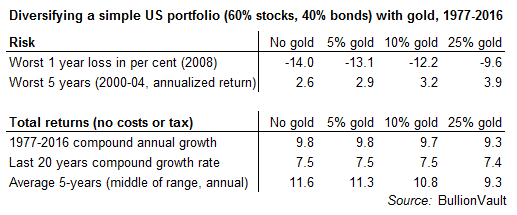
For a summary of these and other studies, see:
GoldCore: Gold is a Safe Haven Asset (PDF)
In Gold We Trust: A Case for Up to 25% Gold Allocation
The well-respected In Gold We Trust report by Incrementum AG recently analysed how different levels of gold allocation impact both returns and risk.
In their paper, The Optimal Gold Allocation – How Much Gold Does Your Portfolio Need?, they found:
14–20% gold gave the best balance of risk and reward
40% gold gave the highest returns — but with more volatility
25% gold may be prudent in today’s uncertain macro climate
“Given the sheer magnitude and diversity of the uncertainties that now define our global economic landscape, it may be prudent to consider an even more robust allocation. A 25% allocation to gold could serve as a strategic bulwark.”
This aligns with – but pushes beyond – many traditional studies that suggest a 5–10% gold weighting. The emphasis here is that uncertain times may call for a larger-than-normal allocation.

Related: Why the New Zealand Super Fund Should “Invest” in Gold >>
Silver-Specific Allocation Considerations
While gold often gets the spotlight, silver deserves attention in its own right — not just as a complement to gold, but as a valuable portfolio asset.
A major 2023 study by Oxford Economics, commissioned by the Silver Institute, analysed how silver performed in diversified portfolios over two decades.
Key Finding: A 4–6% silver allocation in a medium-risk portfolio boosted returns and lowered volatility.
This finding was consistent across various portfolio types, from conservative to aggressive mixes.
The research also highlighted silver’s unique advantages:
- It’s highly liquid and widely traded, making it accessible for all levels of investor.
- Its dual role — as both a monetary metal and an industrial commodity — gives it multiple demand drivers.
- Silver often outperforms gold in bull markets due to its smaller market size and higher volatility.
- It’s historically undervalued relative to gold, offering upside potential when the gold/silver ratio reverts.
See: Oxford Economics: Silver in the Optimal Investment Portfolio (Summary)
This study supports our own model of a 30% silver allocation within a gold/silver split — especially for investors with a moderate-to-high risk tolerance.
Silver’s role in a balanced portfolio is increasingly supported by financial modelling, risk-return analysis, and institutional studies — making it a serious contender alongside gold in wealth preservation strategies.
Some investors use the Gold-to-Silver Ratio (GSR) to time their exposure. More on that below.
Gold vs Silver: How Should You Split Your Metals Allocation?
There’s no perfect split, but here are common models:
| Style | Gold % | Silver % |
|---|---|---|
| Conservative | 70% | 30% |
| Balanced | 50% | 50% |
| Aggressive Silver | 30% | 70% |
Adjust based on your goals. You can also rebalance over time based on price movements or ratio changes.
How Many Ounces of Gold and Silver Should You Own?
Not everyone has a million-dollar portfolio. So instead of just percentages, let’s answer the real question:
“How much gold or silver do I need to hold to protect my family, or maybe even buy a home one day?”
Based on Your Portfolio Size
If you’re following the common advice of putting 10% of your portfolio into precious metals, and splitting that 70% gold / 30% silver, here’s how much you’d need in ounces:
🇳🇿 New Zealand Dollar (NZD) Version
| Portfolio Value | 10% in Metals | Gold (70%)* | Silver (30%)* |
|---|---|---|---|
| $10,000 | $1,000 | ~0.10 oz | ~3 oz |
| $50,000 | $5,000 | ~0.48 oz | ~15 oz |
| $100,000 | $10,000 | ~0.96 oz | ~30 oz |
| $500,000 | $50,000 | ~4.79 oz | ~150 oz |
*Based on gold at $7,300/oz and silver at $100/oz (NZD)
🇺🇸 U.S. Dollar (USD) Version
| Portfolio Value | 10% in Metals | Gold (70%)^ | Silver (30%)^ |
|---|---|---|---|
| $10,000 | $1,000 | ~0.17 oz | ~5 oz |
| $50,000 | $5,000 | ~0.83 oz | ~26 oz |
| $100,000 | $10,000 | ~1.67 oz | ~52 oz |
| $500,000 | $50,000 | ~8.33 oz | ~259 oz |
^Based on gold at $4,200/oz and silver at $58/oz (USD)
Based on Covering Living Expenses (Emergency Fund)
Want to prepare for a rainy day or a job loss? One smart approach is using precious metals as a “personal reserve currency”.
Here’s how many ounces of gold or silver you’d need to cover 3, 6, or 12 months of living costs.
🇳🇿 NZD: Gold & Silver Needed to Cover Living Costs
| Monthly Expenses | 3 Months | 6 Months | 12 Months |
|---|---|---|---|
| $3,000 | 1.23 oz G / 90 oz S | 2.47 oz G / 180 oz S | 4.93 oz G / 360 oz S |
| $5,000 | 2.05 oz G / 150 oz S | 4.11 oz G / 300 oz S | 8.22 oz G / 600 oz S |
*Based on gold at $7,300/oz, silver at $100/oz
🇺🇸 USD: Gold & Silver Needed to Cover Living Costs
| Monthly Expenses | 3 Months | 6 Months | 12 Months |
|---|---|---|---|
| $3,000 | 2.14 oz G / 155 oz S | 4.29 oz G / 310 oz S | 8.57 oz G / 621 oz S |
| $5,000 | 3.57 oz G / 259 oz S | 7.14 oz G / 517 oz S | 14.29 oz G / 1,034 oz S |
*Based on gold at $4,200/oz, silver at $58/oz
This is ideal if you’re not managing an investment portfolio but just want a solid emergency back-up.
How Many Ounces to Buy a House (At Full Valuation)
Inspired by reader Stacey McGaughey, many people aren’t looking for portfolio theory — they’re asking:
“How much gold or silver would I need to buy a house when metals reach their full potential?”
Here’s how that could look if property prices fall and gold/silver hit major valuation milestones.
🇳🇿 New Zealand
- House value: $800,000 NZD
- Gold target price: $15,000/oz
- Silver target price: $750/oz
| Metal | Needed to Buy House |
|---|---|
| Gold | ~53 oz |
| Silver | ~1,067 oz |
🇺🇸 United States
- House value: $500,000 USD
- Gold target price: $7,000/oz
- Silver target price: $350/oz
| Metal | Needed to Buy House |
|---|---|
| Gold | ~71 oz |
| Silver | ~1,429 oz |
This is how you plan for real goals, not just asset allocations. And these numbers line up closely with what we calculated in:
NZ Housing to Silver Ratio
NZ Housing to Gold Ratio
GSR Tip: When to Tilt Toward Silver or Gold
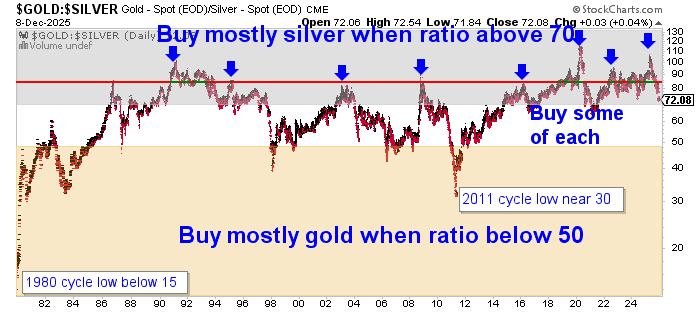
Some investors use the Gold-to-Silver Ratio (GSR) to guide how much of each metal to hold. Historically, when the ratio is above 80, silver is considered undervalued relative to gold. When it’s below 50, gold may be the better buy.
For example, in mid-2020, the GSR hit over 120 — a rare buy signal for silver.
At other times, a GSR near 40 has triggered heavier gold buying.
Gold-to-Silver Ratio Buy Zones Chart
Read more: How to Use the Gold-to-Silver Ratio in Your Buying Strategy →
This simple metric can help you tilt your allocation — for example, putting more into silver when the GSR is high, and rebalancing toward gold when it drops.
Should You Rebalance Your Precious Metals Allocation?
Yes you could – especially after major price movements or life changes.
You can rebalance:
- Annually
- When gold/silver spike
- When the GSR becomes extreme
Example: If silver outperforms and now makes up 60% of your metals holding, rebalance back to your original 50/50 plan.
FAQs: Common Gold and Silver Allocation Questions
For many, yes — especially as a hedge. Some investors go higher in times of crisis or monetary instability. Perhaps up to 25%.
Silver is more volatile and can outperform, but also drops more. A balanced approach is often best.
Historically averages 40–60. At 80+, silver is likely undervalued. Some use GSR as a signal to switch.
Bars offer better value per ounce. Coins offer better liquidity and flexibility.
That’s okay. Start by building a 3–6 month reserve in precious metals. Then work toward larger goals like housing or retirement.
Final Thoughts: Build Your Metals Plan Around Your Reality
Gold and silver are not just investments. For many people, they represent financial independence, resilience, and a way to step outside an increasingly fragile monetary system.
You don’t need a million-dollar portfolio to make gold and silver work for you.
You just need:
- A goal (like buying a house, or preparing for a crisis)
- A plan (based on ounces, not just percentages)
- And the discipline to stick with it over time
Whether you’re a seasoned investor or just someone trying to get ahead in uncertain times, gold and silver can be part of your path to security and sovereignty.
→ Ready to Build Your Metals Strategy? Start with our Free Buyer’s Guide or Get a Quote Now.
Recommended Reading
- Ray Dalio on Gold, Crypto & Debt
- Wall Street’s New Respect for Gold
- NZ Housing to Silver Ratio
- NZ Housing to Gold Ratio
- Why Buy Gold
- Gold vs Silver in 2025: Which Should You Buy Based on Your Goals, Budget and Risk Tolerance?
Editors note: This article was originally published 16 June 2020. Fully rewritten 8 December 2025.
Works Cited

Glenn's dedication to educating individuals on wealth protection through precious metals has helped over 2400 clients from New Zealand, Australia, USA and Europe to safeguard their financial futures. Passionate about financial independence and lifestyle freedom, Glenn’s mission is to empower others with the knowledge and tools to thrive in today’s volatile economic environment. When he's not advising on precious metals, Glenn enjoys spending time with his family and pursuing outdoor adventures.
Education: University of Auckland Bachelor of Science
Linkedin: https://www.linkedin.com/in/glenn-thomas-0984a4310/
- Where Are We in the Silver Market Cycle? - September 15, 2026
- Why the Netherlands Is Moving More of Its Gold Reserves to London - September 9, 2026
- What Is the Gold Silver Ratio? What Is It Telling Us Now? - September 8, 2026

Seems to me that a lot of folks who haven’t previously thought about buying gold and/or silver are now trying to make sense of their options. And I’m thinking these folks, like me, don’t have a portfolio. We’re just people trying to get an edge in the crisis we can see coming – no million dollar portfolio, no large savings fund. Not much of anything really. So articles about what percentage of our ‘portfolio’ should we hold in precious metals aren’t very helpful (I’ve found). So what I did was start from “What do I need to cover when the wheels fall off?” I’m renting so for me – I’ll be wanting to buy a property. So…and here are the long line of ‘if’s…
…if property values tank I could get what I want for NZ$600,000…and if gold goes to US$5000/oz…and if the gold/silver ratio swings back to 1:20…so $600,000 equals 78oz of gold, which equals 1,600oz of silver, which costs around NZ$32/oz, which means in need to spend around NZ$50,000…that’s the kind of approach that I would have found helpful.
Hi Stacey, Thanks for your insightful comment. That is a good point that many people don’t actually have a portfolio. So the way you have done it makes sense. We actually came up with quite a similar number in this post on the NZ housing to silver ratio. https://goldsurvivalguide.co.nz/nz-housing-to-silver-ratio/ See the section headlined: “How to Buy a Median Priced House in NZ Freehold, for Only $33,624…”