

Table of Contents
- If the US dollar Collapses, Would the New Zealand Dollar Soar — or Sink?
- Has the NZ Dollar Really Been Rising?
- So Would This Rising NZ Dollar Change in a US Dollar Collapse?
- What Happens If the USD — the Global Reference Point — Collapses?
- What Assets Tend to Perform Best During Currency Crises?
- Why Gold and Silver Still Matter — Especially in a Currency Collapse
- Protect Your Wealth – Start with Real Money
- FAQs
Estimated reading time: 11 minutes
If the US dollar Collapses, Would the New Zealand Dollar Soar — or Sink?
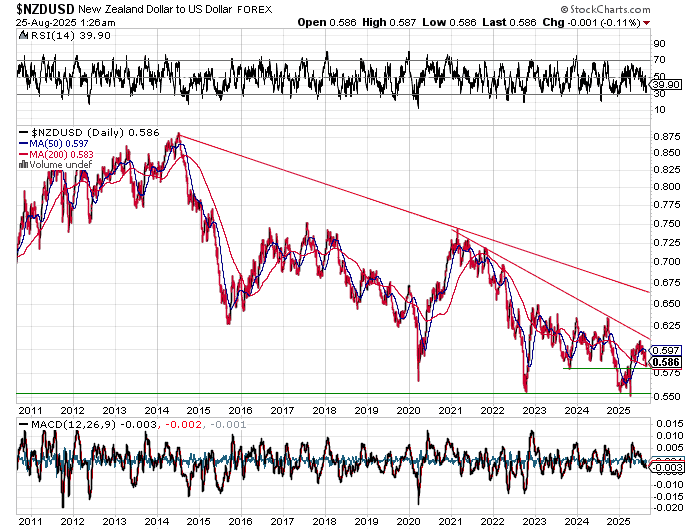
As global markets grapple with renewed economic uncertainty in 2025, the New Zealand dollar (NZD) has become a currency to watch. The Reserve Bank of New Zealand recently slashed interest rates to a three-year low of 3.00%, weakening the Kiwi against major peers. Yet despite this, the NZD has shown a surprising degree of resilience — bouncing off its 200-day moving average to briefly touch 0.5864 against the US dollar. While this may suggest a short-term recovery, the longer-term chart reveals a persistent downtrend in place since 2021.
This mixed picture raises an important question: if the US dollar were to collapse, would the New Zealand dollar soar — or sink alongside it? In this article, we explore what happens to the Kiwi when the greenback stumbles, how gold and silver fit into the equation, and why many are looking to precious metals for protection.
A question from reader Francois still feels just as relevant in 2025 as it did when we first received it:
“Have you seen any (intelligent) analysis to indicate what would happen to the NZ Dollar when the US Dollar collapses?”
With the NZD hovering near multi-year lows, a more dovish Reserve Bank, and the global conversation around de-dollarisation heating up — this question is likely once again on the minds of many New Zealanders. So let’s dive in…
Has the NZ Dollar Really Been Rising?
While the NZ dollar has bounced back from its early-2025 lows — rising around 5% from its January bottom near 0.56 — it remains firmly within a long-term downtrend against the US dollar. The recent rebound, marked by a move back above its 200-day moving average, may suggest short-term technical strength. But the broader view tells a different story: with the Reserve Bank of New Zealand cutting interest rates to a three-year low and global investors still favouring safe havens like the US dollar and gold, the Kiwi remains fundamentally weak.
So Would This Rising NZ Dollar Change in a US Dollar Collapse?
The most obvious thought might be that if the US dollar were to collapse or massively lose value, then the NZ dollar might rise massively against it. However there is another side to consider.
Despite the NZ dollar’s short-term bounce in 2025, a collapse of the US dollar would likely cause far greater ripples than the Kiwi could withstand. It’s important to remember that the NZD is a minor, peripheral currency — heavily influenced by global trade flows, commodity demand, and offshore investor sentiment.
In a true USD collapse scenario — whether driven by a debt crisis, runaway inflation, or de-dollarisation — the global financial system would be thrown into disarray. While some might expect the NZD to benefit as the USD falls, history and logic suggest otherwise. Investors tend to flee from smaller currencies into hard assets or more liquid, widely held ones. That often means gold, silver, and possibly other reserve currencies, but not the NZ dollar.
In fact, the Kiwi could be hit hard in such an environment. Why? Because foreign capital would likely exit New Zealand markets, the Reserve Bank might be forced to respond with further monetary easing, and global demand for NZ exports could drop in a broader contraction. All of this weakens the NZD — not strengthens it.
Rather than being the first to fall, the US dollar could be the last — not because it’s immune, but because it sits at the centre of the current global monetary system. Historically, currency crises often begin at the periphery and move inward. This would explain why emerging markets are hit hardest first, while the USD gains ground — at least initially.
Take the US freezing Russian foreign currency reserves after the invasion of Ukraine. Ructions like these could encourage China and other nations to reduce their reliance on the US dollar for settling international payments (they likely already are).
But here’s the paradox: while the world becomes more multipolar, every fiat currency is still priced relative to the USD. The dollar functions as the central reference point for global trade. If the USD were to truly collapse, all currencies that depend on it — including the NZD — would feel the effects.
As monetary analyst Sandeep Jaitly once said (and later echoed by Ronald Stoeferle during his visit to New Zealand), a collapse may begin at the periphery — emerging markets, weak currencies — and slowly work inward. In that case, the US dollar might not be the first to collapse. It could be the last — the final domino in a system-wide event.
So if you’re holding NZ dollars thinking they’ll outperform in a USD collapse… it may be worth reconsidering.
What Happens If the USD — the Global Reference Point — Collapses?
Every major fiat currency today is priced in relation to the US dollar. So if the USD truly collapses, the entire global monetary system will feel the impact. And while many expect other currencies to strengthen if the dollar weakens, the opposite is more likely — especially in the short term.
In fact, we’ve seen this play out before: in both the 2008 financial crisis and the early COVID panic, capital fled risk assets and smaller currencies like the NZD, and flooded into the relative “safety” of US Treasuries. That initial surge into the dollar caused most other currencies to fall even faster against gold.
Only later — once confidence in the dollar began to falter — did we see a second wave: a flight into gold.
This staged progression is why analysts like Sandeep Jaitly and Ronald Stoeferle argue that the US dollar may actually be the last fiat currency to fail — not the first. As Stoeferle said in a Q&A in Auckland:
“The US is so dominant militarily and institutionally that it may hold onto its reserve currency status far longer than people think.”
For New Zealanders, this means that the NZD could weaken sharply against the USD even before the dollar itself is under real threat — let alone gold. So while many focus on a “US dollar collapse,” the real concern for Kiwi savers may be a NZ dollar collapse first… with gold potentially rising sharply in NZD terms as a result.
What Assets Tend to Perform Best During Currency Crises?
During major currency crises, investors typically move away from financial assets dependent on government promises and toward assets perceived as scarce, tangible, or globally recognised. While no asset is risk-free, history shows certain categories tend to attract capital during periods of monetary instability.
Gold
Gold remains globally recognised and internationally priced, even during periods of monetary instability.
Gold has historically been viewed as monetary insurance during periods of currency devaluation, banking stress, and inflation. Because it remains globally recognised and internationally priced, even during periods of monetary instability, investors often turn to gold when confidence in fiat currencies weakens.
Many investors also value gold for its long history as a store of wealth and financial insurance during periods of economic uncertainty.
Silver
Silver often follows gold during monetary crises but can be more volatile due to its smaller market and industrial demand. Many investors favour silver because it is more affordable and may offer greater upside during precious metals bull markets.
Some analysts believe silver could outperform gold later in a precious metals cycle if investment demand accelerates.
Others are drawn to silver because of its unique combination of monetary history and industrial demand.
Cash (Short-Term Liquidity)
During the early stages of financial crises, investors often rush into cash and highly liquid government bonds. This is one reason the US dollar sometimes strengthens initially during periods of panic — even when long-term confidence is deteriorating.
Commodities & Energy
Hard commodities such as oil, natural gas, agricultural products, and industrial metals can sometimes rise during inflationary periods because they represent real-world necessities that cannot easily be created through monetary expansion.
Farmland & Productive Land
Productive farmland and real assets have historically retained value during long inflationary periods because they continue generating essential goods regardless of currency conditions.
Foreign Currencies
In some crises, investors move capital into stronger foreign currencies. However, in a global monetary crisis where multiple fiat currencies are under pressure, this strategy may offer only temporary protection.
Hard Assets & Tangible Property
Tangible assets such as infrastructure, tools, productive businesses, and certain forms of real estate may also hold value better than purely financial assets during periods of monetary instability.
Among all these assets, gold and silver remain unique because they have functioned as money itself for thousands of years. Unlike property, commodities, or businesses, precious metals carry no counterparty risk and remain globally recognised stores of value.
Why Gold and Silver Still Matter — Especially in a Currency Collapse
In more severe breakdown scenarios, investors often debate the role of barter goods versus monetary metals such as gold and silver.
If both the NZD and USD are vulnerable in a global monetary reset, then it makes sense to consider alternatives that don’t rely on any government’s promises. This is where gold and silver come into their own.
These precious metals have acted as money and stores of value for thousands of years. Unlike fiat currencies, gold and silver can’t be printed, devalued by central banks, or rendered worthless by political decisions. They remain globally recognised, borderless, and independent of the banking system.
In fact, history shows that during times of monetary upheaval — whether it’s inflation, devaluation, or systemic collapse — gold and silver tend to rise in value, especially when measured in weakening local currencies like the NZD.
We’ve already seen this in the past decade. While the NZD has lost purchasing power, gold in NZ dollars has reached new highs, acting as a true hedge for Kiwi savers.
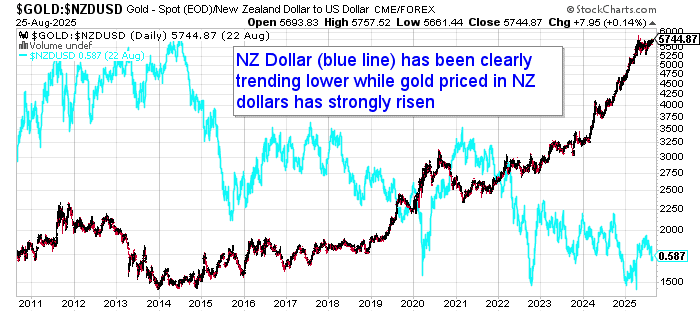
While the NZD has trended lower against the USD (blue line), gold priced in NZD has surged. This long-term divergence highlights how gold protects Kiwi purchasing power — especially during periods of currency weakness.
Central banks know this too — in recent years, central bank gold buying has increased at record pace, especially in nations looking to reduce reliance on the US dollar.
So if you’re wondering how to protect your purchasing power in the face of global monetary instability, gold and silver offer a proven answer. They’re not speculative bets — they’re monetary insurance.
Protect Your Wealth – Start with Real Money
If the NZ dollar weakens and the global financial system comes under stress, what will you have that holds its value?
Gold and silver have stood the test of time — and they’re still available to New Zealanders looking for security outside the banking system.
Some investors also prefer smaller, widely recognised bullion products that may be easier to trade during periods of financial disruption.
✔️ Learn how to buy, store, and protect your bullion
✔️ Understand the difference between paper and physical gold
✔️ Explore secure local and offshore storage options
Or if you’re ready now:
🔗 Browse Gold & Silver Bullion Available Today
Related reading: In a US Dollar Collapse Won’t The Rising NZ Dollar Cancel Out Any Gold/Silver Gains?
Stay Ahead of the Curve – Get Daily Gold & Silver Price Alerts
📈 Want to Track Gold & Silver Prices Daily — in NZ Dollars?
Join thousands of New Zealanders who receive our free Daily Price Alert — a quick, insightful update with the latest NZD gold and silver prices, plus key market insights.
Here’s what you’ll get:
✅ Live gold and silver prices in NZ dollars
✅ Market commentary tailored for Kiwi investors
✅ Occasional alerts when prices move significantly
✅ No spam – just smart, practical info to help you stay informed
📬 Sign up here — it’s free and takes 10 seconds:
🔗 Get Daily Price Alerts
Editors note: This post was originally posted 4 July 2014. Last updated 25 August 2025 with new chart and fully updated content.
FAQs
If the US dollar collapses, the NZ dollar may weaken — not strengthen — as global capital flees to perceived safe havens like gold or the USD itself.
Yes. Gold is priced globally and has historically risen in NZD terms during periods of local currency weakness or global financial stress.
Surprisingly, no. Many experts believe the US dollar, as the global reference currency, may be the last to fall — after peripheral currencies weaken.
If the US dollar collapsed, house prices would likely behave very differently depending on whether they were measured in nominal currency terms or real purchasing power. (Refer to housing to gold ratio).
In many historical currency crises, property prices rise sharply in local currency terms because the currency itself is losing value. However, that does not always mean homeowners become wealthier in real terms.
During severe monetary instability:
– Real estate may hold value better than cash
– Mortgage debt can become easier to repay in devalued currency
– Interest rates often rise sharply
– Property markets can become illiquid and difficult to finance
– Essential hard assets such as farmland may outperform residential housing
Gold and silver have historically been viewed differently because they are highly liquid, globally recognised, and do not depend on local banking systems or property markets.

Glenn's dedication to educating individuals on wealth protection through precious metals has helped over 2400 clients from New Zealand, Australia, USA and Europe to safeguard their financial futures. Passionate about financial independence and lifestyle freedom, Glenn’s mission is to empower others with the knowledge and tools to thrive in today’s volatile economic environment. When he's not advising on precious metals, Glenn enjoys spending time with his family and pursuing outdoor adventures.
Education: University of Auckland Bachelor of Science
Linkedin: https://www.linkedin.com/in/glenn-thomas-0984a4310/
- The Best Time to Buy Gold Is Before You Need It - May 14, 2026
- Silver Breaking Higher as Inflation Heats Up Again - May 13, 2026
- Does Gold Seasonality Affect the NZ Dollar Gold Price? - May 12, 2026

Pingback: Gold Prices | Gold Investing Guide Doug Casey: “America Has Ceased to Exist”
Pingback: Will “the Chinese” takeover NZ? - Gold Prices | Gold Investing Guide
Pingback: What Will Happen to You When the Dollar Collapses? - Gold Prices | Gold Investing Guide
Pingback: Questions From Readers: Precious Metals & Kiwisaver, BoomBust Cycle, Gold & Silver Exit Strategies - Gold Survival Guide
Pingback: In a US Dollar Collapse Won't The Rising NZ Dollar Cancel Out Any Gold/Silver Gains? - Gold Survival Guide
Pingback: USD Gold Up But NZD Gold Down - Gold Survival Guide
Pingback: Silver Plunges 8% Overnight But Still Up 5% on a Week Ago - Gold Survival Guide
Pingback: How Will the Global Monetary System Change Take Place? Will China Take over the Reserve Currency Role? - Gold Survival Guide
Pingback: Thoughts on the “Dollar MilkShake” Theory - Gold Survival Guide